It Was Bike Week. Where Were You?

As much as I crave brilliant, sharp chronology when it comes to posting things on this elegant, user-friendly venue (thank you, Posterous), I am now taking you back in time to before the New York International Auto Show (non-Depraved, see below) to a month they call March and a thing they call Bike Week in Daytona Beach. I knew I was poised for an interesting trip when on the flight down, I could actually see the contrail of the Space Shuttle Discovery just above and in front of the 737 I was riding in. The Discovery was returning to earth after its final mission (see photo), and I was overcome with nostalgia. Crikey, I can remember its maiden voyage. Has that much time really gone by? Wow. 

Discovery
Bon Voyage, Discovery

Meanwhile, down in Sin City Southeast (are there many ten-year-old- kids in Florida named Chad, by the way? Just asking), I managed to jump on six bikes in just a few days which I reviewed for various publications. I found them all to be pretty interesting machines, and an encouraging sign of the health of the motorcycle industry at least in terms of their determination to build desirable new products. One of these, the Ducati Diavel, I’ve already talked about in a post below. See? It’s down there. Scroll, man. Anyway, the other bikes I shall now recount briefly, and I hope if one spurs your interest you’ll research further and sample one yourownself to see if its a good fit.
Blackline_a
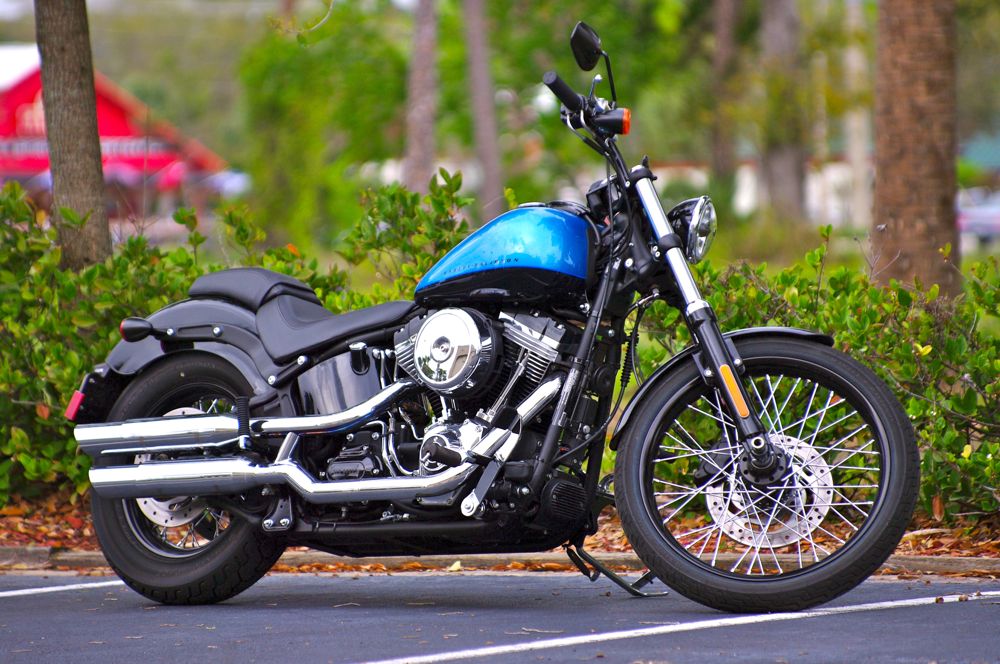
Harley-Davidson FXS Blackline 

Here’s the Motor Company’s latest Dark Custom, first revealed at a party at Don Hill’s in SoHo back in January. It was a wild night. I heard (as did the rest of the attendees) from a Harley engineer (on stage no less) that Harley-Davidson is no more. It’s Harley-F***ing Davidson, thank you very much, and don’t you forget it, Bitches. The crowd loved this rebellious attitude, which is what the whole Dark Custom thing is all about after all. But I wondered, what will we tell the children?

We’ll tell them the Blackline is a f***cking nice bike, and a genuine pleasure to root around on. The Twin Cam 96B engine is smooth, soulful and puts out real nice torque. The riding position is kicked out and chopperish, but it works just fine around town. Despite the rather brilliantly-executed minimalist retro styling there’s some very contemporary features, like an odometer window that has a menu that toggles via a handlebar switch and includes a tachometer reading and gear selection (among other things). The biggest techno-surprise turned out to be ABS brakes, which I didn’t realize the bike had until a tiny yellow self-test light winked out whenever I rolled off after first starting the bike. Subsequent braking shenanigans in a parking lot confirmed this diagnosis, and that’s a f***ing great feature for a Hog to have, Bitch. And, overall, the Blackline was a very satisfying bike, whether you’re into the Harley mystique or not. $15,499 gets you started.
Tiger
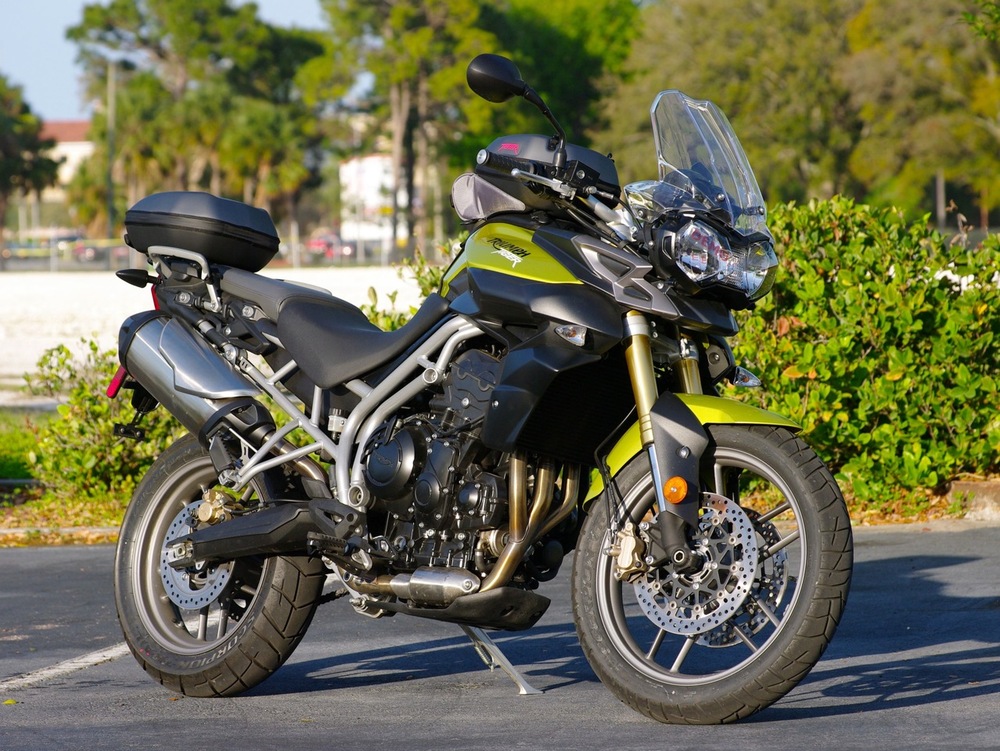
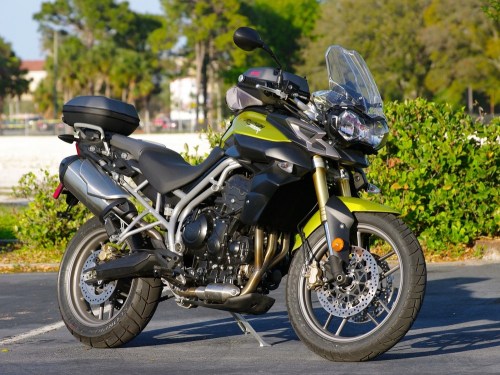
Triumph Tiger 800

From form with some function we go to function and then some, and a totally well-rounded mount that helps illustrate why dual-sports are so popular. This plucky Brit Adventure Bike has a sweet, smooth Inline Triple, tuned for great low-to-midrange grunt and great response. As is typical for the breed, an upright riding position and a broad, wide adjustable handlebar make the Tiger very flickable whether you’re on the trail or in traffic, and a real pleasure to spend many miles on. Surprisingly, the seat height is less lofty than most trailies which makes balancing the bike at stops much easier for those that are short of inseam. If you are more Lakerish, you can easily flip a bar under the seat and gain another inch or so of seat height for more leg room. A massive collection of accessories is available form Triumph, including really well-designed tank and tail trunks I sampled that are perfect for small items and have interiors that are very well-protected from the elements. And speaking of Mother Nature, I got nailed by a thunderstorm (imagine that: a thunderstorm in Florida) and I couldn’t have been on a more tractable mount in heavy rain. I’ve saved the best for last: I think this is one of of the smarter dual-sports out there, and the base price is $9,999. That a lot less than a lot of the competition, and to be honest as good as the class is overall a lot of the other guys don’t have it going on to near the extent as this kick-ass kitty. 
Vaquero
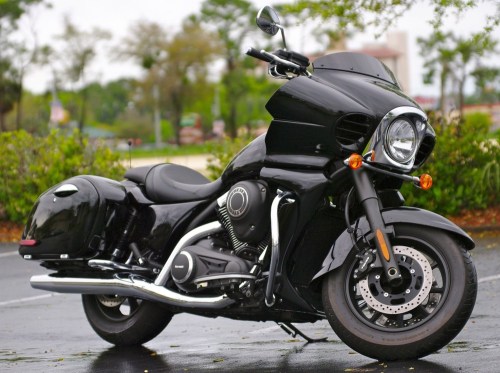
Kawasaki Vulcan Vaquero

From the city road, country road or whatever pit of goo the Tiger finds itself slogging through, we move to a big, bad bagger in the form of the Kawasaki Vulcan Vaquero. This is a heavy, yet graceful long-haul bike that is a true turn-key, get-outta-town mile muncher. A big, loping 1700cc V-twin is perfectly suited for all-day highway dispatching, and the standard cruise control and comfortable accommodations are likewise ideal for long days on the road. Excellent roll-on performance, very stable handling and solid brakes make the big rig dance reasonably well on tighter pavement, and air-assisted rear shocks can help adjust to the load of gray market iPads and pirate costumes you’ve stuffed in the attractive, roomy saddlebags. Great coverage from the fairing, terrific low-speed balance and even a potent sound system make the Vaquero one buen amigo, Bitches. Sorry. That Harley ‘tude pops up from time to time when there’s big-ass V-Twins involved. Plunk down $16,499 and you can motor off to distant horizons. 

Cbr250r
Honda CBR250R

Here’s a wee motorcycle at a wee price, that is such an obscene bargain for those that appreciate things like corner speed and fuel economy that you want to buy his and her models and surprise the Significant Other. This smallest CBR is powered by a modest 249.4cc Single, but it’s counterbalanced and surprisingly smooth. It’s no V-max, but the engine moves the 357-lb. bike along just fine and the 6-speed tranny has perfect ratios to maximize acceleration. The riding position is sporty but still fairly upright for in-town comfort, but this bike is the most fun on tight, curvaceous pavement where the great balance and light weight can shine (and the fact that you don’t have a MotoGP bike motor between your legs isn’t as important). The styling, fit and finish of this bike says anything but entry-level, and you can even get ABS which is a brilliant option considering newbie riders may be in the saddle in large numbers. The thing is, though, this little CBR is not a bike you’re going to outgrow; indeed it would make a great track bike as well as a very frugal commuter. Pricing starts at $3,999.
Stryker

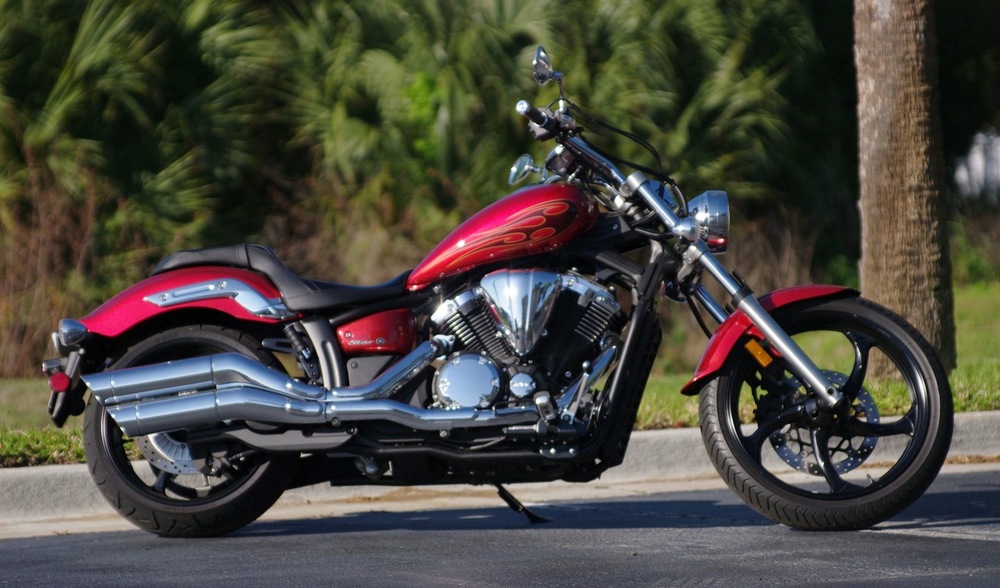
Star Stryker

Our final Daytona Bike Week machine comes from Yamaha’s Star division, and more than any other bike here got attention everywhere it went thanks to its aggressive, ultra-custom styling. This is a show bike you can ride, and one surprise was the 1304cc 60-degree V-twin that was fine at speed but seem a bit weak at low RPMs which is unusual for this kind of mill. But the kicked-out front end does a decent job in the twisty stuff despite the lazy steering geometry, and while it’s easy to drag your heels in tight turns overall handling is fine for a long, low cruiser. Cool touches abound, such as a downright Gothic instrument cluster that has cool trip computer you toggle with a button on the right handlebar and the overall fit and finish is superb. This is certainly aimed more at looks than outright performance, but it is perfectly acceptable for scooting around town and definitely starts conversations. MSRPs start at $10,990. 
The New York International Auto Show is Not Depraved

The title of Hunter Thompson’s groundbreaking magazine piece that launched his career as the father of gonzo journalism was, if memory serves, “The Kentucky Derby is Decadent and Depraved.” Now, I’m not implying that the New York International Auto Show is in any way, shape or form like the violent, puke-filled orgy of weird that was, and I hear still is, the Derby. In my experience New York’s annual Metal Mashup doesn’t even rate on the same scale in the D &D department, and is arguably a more benevolent gathering (and almost completely free of galloping horses and gambling. I think. I have never expected every last nook and cranny, though).

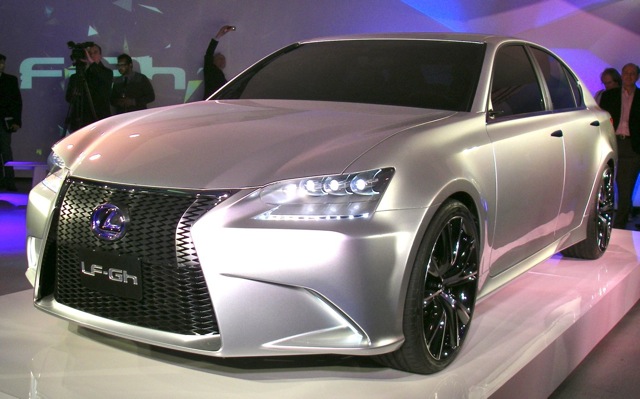
But this soiree is an eye-opening experience especially if you don’t live the dynamic auto journalist/trade associate lifestyle where events like this are all part of a typical week on the job (and you therefore become desensitized). I’m my entire staff and am usually booked here at my undisclosed location driving new cars, riding new motorcycles and testing all kinds of gear, and as a result I don’t make it to many industry functions purely due to logistics. When I can get away, though, it’s a vast, fascinating experience that really drives home what a world unto itself the automotive sphere is. And while I rarely wade into the sea of suits that runs these corporate giants, there is one affair that I always try to make fit into the schedule. The New York International Auto Show media days (there are two, and I typically manage one of them) beckons me into Gotham’s massive Javits Center, and at this famous venue the OEMs really go all-out to drum up some excitement over their latest offerings. A lot of dealer folks are usually present at the media previews too, so some of the stagecraft is clearly aimed at them as well. And man, it can be a heavy-duty theatrical production when a company (literally) rolls a new vehicle out on the public stage. This year certainly had its share of fanfare, including the launch of a new Lexus concept vehicle that was conducted off-site the night before, complete with an art gallery full of trendy New Yorkers and appetizers prepared by an Iron Chef. Neat stuff all around, and the car is not only fetchingly exotic but a hybrid to boot.

Back at the event proper on the first press day, Hyundai’s more conventional launch had fuel consumption frugality as its main theme, and taunted their considerable supply of models that get 40 MPG or better on the highway. VW also talked of miserly appetites especially with their clean diesels, and Chevy is very proud of the mileage numbers with their all-new 2013 Malibus. These things won’t go on sale for well over a year (about two, actually), but here they were nonetheless. On the other hand, a car that for ages was vaporware is now at dealers, and Chevy Volts were well-represented in the massive GM wing of the show, which I thought was a positive statement. It was clear that easing the pain at the pump was on the front burner of their latest offerings, and I’ll be testing one of their innovative new hybrids in a few weeks. While it’s a bit too early to tell, they may just have delivered a car that’s very close to what they’ve been promising for over two years. We’ll see.

Then there was Jeep and Chrysler. Weird, man. The flagship Jeep presentation involved first a Wrangler Unlimited Sahara, which is so much larger than the original Jeep that first appeared 70 years ago that it begs the question if anybody in the design department understands why the original article was so useful. This was followed by their belle of the ball: the new Grand Cherokee SRT-8 with something like 465 horsepower in its 6.4-liter HEMI V8 and great performance numbers at the track. This is just what the public wants, what with $4 a gallon gas, right? Of course. Clearly it’s aimed at the wealthy, luxury SUV set, but will these types wander over from Range Rover, Mercedes, BMW and Lexus in sufficient numbers to help the ailing company?

Likewise, the ’12 Chrysler 300 SRT-8 with another 6.4-liter V8 was a star on their stage, and looked great. But is this where they need to be to get their groove on? They only have one shot, according to the Eminem tune they are using as their new theme. This latest permutation of the company is hooked up with Fiat, and they do have Fiat 500s arriving in showrooms that are fuel-stingy and cute as a button, but I don’t think this car will be viewed as a triumph for Detroit if it does well. Another odd thing: with both Jeep and Chrysler, the focus was squarely on American Heritage and the pride that will bring Detroit back from the ashes. Yet both presenters, starting with Jeep’s Mike Manley, President and CEO of Jeep Brand, and later Olivier Francois, President and CEO of Chrysler Brand and Lead Executive for Marketing, had accents that sounded like they woke up a long way from Michigan.

Now, I have nothing against either the heritage of these gentlemen nor their countries of origin; in fact I embrace these things. But I found it odd with all the “America’s back” and “Jeep is an American Icon” stuff to hear such distant voices, as Mr. Francois hails from France and Mr. Manley is from England. Don’t get me wrong, here, but given the thematic context created by the divisions I was expecting Jeep to have a former army veteran from Iowa at the helm, and Chrysler to be run by a 3rd-generation grassroots assembly line worker who climbed up the corporate ladder. Their voices just didn’t fit the narrative, you know? Probably just me.

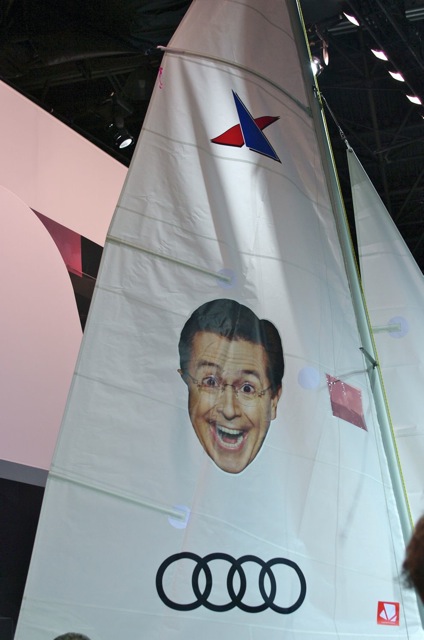
Something else that seemed an odd fit initially, but turned out to be pretty hilarious, was Audi’s “special celebrity guest” at their press conference. We knew it would be somebody currently quite popular, and I really didn’t have a clue as to who would be a good fit for the company. As it turned out, it was Stephen Colbert and Audi is sponsoring his sailboat in the Charleston-Bermuda race, where he will of course serve as Morale Officer. “If you’re going to win a race, you want to be in an Audi,” Colbert explained to the crowd of surprised journalists. “I tried bolting a mast and sail to my S5 Cabriolet and took her for spin on the harbor, and the results were . . . moist! So I decided if I couldn’t sail an Audi, I would ask them to sponsor my boat.”

Colbert was in character and in fine form. Audi of America President Johan de Nysschen presented him with a gift composed of traditional lifesavers assembled together to form the Audi ring logo, and I have to give props to the prop department for a job well done.

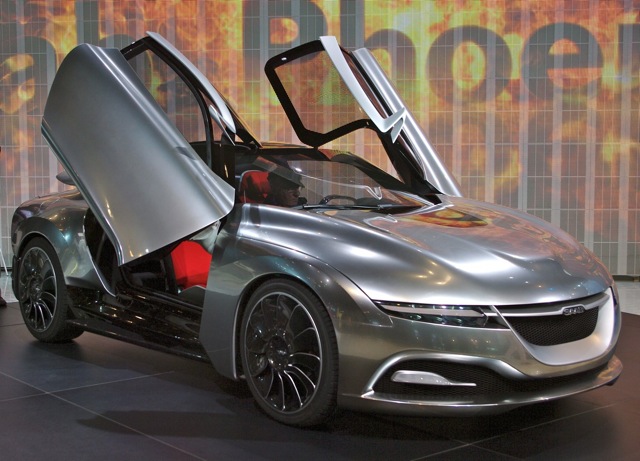
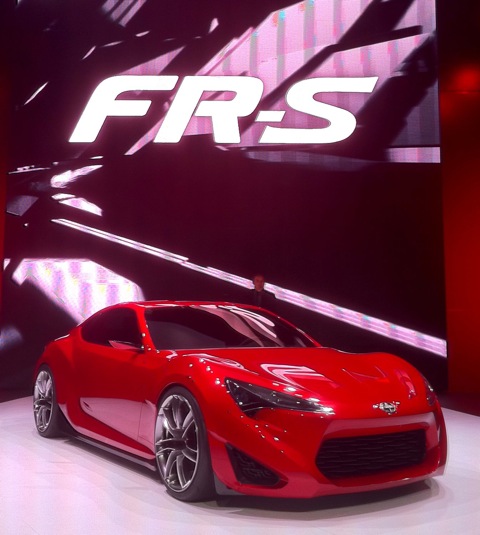
Scion had what I thought was the most interesting concept car of the show (although the Saab Phoenix is quite striking), because it looks like it’s almost ready for production and reminds me of the glorious days where a certain minimalist engineering discipline spawned the likes of the Datsun 240Z and Toyota 2000GT decades ago (only updated for the 21st Century). In his introduction of the car, Scion Vice-President Jack Hollis mentioned this is truly an enthusiasts car; a race-on-Sunday, drive-on-Monday kind of hoop that was really inspired by the AE86 Corolla (known by hard-core autocross-types as the “hachi-roku”). Hollis explained: “The AE86 didn’t rely on brute horsepower, but instead a remarkable combination of a lightweight design, manageable power and great balance. It made its way into almost every genre of racing from grip to drift-and from the circuit to mountain roads.”

So a quarter-century later Toyota has embraced the gung-ho (on a budget) fun of that Road Warrior Corolla and presented the FR-S concept. Many times they don’t tell us much about what’s under the hood of concept cars; indeed at the Lexus soiree the beautiful LF-Gh concept’s engine was described just as Lexus Hybrid Drive. With the FR-S, they eagerly announced it’s powered by a Flat Four Boxer engine (remember, Toyota owes a chunk of Subaru which has boxes and boxes of Boxers) and rear wheel drive, as well as a bitchin’ hot body, man. Light weight allows for a smaller engine (and the flat architecture allows for optimum placement and mass centralization), and ultimately better handling and braking. It’s a concept, but like I said I think this coupe may show up very soon as a near-as-dammit production model. Scion’s launch was done with full-on show fanfare, too, in the ballroom away from the regular show floor. It really was, for me at least, the most interesting and unexpected machine at the show because I think this will not only be built, but be very successful and focus performance, affordability and economy in a way that hasn’t been done in ages. Who knows? So much depends on Japan’s ability to rebuild after a disaster of epic proportions, which really became a sobering undercurrent to much of the show for me.

The scope of what has happened in Japan, unlike the gentle waves that reached the western US quickly after the Japanese tsunami, is taking its own sweet time getting here. Toyota’s North American division did a fine job of bringing up what living hell has descended upon our Japanese brothers and sisters, and the courage they are showing under unbelievable hardship and destruction. They have soldiered on, as have the other Japanese auto companies but you could sense the pain underneath, and the grim reality under all the corporate speak of what’s really important under all the pomp and circumstances. Cars are just brilliant mechanical expressions of art, science and engineering, yet are ultimately created by living, breathing human beings that are oh so fragile.

To finish my trip on the lighter side (and far away from the show floor and the Javit’s Center itself), my last stop before rocketing home was at Kia’s cocktail party, which is always interesting and typically very visual as it’s almost always held in an art studio. This year the Soul-themed (in an automotive sense) gathering included Microsoft Kinect games for guests to enjoy and a brace of DJs called AndrewAndrew that have a twin persona that has made them quite famous. They navigated through the crowd, schmoozing and mixing their music with requests from the punters through the miracle of iPad wireless technology. I’ve said it before and I say it again: Witchcraft! It’s everywhere. Thank God I bothered with those Extended Education courses at Hogwarts. Below, there are some pics to click through from this year’s NYIAS experience.

MoriLf-ghTransformJeepPhoenixFr-sStephenKiaAndrewandrew

Little Big Van

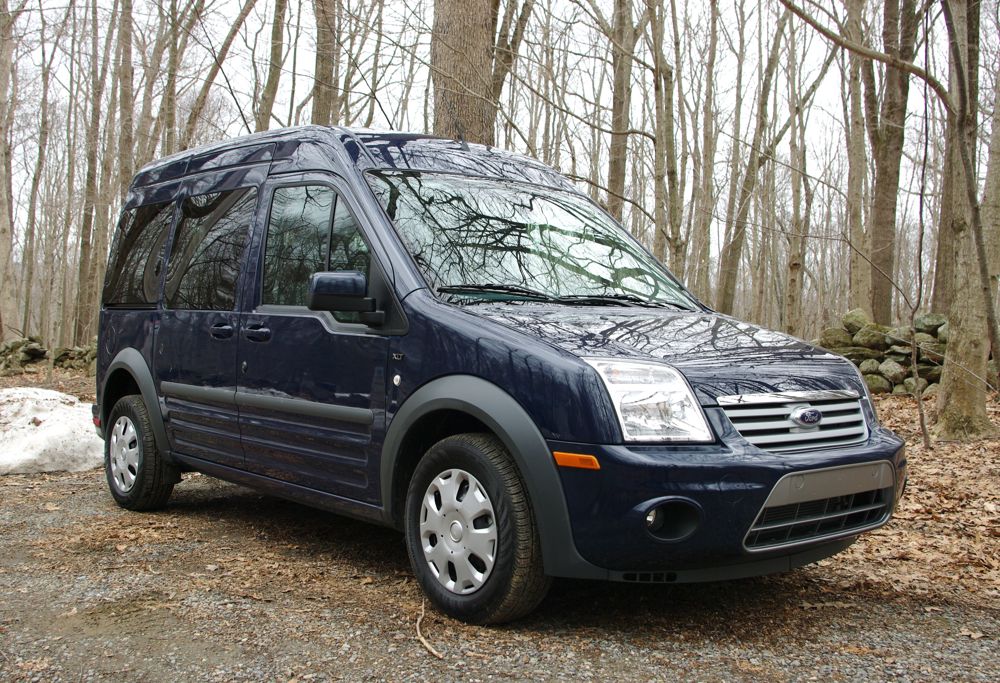
In keeping with the topic of space utilization touched on by the previous smart passion cabriolet discussion (see previous post, complete with Red Green Appreciation photo), we have a vehicle that, while certainly not huge on the outside, could almost haul said weenie little smart car around in its cargo area. This Master of Space doesn’t refer to itself in the lower case like the smart does, either, and proudly calls itself the Ford Transit Connect. This is a very European take on the van/minivan genre that is not only quite brilliant, but a great fit for a lot of folks in these United States. The basic chassis foundation is the same starting point as found on the Ford Focus, although it’s really a very different beast. What we ultimately have here in the T-Connect is a front-drive minivan with a very tall roof, great mileage and a really impressive amount of room. The version I tested had a rear seat (but no third row although there’s certainly room for one), and a decent number of creature comforts for about $25K. With the rear seat in operation you have 78 cubic feet of load space, and with that seat folded you have 118 cubic feet of cargo-gobblin’ goodness. This is a lot of room by itself, but when you see how small the vehicle’s footprint is it’s very smart packaging indeed.

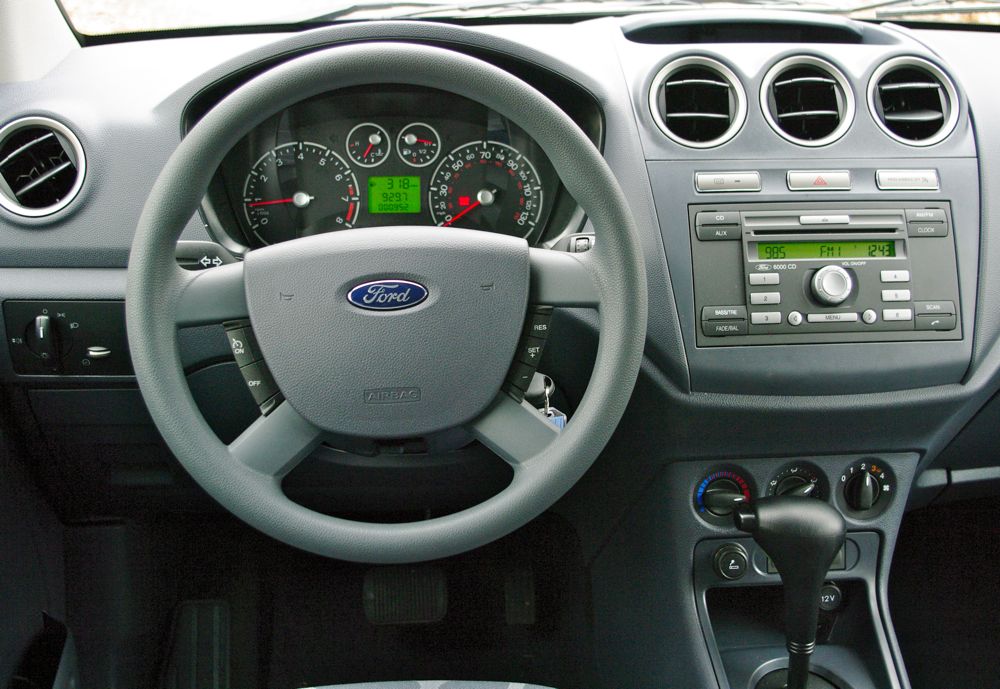
The lone powertrain is a 2-liter Duratec Inline Four with 136 horsepower, with is mated to a 4-speed Automatic transmission. Basic stuff, and certainly no dragster (0-60 in about 11.4 seconds), but it gets the job done around town just fine and delivered 24.7 MPG in mixed driving. I loved this thing. The moment you sit in it you see a Spartan yet nicely done Mobile Rolling Box Environment (MRBE), and I immediately looked around and started thinking about how a contractor could totally have their way with this vehicle and configure it to be the ultimate, fuel-efficient working companion. While you can’t quite stand up in the back of it, it does load an unload easily (two conventional doors in back, and a sliding door on both sides). Provided reliability is decent, I could see very low operating costs and considering it gets 10 MPG (or more) better mileage than most full-size pickups and has a lot of locking storage capability (even the hood opens only with a key-great for urban street parking security), it could be a very smart choice for many independent working folks. The question is, why did it take until 2011 for such an obviously useful vehicle so show up here?

Transit_connect_aTransit_connect_bImgp2818

The Golf Cart Writ Large, Or Did Red Green Motorize a Swing Set?

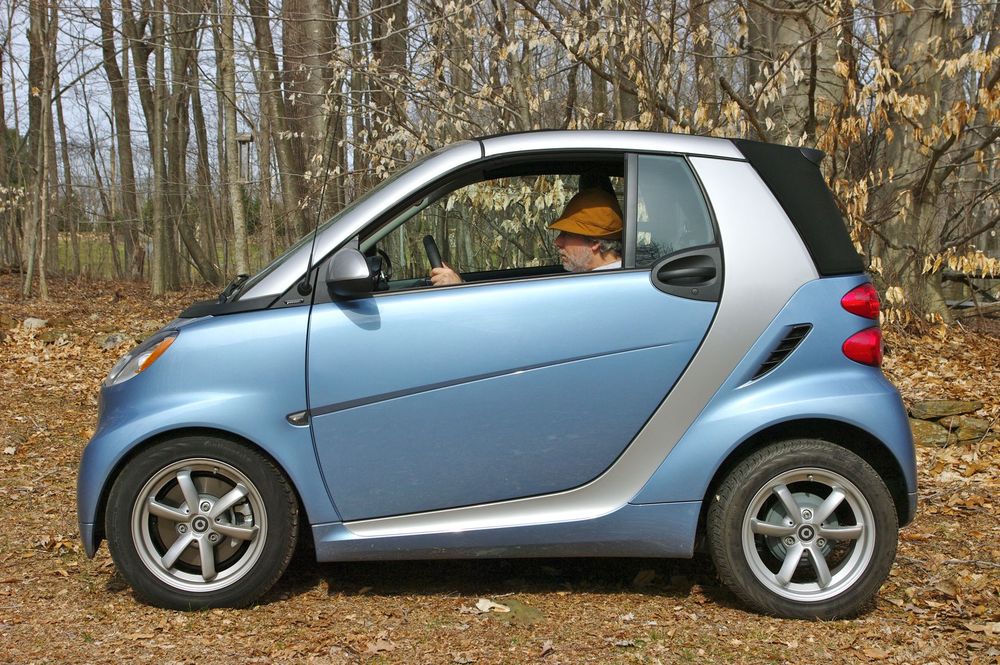
There’s nothing quite like diversity, eh? It does tend to sweeten the pot, and make a potentially mundane field of daisies (like economy cars) much more interesting. I like outside of the box thinking, even when it goes across the street, into the neighbors shed and into that box of old golf magazines that’s been there of decades. I think that’s what the makers of smart cars (yes, they deliberately keep themselves lower case) have done, because when I first fired up a passion cabriolet and headed out into the world of larger cars, I was reminded of an ancient Harley-Davidson golf cart I once guided around a golf course in Plano, Texas, many, many years ago. It was the sound of the engine and the similar size of the two vehicles I think that took me down memory lane, although the golf cart had more cargo room (but it was always exposed, unlike the smart).

Once you get used to the fact that this car is so small, though, you get used to driving it like a regular compact and most of the golf cart comparisons disappear. Not all of them, though. They are both rear wheel drive, which is kinda cool, and both have wickedly tight turning radii, which is likewise desirable. I have no idea what kind of engine the Harley cart had, and to be honest it was the first and last golf cart I ever used that wasn’t electric. But I do know what propels the smart, as it was a couple of feet behind me below the cargo floor. Open an access hatch and you’ll find a modest little wheezer of a mill, a 999cc Inline Triple with a whopping (claimed) 70 horsepower. Oh, lest you think we’re talking a gas-powered sewing machine here, there is 68 lb-ft. of lovely torque, which unlike the horsepower figure is better than the claimed output of my Triumph 675 Street Triple (107 horsepower, 51 lb-ft. of torque). Makes you think, though. Either this 1,800 lb. car is a tad on the weak side, or my Triumph is all-powerful. You decide.

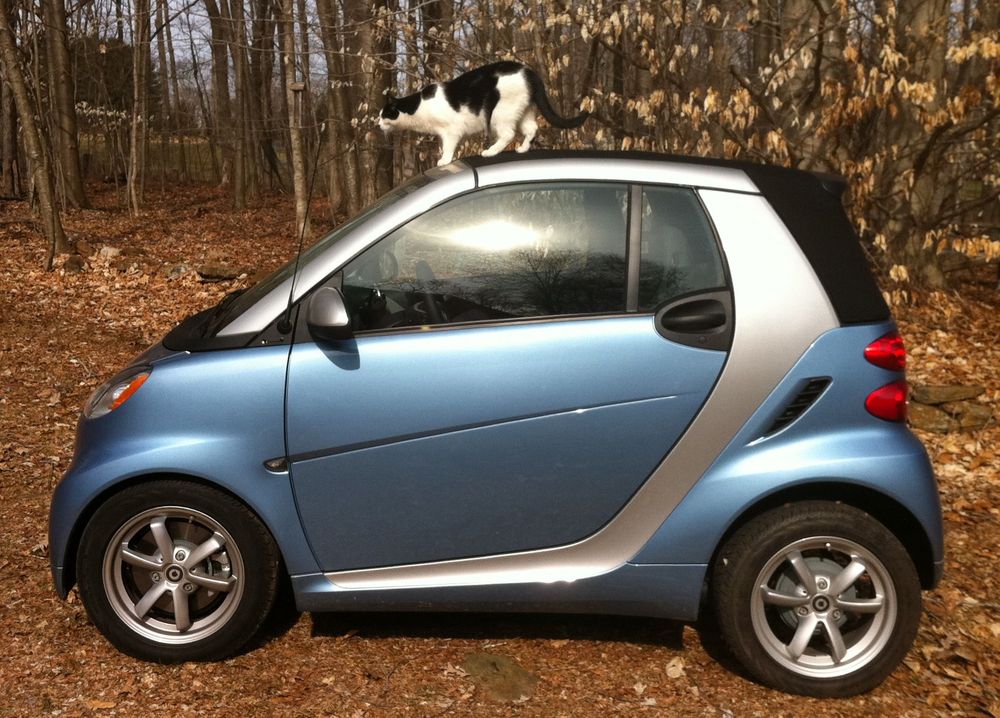
But wait: in order to make a sound judgement you must drive the smart, and while it’s almost small enough to email it to you, I can’t, so you’ll just have to trust on my impressions. 0-60 arrives in a leisurely 12 to 13 seconds, and (amazingly) the real reason this vehicle falls far short of achieving escape velocity is not the bitsy box of pistons out back but the transmission. Smart (sorry, smart) calls this gearbox a smartshift Transmission, and it’s basically a 5-speed automatic with a difference. The difference is, there’s huge gaps between shifts that makes you think a rather foul, decrepit house elf (think Kreacher, from the House of Black) is doing the shifting and his wee legs have trouble reaching the clutch pedal. It’s really rather bizarre, and a major flaw in what otherwise would be an acceptable (albeit underpowered) drive train. A surprisingly thing is this little egg can whiz down the road (dare I say it?) rather smartly at 70 MPH, and seems stable enough unless it gets really windy. It’s a ball to throw around on a tight road, the suspension soaks up bumps surprisingly well and its tridion safety cage should keep you as safe as is possible in a crash. It would probably bounce off of anything that it hit like a beach ball, and has very high crash safety ratings. The cabriolet’s convertible top works well, and can be deployed and retracted on the move. Oh, and you can park this thing pretty much anywhere, as it really doesn’t have a footprint much larger than a lawn tractor.

But, it must be said it doesn’t have the chops in the fuel efficiency department, which is very surprising as you would think that’s what it’s for after all. I only got about 35 MPG, which means a Prius not only destroys it at the drag strip but the fuel pump as well. This might be OK if you could by a brace of smarts for the price of a lone Prius, but our tester (nicely equipped, but no cruise control, spare tire or tilt wheel) was stickered out at $21,590. That’s a lot of tee times, chum. But, in this rather wild little two-door’s defense I will say in over a decade of driving Other People’s Cars nothing, even some pretty exotic stuff, has ever landed the kind of attention this funky little buglet does. Some laugh at it, some laugh with it, but it brings a smile to the masses like few things I’ve ever negotiated through a crowded Sear parking lot. They may not make it worth the asking price, but it does say something about being different. Now, if they’d only sell an electric version with decent range. . .

RedLittlesmart