
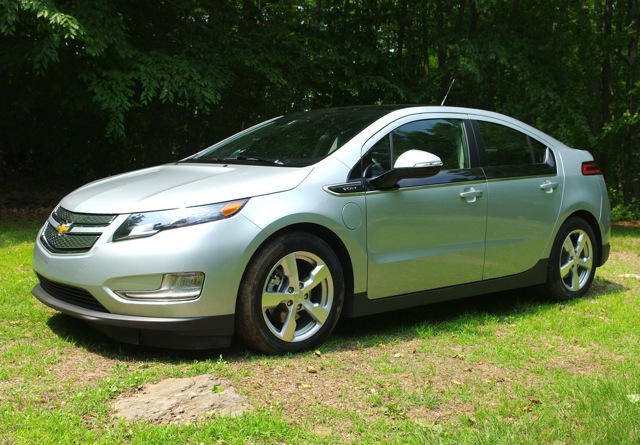
Oh sure, I was a big-time naysayer. The Chevy Volt was vaporware for quite awhile, and yet, ironically, was being rushed to market with blinding speed. This is quite a juggling act, if you ponder it for a second. When you also consider that Toyota and Honda had hybrids on the road nearly a decade before GM even started to adopt the technology (and Ford was also part of the party with the Escape Hybrid), then the Chevrolet Division’s decision to just leapfrog everybody with a futuristic plug-in was certainly grounds for skepticism. To top it off, I quickly grew tired of all the company-generated hype including social network campaigns and some truly tedious “Town Hall” meetings at auto shows.
But danged if the General didn’t focus like a laser and develop some serious engineering solutions. Danged if they didn’t manage to build some prototypes that evolved into production models, and double danged if I didn’t just spend a rather entertaining week with this all-new extended-range electric vehicle. To recap what the Volt is, it’s a true electric vehicle that you plug in to fully charge (about 10 hours at 110V; roughly half that at 220V), with a huge lithium ion battery pack that powers the electric drive unit that turns the front wheels. Once this battery is depleted, you don’t have to go commando with an extension cord and steal juice from some unsuspecting residence or convenience store. Under the hood where you usually find an engine there is in fact . . . an engine; in this case a 1.4-liter Inline Four that functions as a generator. This is the “extended-range” part, and with a 9.8-gallon fuel tank you can keep right on going for an overall range of well over 350 miles.
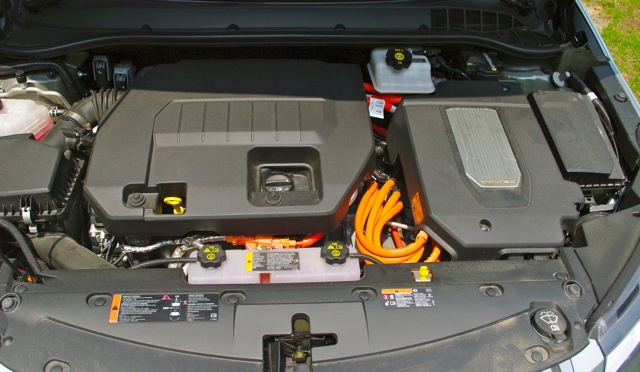
I tested a Prius Plug-In hybrid a few months ago (see the post located somewhere in this thrilling collection of prose), and while this is the closest soon-to-be competitor to the Volt they are still very different beasts. The Prius is a plug-in evolution of the science of Priusology, where the already excellent hybrid engineering gets a new twist with lithium-ion batteries instead of the tried-and-true nickel-metal-hydrides. Armed with these more-powerful laptop renegades, you can plug-in the car for about three hours (at 110V) and get 18 or so miles of pure EV range. After that, this SuperPrius becomes Clark Kent once again and operates much like all the other (over a million or so) Prii around the globe. This means it runs on the engine, the electric motor or both until you plug it back in and start over. It’s a plug-in take on an already proven platform, so one big quality in its favor is literally over a decade and millions of miles of real-world durability.
The Volt is a whole different kettle of tech, and a boatload of brand-new engineering from stem to stern. It’s an electric vehicle all the time, for the engine is really just there to charge the batteries when they become depleted so you can keep on rollin’. Another difference is you can taxi your backside down to a Chevy dealer and buy one, for even if you might have to wait a bit they are available right now. It will be spring 2012 for the plug-in Prius is at dealers, so GM actually beat Toyota the market this time.
So now we have a couple of different approaches to cars that, even though there are internal combustion bits under their respective hoods, require you to plug them in like giant vegetable steamers to achieve full low-emission, high-mileage greatness. This seems odd at first, but in the case of the Volt I got into a routine where it was really not a big deal. The thing is, you need a full ten hour nap at a normal 110V outlet to top off an exhausted battery array which might be an issue for some people. But for most drivers, especially those with a round-trip commute of 40 miles or less, this might work out just fine as charging times would be a bit less because the battery may have some charge left when you plug it in. What you get in return is about $2 added to your electric bill per full charge (that’s here in CT. Your e-bill will likely be less), and more importantly a car that cruises along quite nicely on all-electric power while making little noise and soiling the air with no real emissions to speak of. Repeated 0-60 MPH runs came in at just under 9 seconds, so the Volt moves out just fine without gas engine assistance. It’s also fun to drive with sound handling, excellent brakes and comfortable seating for four because a tunnel filled with batteries relegates the seating to 2+2 status, but there’s decent room at all four perches (a car like this makes me want to call them “seating stations” instead, though). This is basically a Chevy Cruze chassis, but for some reason I liked it a lot more in the Volt application that the plain ol’ Cruze version.
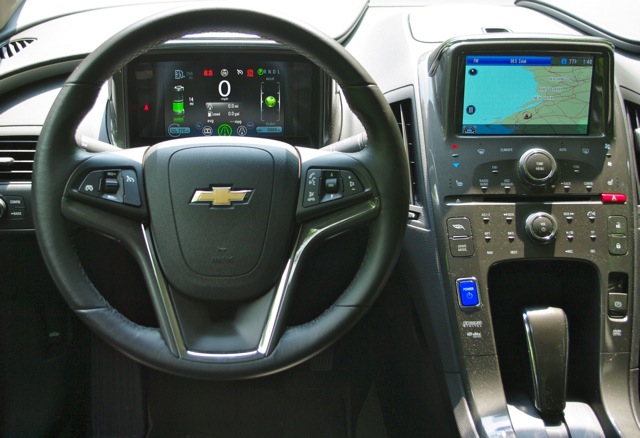
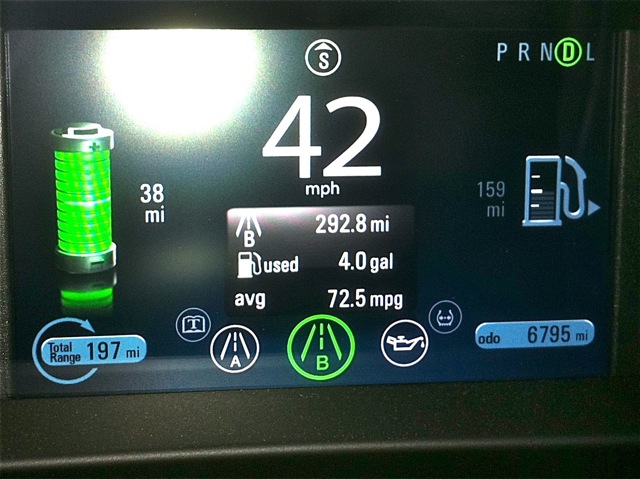
One of the more gutsy (and completely appropriate, in my view) design choices with the Volt involves the driver and control interfaces, for they decided to celebrate the fact that this is a very different kind of car rather than disguise it. I think this is bold because the Chevy brand has always been associated with more conventional U.S. car styling values, and has therefore been tad on the bland side in order to appeal to a huge swath of mainstream America. The Volt gets all touchy-screeney (with touch even on surfaces that aren’t actually screens) to handle all the conventional car operations, and you’ll either love it or think it’s over the top. The driver’s display consists of a 7” LCD screen that gives you an excellent snapshot of the state of your electric and gas-powered devices. It also adapts itself depending on what is happening, such as when you make the transition from full battery electric to engine-generated electricity. Even though the heavy work is going on under the hood, magical things happen right before your eyes. The fuel gauge which is grayed out lights up and becomes a prominent part of the display when you switch over to generator juice, and keeps you apprised on your range. Incidentally, when the engine kicks on it’s fortunately not a wheezy, loud generator like you may be familiar with in the industrial world (with the exception of the big 700kW gennies on the back of the tractors used in the film business-those things are amazingly quiet). This is a contemporary, reasonably-refined mill that seems quite normal and familiar, with one notable (and strangely interesting) RPM characteristic: the engine sometimes revs to increase generator output when you’re not accelerating. This creates a weird auditory/tactile incongruity compared with conventional automobiles, but you soon get accustomed to it. Overall the GM engineers have done an excellent job of keeping the generator’s presence as unobtrusive as possible.
Ah yes, back to the display/control interface experience. There is a touch screen in the center stack of course thus giving us two LCD screens, but in addition to this there’s touch stuff in the stack itself that deal with Audio, HVAC, etc. I had some trouble with this in that I really had to take my eyes off of everything else to find the switch in question, and found it too easy to engage the wrong touch interface by mistake. Not a huge deal, but something I hope they’ll tweak a bit down the road.
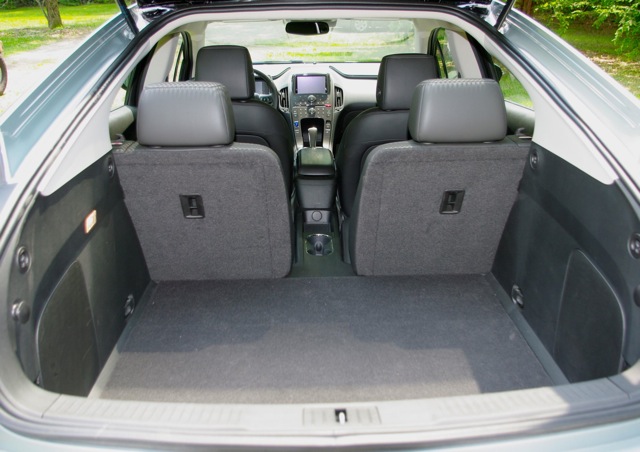
Finally, one of may favorite surprises with the Volt was usable space in terms of cargo. The charging unit and its associated cord are stored in a nice bin under the floor, and there was no spare tire on our unit but instead some flat fixing goo and a small air compressor. With the seats occupied you have 10 cubic feet of cargo space under the hatch; fold down the seatbacks and that swells to. . . something larger. I can’t find the spec, but it’s pretty dang roomy. All in all space utilization is quite good, making this car satisfyingly versatile even though the battery tunnel means you have two buckets in the back seat.
Now we come to the Big Question: is the Volt a good fit you the likes of you? This really does depend more on your driving habits and where you live. I’m not sure how the Volt would do in the dead of winter when you really need a lot of heat in the cabin, for without the engine generating heat all the time like with a conventional car it would become a battery-stressing business to keep you toasty. On one cool morning the front seat heaters actually came on by themselves to try and warm things up (this is tweakable in the climate settings) which for some reason didn’t really work for me. I also don’t know what really cold temperatures might do to charging and battery life, either. Another concern is charging in a big city situations, such as when you have to leave the car on the street with the complications that running the power cord between the garbage cans and over the sidewalk would entail.
But none of this really detracts from how well the Volt does its thing of delivering low fuel consumption and low emissions, and how good the overall package really is. During a week of driving about 50 miles a day and charging the car fully overnight, I got about 72 MPG. I’ve been skeptical of using lithium ion batteries in cars as opposed to the nickel-metal hydrides (which have proved to be near bulletproof) that have been the staple of hybrids until now. Maybe my prejudice revolves around early experiences with laptop batteries losing their juice after a year or so, but shoot, the MacBook Pro I’m writing this on is a year and a half old and still gives me about 5 hours every night so obviously there has been considerable improvement. The Volt has an 8 year, 100,000 mile warranty on the hybrid battery and who knows? It might prove bulletproof as well. If the hard parts on this car live up to the overall build quality on the one I tested, Chevy has a real special car for sale. The (very well equipped) $43K asking price is made more palatable by a $7,500 tax credit, so it’s not exactly excessively priced either. We’ll see how Toyota ultimately prices the plug-in Prius next year, and the Hybrid Cord Wars will truly be On. Oh, and Chevy, please put a wiper on the rear hatch window. I really missed having one in the rain.
 RollingProse