
“Toucha-toucha-toucha Touch me, I want to be dirty.”
Ah yes, the immortal words of Janet, who, like her fiancee Brad Majors, was a young, ordinary, healthy kid. And it’s a sad day indeed when a bit of healthy touching is frowned upon, but as I do enjoy playing the role of Old Coot (even though I like to think of myself as a middle-aged Coot) I must criticize a bit of touching going on out there, in some of our latest automobiles no less. As we all know, there’s a horse race taking place in what is euphemistically called the “tech” industry (but is actually just the personal computer industry, which now includes mobile phones) to see who can get the most touch-screen interface products on the market the quickest. This exploded with the arrival of Apple’s first iPhone, which for the first time utilized touch in a way that worked better and more logically than ever before. This was the first true mass-market application of a nearly buttonless and switchless operating system for mobile devices, and it spread like a Texas wildfire.
Quicker than you can say “Sync my ride,” the touch screen was off and running in other areas. On the automotive front the limited use of the touchy-feely way of changing audio and HVAC settings was quickly launched, especially with navigation systems (as there was already a screen ready, nay, aching, to be touched). But Ford has really gone after the technology aggressively in an increasingly inclusive arc, with mixed results in my view. But rather that give you a blow-by-blow account of what I like and don’t like about Ford’s new MyFordTouch interface, I’d rather focus on the big conceptual picture instead as I think it’s more important at this stage of the game. With all the new ways we have to operate electronic devices, and by extension, the devices these devices operate, what are our objectives exactly?
Here’s the thing: what goes on in the tech field regarding things like desktop and laptop computers, tablets and even our phones is pretty amazing, and change is accelerating at a staggering pace. This technology is having an effect on everything around us, and when it comes to automobiles the introduction of the latest in e-interfaces is being introduced in a slightly more incremental fashion, true, but nevertheless it’s happening quickly compared to the way things have typically been done in the past. But the important question is, is this inclusion of this revolutionary way of operating things going to make our cars work better and more intuitively, or just insure that touch expands into (and permeates) every last corner of our lives? Is the way we control our phones, pads, desktops, laptops, etc. really the way to go when it comes to the cockpits of our cars (which are, after all, the ultimate mobile devices)? True, one of the reasons the iPad is such a smash success is its simplicity in terms of user interface. But is what works for a tablet PC the best form factor for automotive operation?
Here’s another way of looking at this situation that I find equally perplexing, and even troubling (I’ll call it trouplexing). Right now, PBS is running a Ken Burn’s documentary on Prohibition, and while I haven’t seen any of this program (although I’m sure it’s probably very interesting), taking this history as precedent are we seeing a new type of struggle to regulate something very powerful in the form of bringing the tech communication world into our cars? Here in CT it’s been against the law to use your mobile phone in your car without a hands free device for years, yet just from my own observations it looks like more drivers have their phones planted on the side of their heads than ever before. Much like the masses insisted on drinking alcohol in the USA which killed Prohibition; banning cell phone use in cars w/o the prescribed headsets apparently isn’t going to work, either. So, arguably, there is a certain logic in saying, look, people are going to use their phones, text, use navigation systems, stream from their portable devices, etc. from now on and there’s nothing you can do to stop them. Therefore, we need to use technology to allow drivers to use their technology safely. Right?
Of course. Such is today’s conventional wisdom.
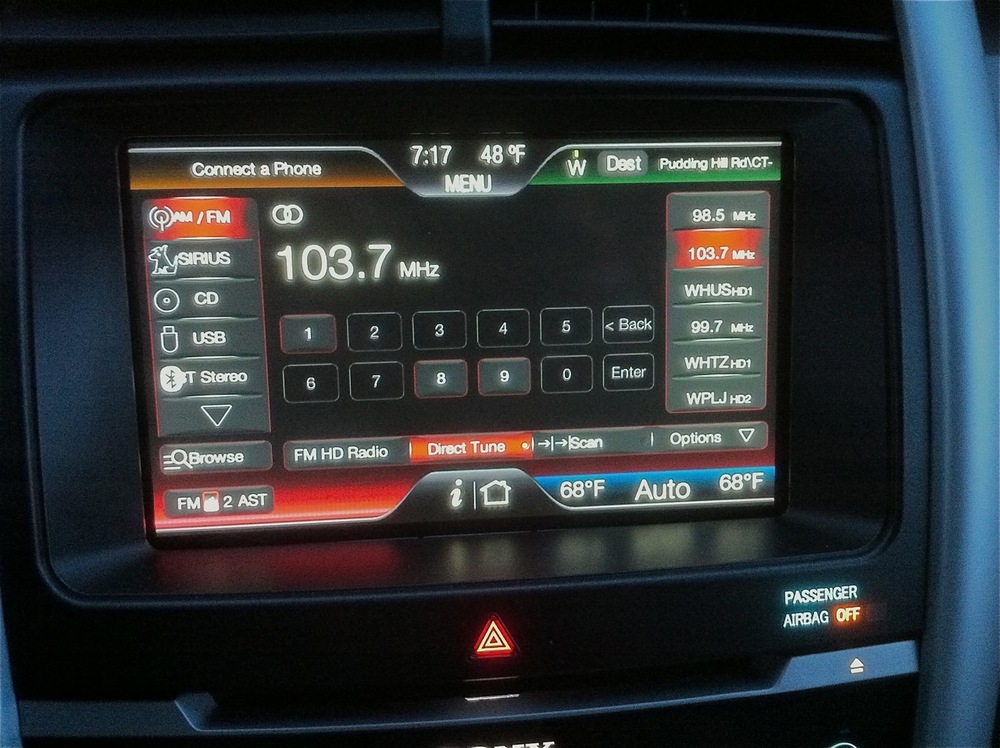
To address this, we now have technology like Ford’s Sync, MyFordTouch, and all the other competing (primarily bluetooth/voice recognition) systems out there that aim to keep your hands on the wheel while you dictate everything, therefore keeping you focused on the road. It makes sense in theory, but then there’s the dark side that I observe especially when I’m riding a motorcycle in the same environment as people driving their highly teched-out cars. In a way, I see all these miraculous developments as enablers of distraction and see people doing stupid things on a daily basis. Hey, their Ride may be Synced, but their attention is still elsewhere and driving in a safe, responsible manner on the public roadways is suffering for it.
Here’s an intrigue: remember the extraordinary brouhaha over Toyotas suddenly accelerating by themselves? I smelled a rat from the get-go, especially since the reporting on the alleged phenomena was incredibly one-sided. As we now know, with the exception of floor mats becoming lodged under accelerator pedals (because said mats weren’t properly installed, BTW), there was nothing seriously wrong with the cars at all. So why was it happening? Funny thing: the time frame information that traced the increasing number of these “unintended acceleration” cases fit nicely on a graph of increasing popularity of cell phones, yet I never saw anybody make this connection in a major media expose´. And when somebody plowed into another car because they were dialing, taking, texting, eating, fornicating, etc. it was much more convenient to just blame the car. This looked familiar to me, as whenever somebody turns left in front of a motorcycle and causes an accident, they claim they never saw the motorcycle. They are no more likely to admit they saw the bike but pulled out anyway than they are to admit they were dialing their cell phone when they rear-ended some nuns in a van, or took out the front window of a Dunkin’ Donuts because they mistook the accelerator for the brake pedal because they weren’t paying freakin’ attention to what they were doing.
Of course, to help counteract this new phenomena we have more technology thanks to collision avoidance systems (that will activate your brakes when you won’t because you’re updating your status) and even cars that monitor us and tell us when we’re not paying attention and/or falling asleep. Google, a company you may adore but I avoid interacting with as much as possible, is even pushing autonomous cars. They say it’s for safety reasons; I say it’s because they don’t want to have to pay and insure people to drive street-view camera cars. They really are pure Evil, by the way. You have been warned.
But I digress.
The bottom line here is, the light-speed thunderbolt mega zoomdragon that is today’s rate of technological advancement is a runaway train that is messing with us more than we realize. Everybody’s trying to keep up, and I think the engineers in the auto realm are some of the brightest and hardest-working out there. They are also hip-deep in change trying to wade through how we interact with the world of ever-changing instrumentalities, and find the Way Forward. But I think they need to slow down and ask some very basic questions. Most important is this: are the changes they are making to the human/control interface making the car easier and simpler to operate, or more complex and more difficult? Are we safer as a result, or just more detached while operating our cars? Funny thing: good mass transit solves an incredible number of these problems, and can let you use your gadgets to your heart’s content. Yet here in the USA . . .
Well, you get the picture. Now pull over if you want to text it to somebody, OK?












 RollingProse