
You might think, if you were a thinking-type being, that now that gas/electric hybrid cars have a couple of million units on the road (and they’ve been with us well over a decade), they would be a more commonplace item in manufacture’s product lines. But the fact is they’re still fairly uncommon, even though they have shown themselves to be the way to go when you want to save fuel, cut down on emissions and lower operating costs. Despite the rhetoric spouted by many on how hybrids are prohibitively more expensive to buy (not true at all, if you do your homework) and more costly to maintain than conventional drivetrains, the opposite has been shown to be the case. Hybrids have proved to have very low service requirements, excellent reliability, and in the case of Toyota have eliminated things like drive belts which is one less maintenance/reliability issue to deal with. Even brake pad life has been extended thanks to regenerative braking that uses the electric motor as a generator during coasting and braking, and helps slow the vehicle and reduce the load on the brakes.
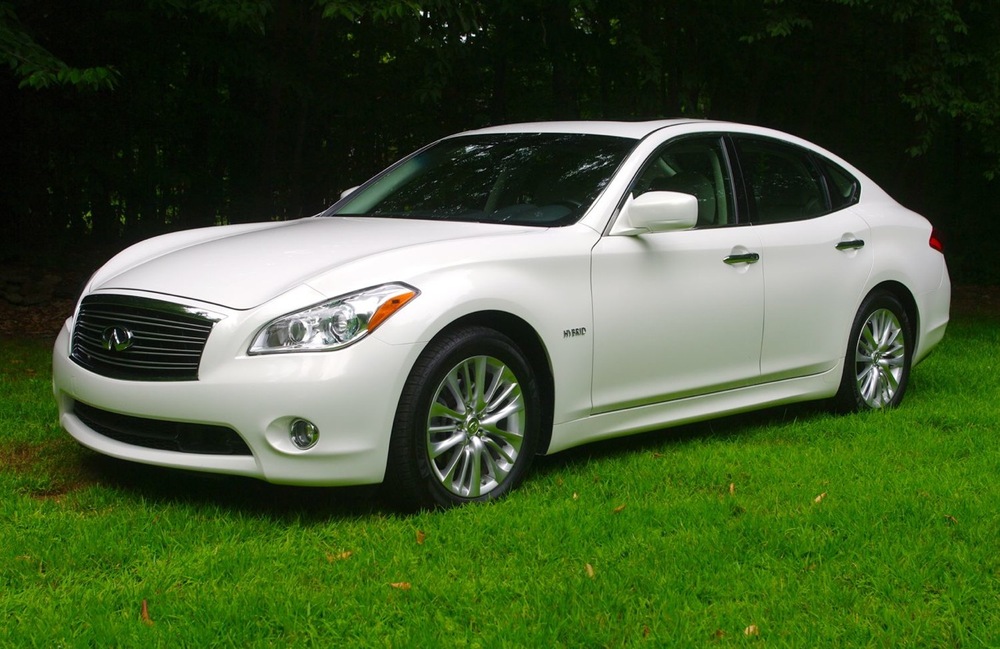
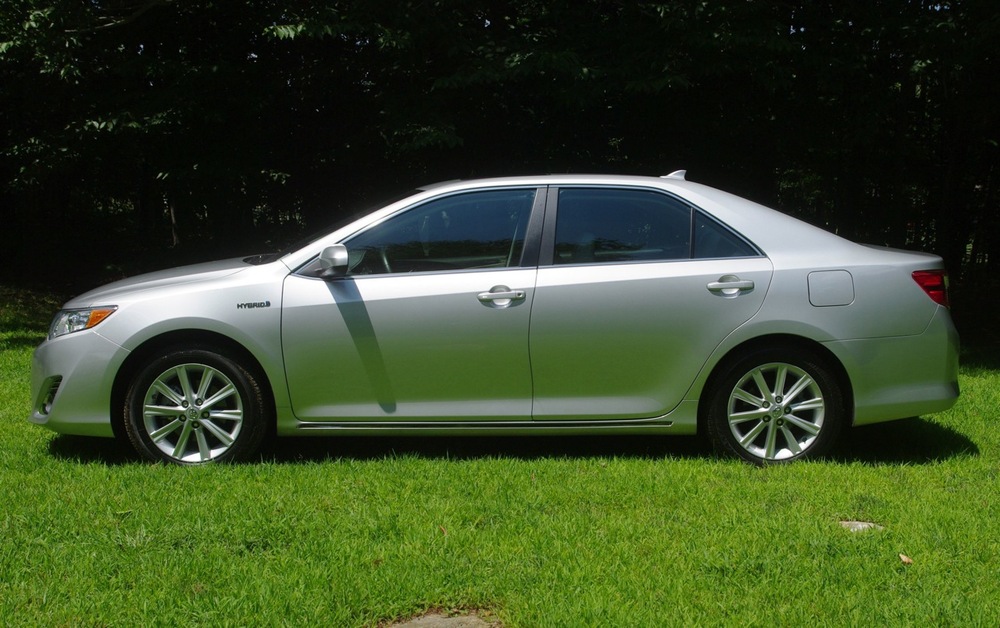
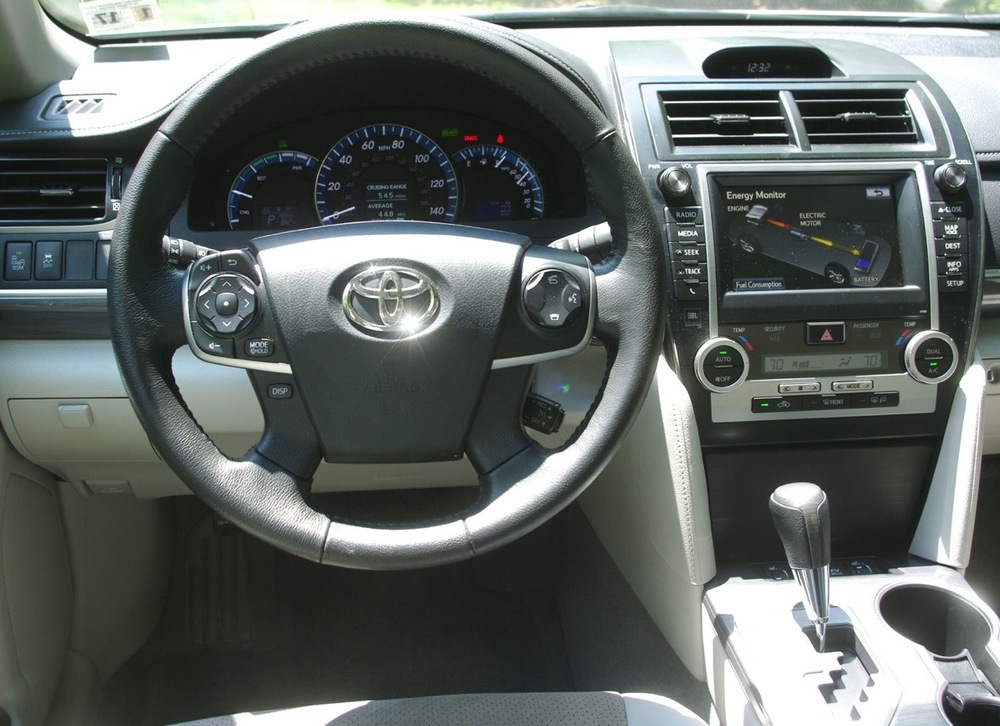
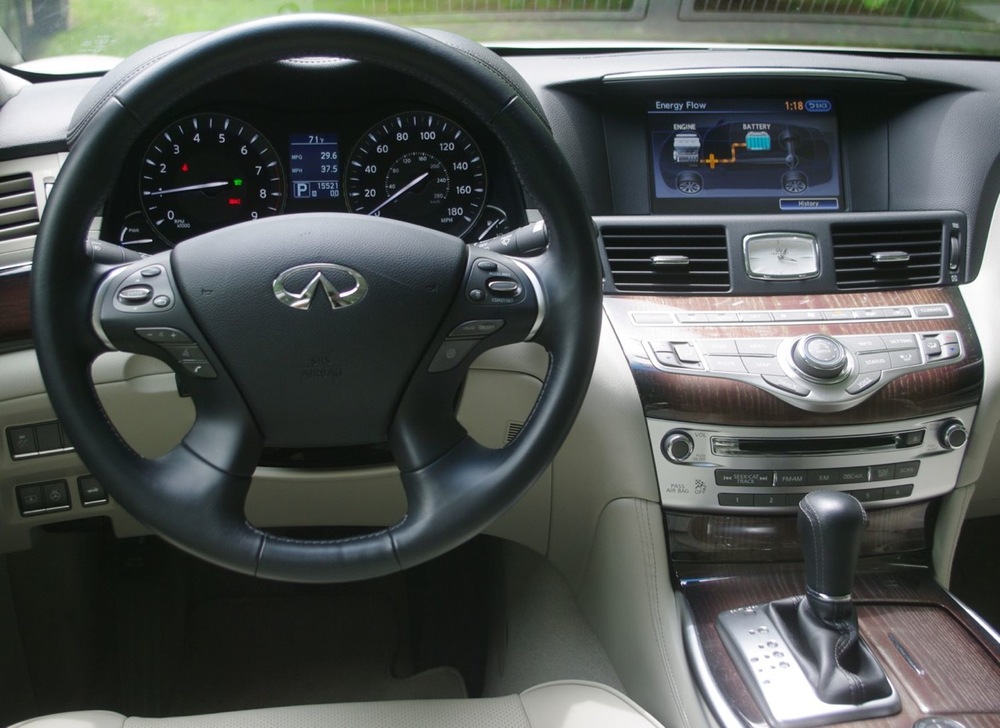
Fortunately, even though hybrid popularity hasn’t exactly exploded there are still manufacturers that move the breed forward, and here’s a couple of very interesting 2012 units that have dramatically different approaches to hybrid powertrain incorporation yet still deliver great fuel economy, low emissions and very satisfying (if very different) driving experiences. These two examples aren’t really direct competitors, but show you how far hybrid drivetrains have come in the variety of applications that designers and engineers have been working on. Today, I give you Toyota’s all-new Camry Hybrid XLE and Infiniti’s M35h Hybrid Sports Sedan. These are both handsome four door sedans, but they’re as different as chalk and some other kind of chalk that is oh so different than the previously mentioned . . . chalk. Some particulars: The Camry is a front driver, while the Infiniti uses rear-drive architecture. The Camry’s four-cylinder gas engine/electric motor is mounted transversely, while the M35h’s V6/electric motor is mounted in a classic longitudinal configuration. Toyota continues to use the tried-and-true nickel-metal-hydride battery for its electric motor needs, while the Infiniti goes with newer Lithium-ion fare. The Camry has a Constantly Variable Transmission (CVT), and the M35h has a 7-speed automatic.
The Infiniti is a bigger car, with nearly 5 more inches of wheelbase and overall length. That said, the Camry feels roomier and has a bigger trunk (and the M’s trunk is kind of a funky shape). Both cars are comfortable and well-finished, with the Infiniti especially opulent (which you would expect given the prestigious label). The most substantial differences between these two hybrids are in fact the performance, fuel economy and price, and once again these differences underscore the very difference design goals of these two sedans.
In a nutshell, like its M siblings the M35h is a rocket, launching you to 60 MPH in an observed 6.3 seconds (the Camry managed a more leisurely 9 seconds, but the car certainly feels quicker compared to the Camry Hybrid of before). This is not surprising as the total system horsepower for the Camry is 200 while the M35h is 360 (although the Camry is 688 lbs. lighter). The latest-generation Camry has benefited from an extensive chassis overhaul that has resulted in tauter handling and a firmer ride with more control, but the M is clearly the sport sedan in this pairing with impressive back road manners and true performance credentials. Both cars have excellent brakes, and are fairly quiet although there is some road noise that creeps in on occasion. So while you may be leaping for the keys for the M if you’re performance-minded, be advised that there is a hitch in the car’s giddyup. The on/off transitions of the V6 engine as it powers the car with and without the assistance of the electric motor can be less than fluid. Perhaps it is often so noticeable because the rest of the car is a model of solidarity and refinement, and any imperfection in an otherwise superb drivetrain sticks out like a sore piece of chalk. But these transitions are pretty obvious, especially in contrast to the Camry’s very smooth transitions and overall seamless hybrid drivetrain. When EV (electric vehicle) mode, both cars are eerily smooth.
Finally, the fuelish bottom line. The performance you get from the M35h is balanced by really impressive fuel economy for the class and in a week of driving I averaged about 29 MPG. This is quite laudable when you experience how well this machine gets off the line, and the only disappointment is the car’s penchant for Premium fuel. If you’re more interested in fuel economy over performance yet like a similar comfort level, the Camry Hybrid is a very slick package that was able to squeeze out 42 MPG with reasonable ease. There’s also a price difference of course, as the Infiniti’s upscale brilliance will set you back $65,395 (as tested), while the Camry Hybrid XLE rings in at $34,596. Two very different sedans, two very different hybrids, both very, very interesting higher-mileage alternatives to the standard fare out there.




 RollingProse