
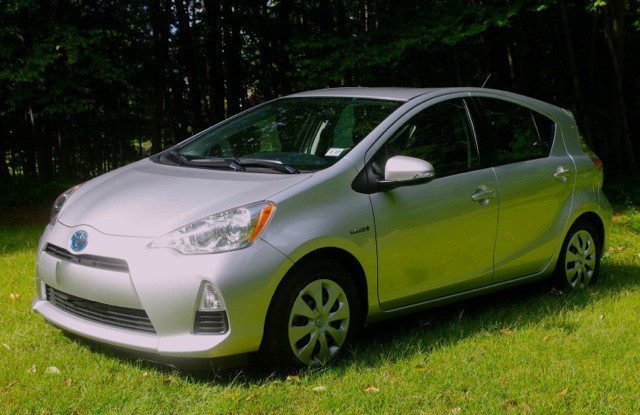
Once Toyota launched the first Prius gas/electric hybrid and the car turned out to be a great success by hitting all its design objectives including exemplary fuel economy, reliability and low operating costs, the company has been going full speed ahead (at a prudent engineering pace of course) with a whole host of hybrids. This year is especially important for the Prius, as the family of cars has now grown to four: the Prius, Prius v (reviewed somewhere on this site), the Prius Plug-In (also discussed on this stunning web-based prattle-fest. Somewhere), and now the latest edition, the Prius c. C in this case stands for city and thus defines the car‘s urban transport suitability, and this is the smallest, least expensive, and most economical Prius in the line. I think once people get out and drive these things it could become the most most popular, too. The reason is the car actually has decent room in it for the compact class, is actually pleasant to drive and gets better mileage than any of my motorcycles (which is quite impressive). It’s also built by the company that has more experience than anybody with gas-electric hybrid powertrains, and judging from past experience this latest edition should be very reliable and low-maintenance as well.
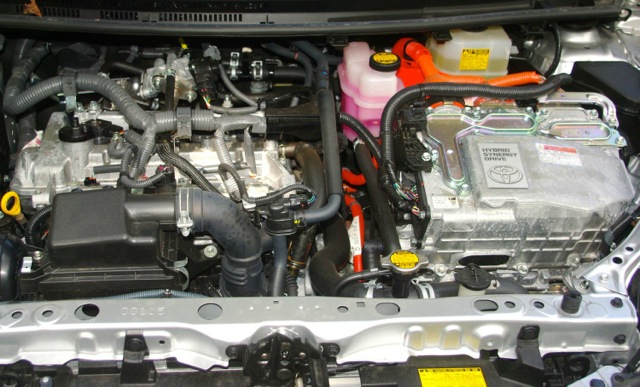
That last bit is helped by the fact there are no belts to fail or replace at regular intervals, as the components they drive on conventional cars are all electrically driven on all new Prius models. The Hybrid Synergy Drive powertrain consists of a 1.5-liter Atkinson cycle Inline Four, that puts out 73 horsepower, and is mated with a 45kW (60 horsepower) electric motor with an overall effective output of around 100 horsepower. As with every Prius (except the Plug-in), the battery pack that powers the motor is a nickel-metal hydride unit hidden under the the rear seat, and the car can be powered on electric power alone, gas and electric power together or the gas engine by itself. Toyota describes the car’s adjustable drive mode system thusly: “Prius c offers three distinct drive modes: Normal, Eco, and EV mode. Eco mode reduces overall energy consumption by governing climate control and throttle to improve vehicle efficiency. Under certain conditions, the EV mode allows the Prius c to be driven solely by electric power for a short distance (under 1 mile) while remaining below 25 mph.” The transmission is a Continuously Variable unit like on all Prii, and works well in this application and is quieter than a lot CVT units out there.
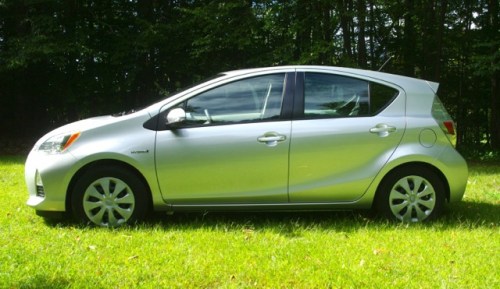
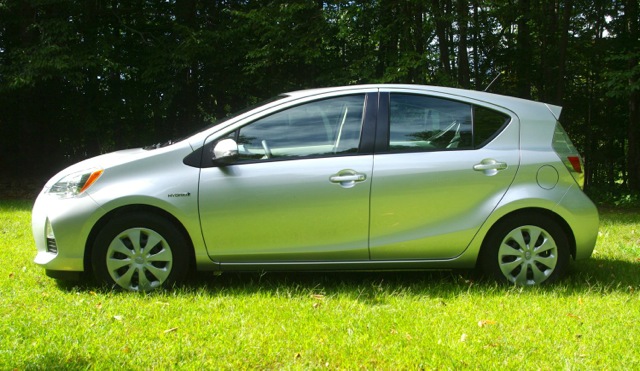
And yes, this Prius Junior will not pin you in the deep recesses of its stout upholstery under hard acceleration, but it has enough giddyup to get you onto traffic just fine. The overall chassis feels substantial and handling is tight, with a firm but not excessively stiff ride. In this regard it’s on a par with other economy cars in the class, and like I’ve been saying for a while the quality level (and the amount of equipment) you can get on entry-level cars is quite an improvement compared to what was out there even just a few years ago. The cabin isn’t Lexus quiet but neither is it excessively noisy like some compacts. The transitions from the gas engine and electric motor are suitably smooth, and reflect that years of development that have gone into Synergy Drive research.
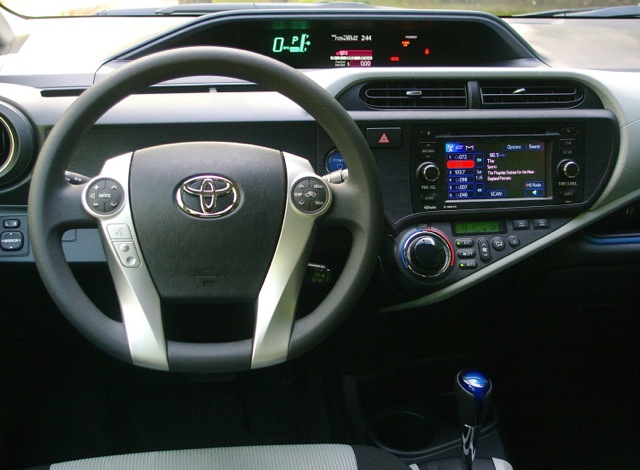
Inside, there’s decent room for four despite the very compact external dimensions, and the centrally-located digital instrument cluster should look familiar to anyone who’s spent quality time in a Prius. Depending on your budget, you can load up the c with all manner of options and our Prius c “Three” model included the usual cruise and auto climate controls, a touch screen radio interface with Navigation and Toyota’s Entune infotainment system, a Smart Key system; all the the latest goodies that are becoming common these days. The upholstery is durable enough, and while there’s a lot of hard plastic in evidence it’s (as I keep saying) at pretty much on the same level as most entry-level compacts.
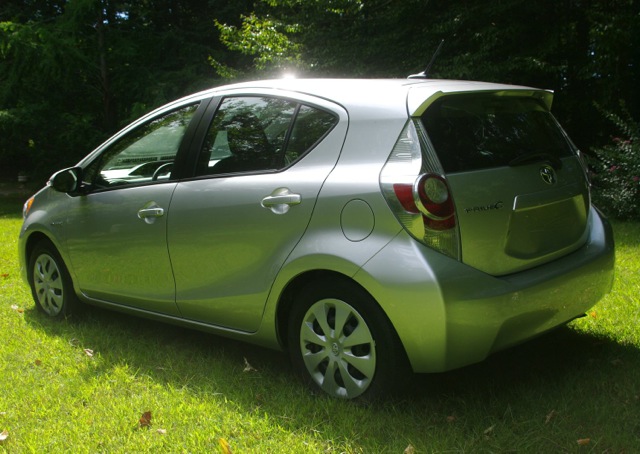
Which in a way is a slight problem initially for this incredibly frugal little 5-door. People forget this really is a comparatively inexpensive car with a comparatively expensive drivetrain; a hybrid system that delivered 53 MPG during a week of mixed driving in these parts. Apparently some people think it should have the feel and interior materials of its more expensive siblings instead of fittings more fitting for a car on the low end of the vehicle line. I really liked the car, and felt like I was driving a quality piece that gets the best gas mileage available in a highly maneuverable package that can escort three associates comfortably as well as some of their belongings. With options, the Prius c Three sticker came to $22,669.
 RollingProse