 So here’s a good bit of aggressive counter-marketing, courtesy of the General Motors Corporation. Yes, this is a story about the new Ford F150, but bear with me for a minute.
If you’ve been paying attention, any attention at all, to the new 2015 Ford F150 pickup’s big bold changes, you know they have dived seriously into the pool of alternate materials to lower weight and raise the fuel economy of their best-selling vehicle. In this case, the new material means extensive use of aluminum in the body (including the pickup bed itself) which slashes the curb weight up to 700 lbs. They have been going on about this dramatic advancement for at least a year prior to the truck actually being available, and it has caused a bit of a stir among those interested in pickups (which are the largest share of vehicle buyers in the US). If I had to evaluate Ford’s pre-launch promotional strategy I’d have to say they did a good job, as there was certainly a lot of interest in the truck. Ford claimed not only better fuel economy but better performance, cargo capacity and towing ability not to mention superior rust resistance (very welcome in parts of the country like the Northeast, where insane amounts of salt are dumped on the roads during the winter).
So what did GM do? In a recent TV ad I observed they mentioned the Silverado’s “all steel” construction, or something to that effect. The bottom line was were clearly implying their product was better than that new aluminum thing from the other guys. I was quite surprised by this, as I thought it was just another way of pointing out how the Ford engineers were being pretty ambitious and trying something daring to make their trucks better. So the question is, is Ford’s move to Al-You-Minnie-Um the way of the future? Did this expensive gamble succeed, or is the F150 now a TV dinner tray with wheels? First, a couple of things about why using aluminum on this scale is no small task. The alloy is costly to produce and fabricate, but even more challenging is the fact that it takes a lot of engineering time and effort to replace steel pieces with aluminum so they do everything that is asked of it. Here’s a bit if inside pool I learned back in 2013: I was at the Range Rover Sport intro (scroll down, it’s easy to find thanks to my lack of fresh postings), where we got to hang out with some of the Land Rover engineers who made this highly advanced luxury SUV into a mink beast. It has a generous amount of aluminum construction, and one engineer told me the aluminum battle was made winnable thanks to the fact that the Jaguar engineers we pretty much across the hall from his group, and provided tremendous help (Jaguar has been a leader in modern aluminum car construction for decades). And who owned both these companies a few years ago, when a lot of the primary engineering was going on? Ford, of course. Intrigue!  Jaguar and Land Rover are now the property of Tata Motors of India, but Ford gained heaps of aluminum engineering experience (and other things) while they owned these British icons. I can’t help but think it has helped tremendously with the creation of the new F150’s aluminum apparel. There’s still a boxed steel frame and lots of high-strength steel used on the truck, but the body panels and bed, and other bits and pieces are made of aluminum.
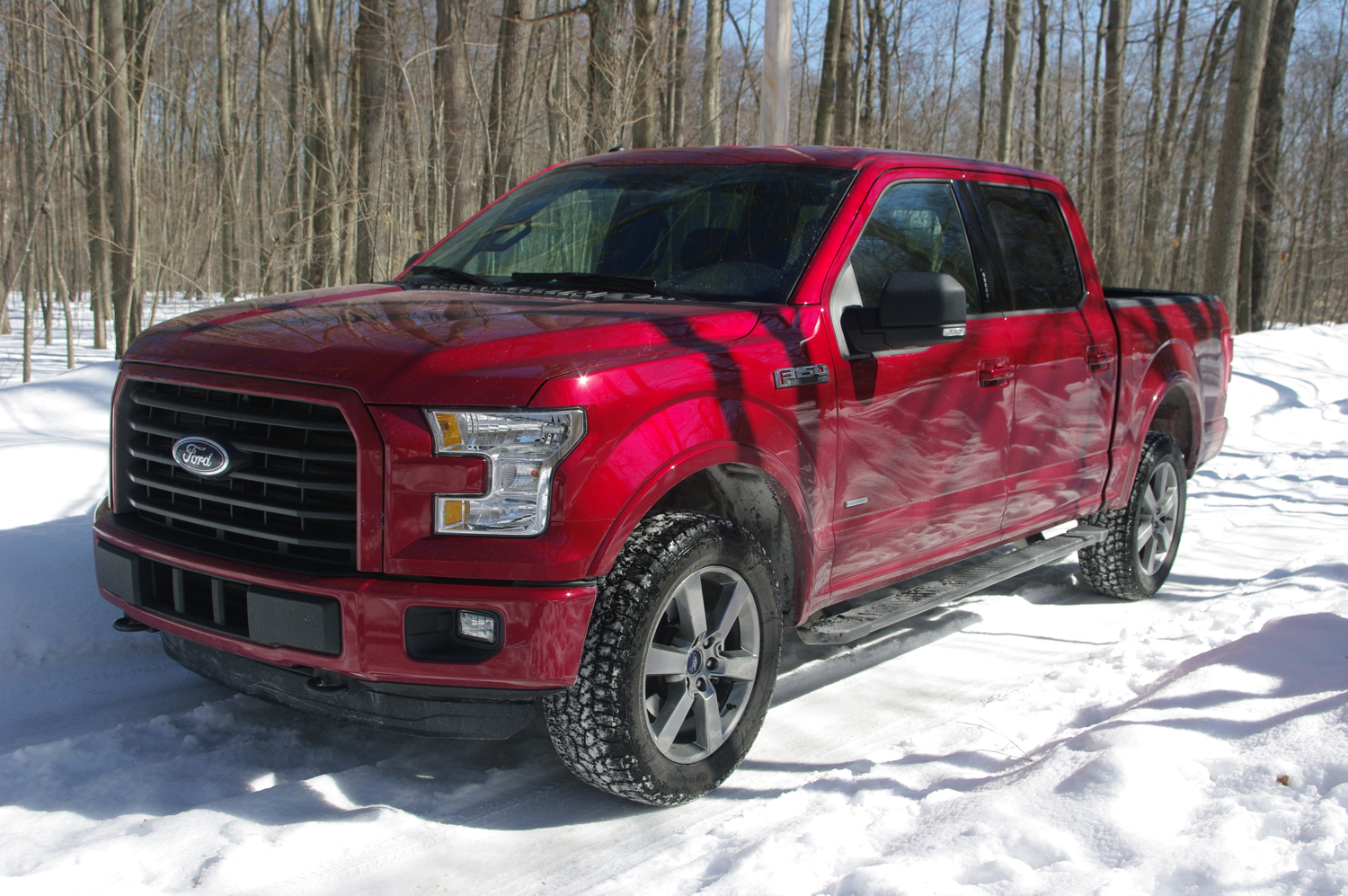
The test F150 SuperCrew 4X4 I sampled had the 3.5-liter EcoBoost turbo V6 under the bonnet, which generates 365 horsepower and 420 lbs.-ft. of torque. The engine feels strong, with no dramatic spikes in power that turbos used to have but rather a flat, tractable power curve. It feels much like a V8, but is designed to use much less fuel. That said, I’ve yet to drive an EcoBoost that was dramatically more frugal than V8 counterparts; with this truck I averaged 17 MPG. Thanks to the muscle and lesser mass, acceleration is brisk and the big question I always have with these new engines is long term durability. Turbos have far more parts and require a lot more integrity out of the “host” engine than regularly aspirated engines, and there’s a lot more that can go wrong compared to non-turbo mills. I know, long haul truckers will laugh and mention that turbo diesels last for billions of miles, but the fact is a diesel is much more fortified to begin with thanks to its high-compression nature. I’m sure Ford has reinforced and tested the bejeesus out of their EcoBoost truck engines to make sure they’re going to last, but I could see why potential owners might be a tad wary. The engine does carry a $1995 price premium according to our sticker, and there’s still an ol’ 5-liter V8 with more horsepower that’s also offered on the truck.
Anyhow, the truck drives on a par with the competition, and the 6-speed automatic is a good fit with this engine. The lighter weight doesn’t in any way interfere with the truck’s feeling of solidarity, as the aluminum bed feels quite stout and capable of taking some punishment. Where things get weird is ride quality and winter traction, as the unloaded truck did have some traction issues in snow and the ride quality was a tad on the firm side, which became quite busy on rough pavement. Maybe the tuning is deliberate, as the truck may be lighter but it still feels quite substantial. A lot of buyers like such a personality, and it helps gives the truck the rugged image that so many want in their hefty hoopy. On particularly nasty frost heaves, the truck bounced around like pretty much every other full-size does, so the big advancements with this truck don’t extend to ride quality.  Another thing that surprised me on this $52,000 truck was a non-counterbalanced tailgate, which if you’re used to one of these modern marvels like I am it makes the Ford’s feel a bit heavy. It did have the optional tailgate step, which is clever but ever since Ford introduced it a few years ago I’ve always wondered how a Mega Bubba would negotiate the thing without falling off and leaving a massive crater somewhere. Regardless, I think there is a lot of other optional kit that is quite useful, like a remote tailgate lock/release, on-board loading ramps, LED bed lighting and tons of other goodies. The XLT interior is well-designed and comfortable, including the SuperCrew’s rear seats that don’t offer as much room as the Tundra CrewMax or Ram Crew Cabs but there’s still plenty of space. Incidentally, the SuperCrew is the only way you can get four regular doors on a F150. Unlike Ram, GM and Toyota you can’t get an extended cab with front-hinged doors; you’re stuck with having to open the front door to open the rear-hinged hatches.
As for all the techy goods, yes, the F150 is loaded with all the latest electronic interface systems that so many people want as they’re just not distracted enough. At least the company is starting to roll back some touch screen stuff and reintroduce knobs in places where they are still the best way to do things. All the latest Stability and Trailer Sway mitigation black-box voodoo is of course on board, which is the best expression of modern technology on such vehicles anyway. Interestingly, the 4WD system has just 2Hi/4Hi /4low settings with no Automatic mode; you have to go to a higher trim level than our XLT to get that. So all in all, the new F150 is a bold move. Aluminum is more expensive to fabricate than steel, but it does have its attributes. As for the question of more expensive body repairs in the event of damage, this will likely be no big deal in the long run. Incidentally, Edmonds did one of the most ludicrous “tests” in recent memory when they took a sledge hammer to a new F150 and then saw what it would cost to get it fixed. It was about as unscientific as you can imagine and proved basically nothing. It did get a lot of page views I reckon, which is why they did it. Suffice it to say, your deductible will likely be all you’ll pay anyway and whether the overall insurance rate will change will take time to determine.
The Combination of EcoBoost engines and weight reduction looks great on paper, but whether this is the way to go for a work truck you need to last a decade or two is a tough call. I didn’t find all that much difference compared with the offerings of the other guys (I’ve reviewed all the latest from, GM, Ram and Toyota) who are arguably using older, but proven, technology. These things, like all current pickups, are getting really expensive but then they have a huge profit margin for the OEMs and folks seem to love them, especially while gas is cheap. The new F150 I’ll wager is the most expensive of the bunch to build, and I know Ford will work hard to keep the price competitive even if it means trimming their per-unit profit margin. The next few years will determine not only if the public adopts these new approaches, and but whether the competition starts to copy it. The company is certainly not resting on their laurels, or anybody else’s, and time will tell if these changes were worth the considerable effort and expense that produced them.
 RollingProse