A Mini Goes Mega?

Countryman_copy

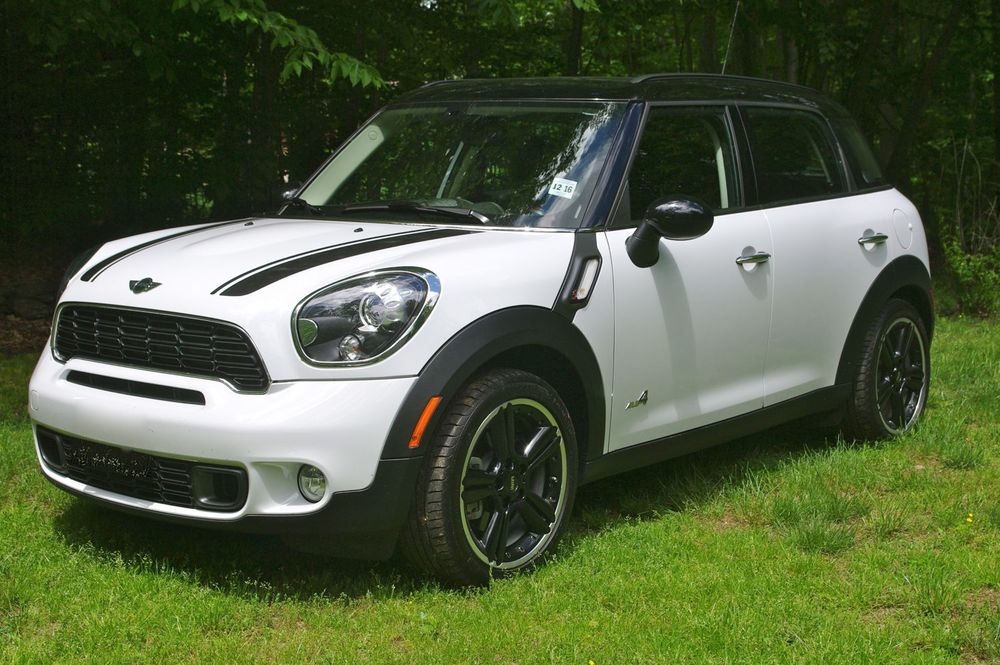
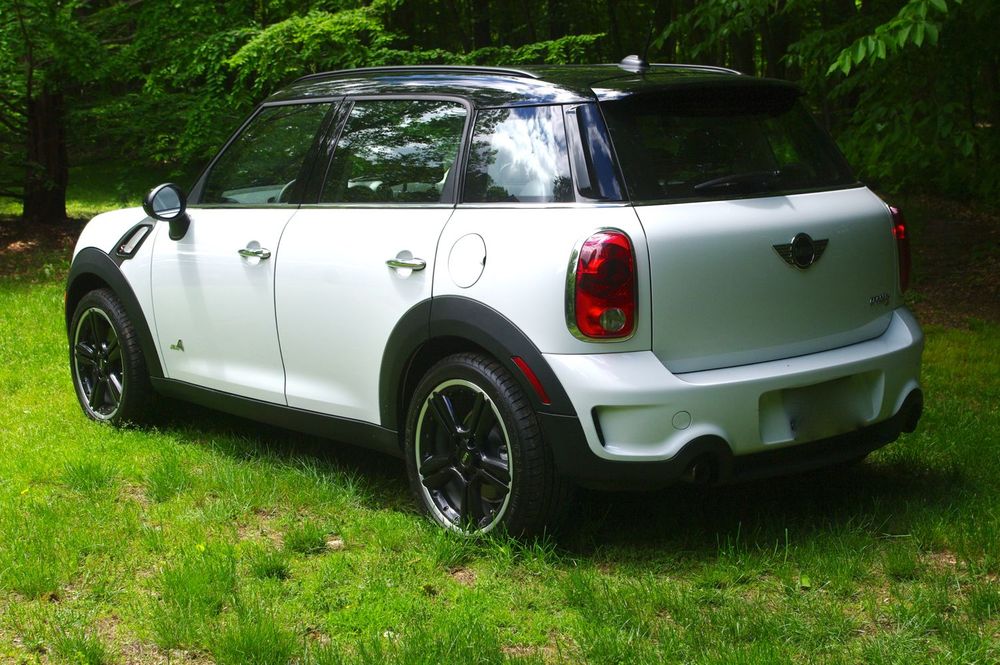
So there really isn’t anything in a name, is there? I mean, we often think that a name like, oh, I don’t know. . . Mini, for example, implies a certain type of vehicle. The name is known the world over as a smaller version of something else, or in car circles, conjures up images of the famous Mini Cooper which was one of the first (and one of the most successful) micro cars ever produced. The original British marque has been part of BMW in 2001, and since then has not only been a hit but is continuously sprouting new variants that take the Mini name to places it’s never been before. And, wonder of wonders, this even means the land to of the SUV and the Mini Countryman, which is a properly pumped-up Mini that still has the general aspect but looks like a charge into the bush (intended, this time) is certainly not completely out of the question. Sporting a larger size, more ground clearance and available with All Wheel Drive, the Countryman might initially make you think the standard Mini has suffered an allergic reaction to some shellfish, or at least Shell gas.

Countryman_side

But once you get used to the proportions what you have is a big Mini, and it makes the car much roomier and with the optional ALL4 All Wheel Drive system you have all-weather capability and the possibility of venturing off the road as much as you think your nerves will allow (this is still a British sports compact, and not a Range Rover). I sampled a Cooper S Countryman with the AWD drivetrain, and found it to be an eccentric, but very fun, and undeniably unique, SUV.  There’s no locking center differential or low range on the test mule, but it does have good all-road capability which is what I think they’re really driving at to begin with. 
Countryman_engine_copy

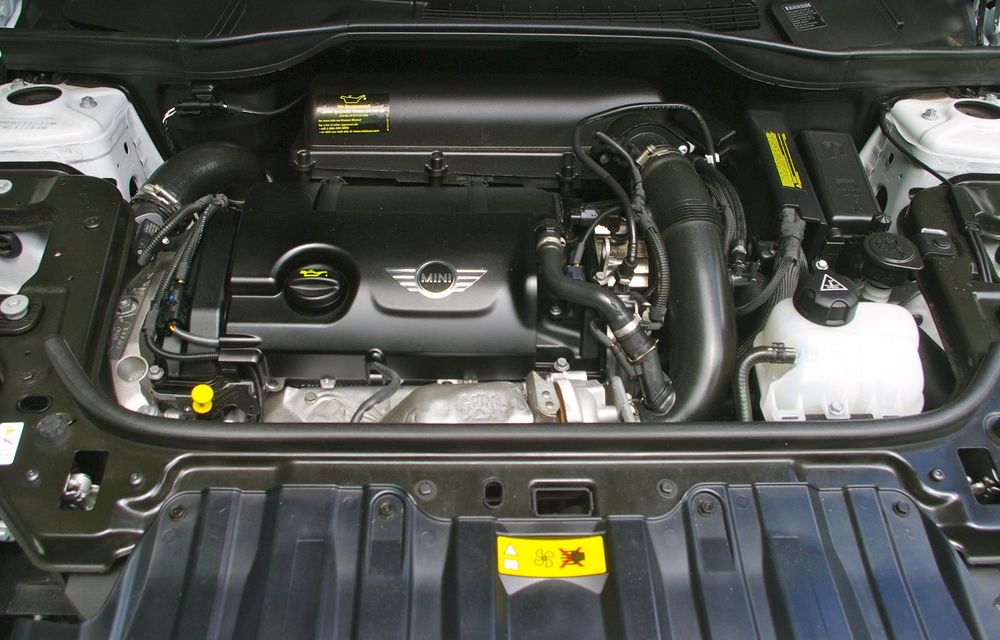
And as driving in a spirited manner is what the whole Mini thing is really about, you have to have a proper drivetrain such as a stout little Inline Four with a twin-scroll turbocharger, which in the engine room of this Countryman displaces 1.6 liters and summons forth 181 horsepower. You can get a 6-speed manual gearbox, while my CountryDude was armed with the latest in STEPTRONIC automatic transmission hardware with 6-speeds and paddle shifters on the steering wheel for the manual mode. Shifts are crisp in either manual or automatic mode, and the turbo is very smoothly integrated into the power delivery without any abrupt peaks or valleys. The “wheel at every corner; I’m still a go-cart I just like fried food” architecture makes the Countryman fun to hustle around, and although it is carrying more mass it’s still light on its feet. Better suspension compliance is another benefit of the higher SUV-ish chassis as it allows for a bit more wheel travel, or so it seems anyway. 
Countryman_int_copy

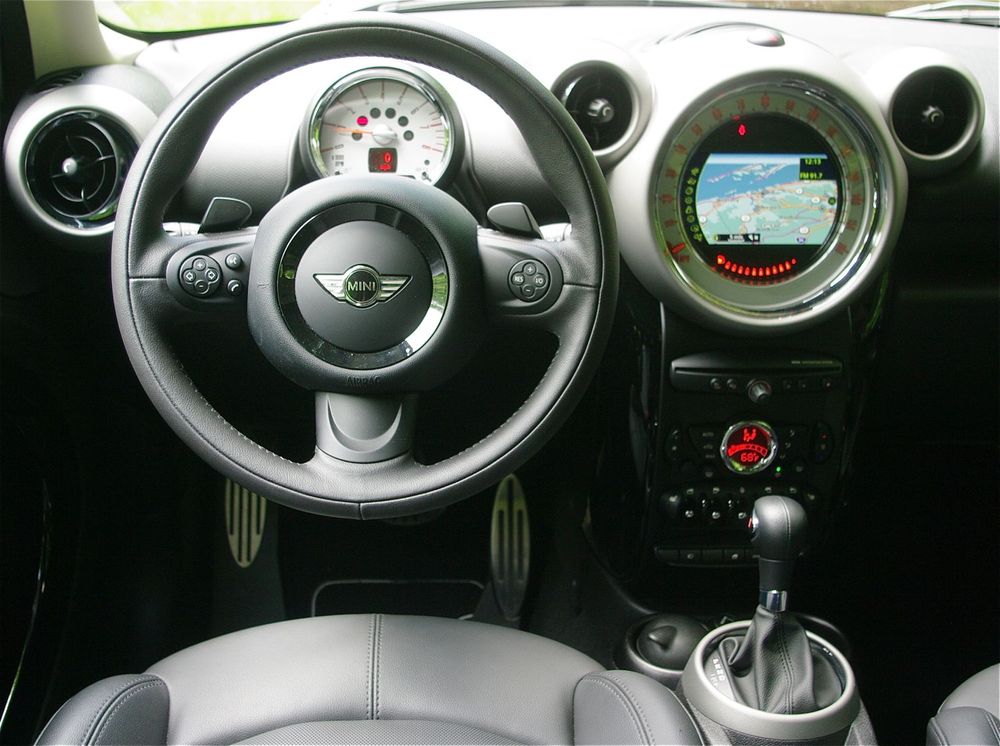
Inside there’s a truly accessible and serviceable rear seat, no doubt the roomiest of any Mini to date. With the rear seats folded you have 41 cubic feet of load space. So this Mighty Mini is very competitive in the class in terms of room, but offers it’s own unique personality and way of doing things (like that speedometer that is only slightly smaller than a garbage can lid). The controls still have the typical Mini toggle switch madness but the NAV display in that huge speedo is unusually sharp and attractive. It’s properly spooled-up wee Inline Four delivered 28.4 MPG in mixed driving, which is very good for the class. 
Countryman_rear_34

I have no idea how appealing the Countryman is in your neck of the woods, but here in the Northeast I see a fair number running around so there’s definitely a desire for a true Four-Season Mini with more room and yet still the same overall personality and economy with much more utility. The sticker on my very well-optioned tester came to $36,350, which certainly isn’t cheap but you do get something pretty unique for your money. 
How smart is this iQ?

Iq_b

There is something to be said for being different, and when you enter a crowded field with something that really gets noticed it’s quite an accomplishment. By “crowded field,” in this case I mean the automobile market that has so many shape and sizes of vehicles these days it’s pretty tough to stand out, much less get lots of looks wherever you go. But in the case of Daimler-Benz’s smart car, it’s such an unusually diminutive conveyance that it really gets tons of attention pretty much everywhere you drive (and especially park) it. It’s so unusually tiny that it can be stashed almost anywhere, but has a lot of shortcomings as you can imagine. It’s not very roomy, not very quick and not as fuel efficient as you might think (and likewise not as inexpensive as you might expect) for such a wee auto, either. 

Iq_a

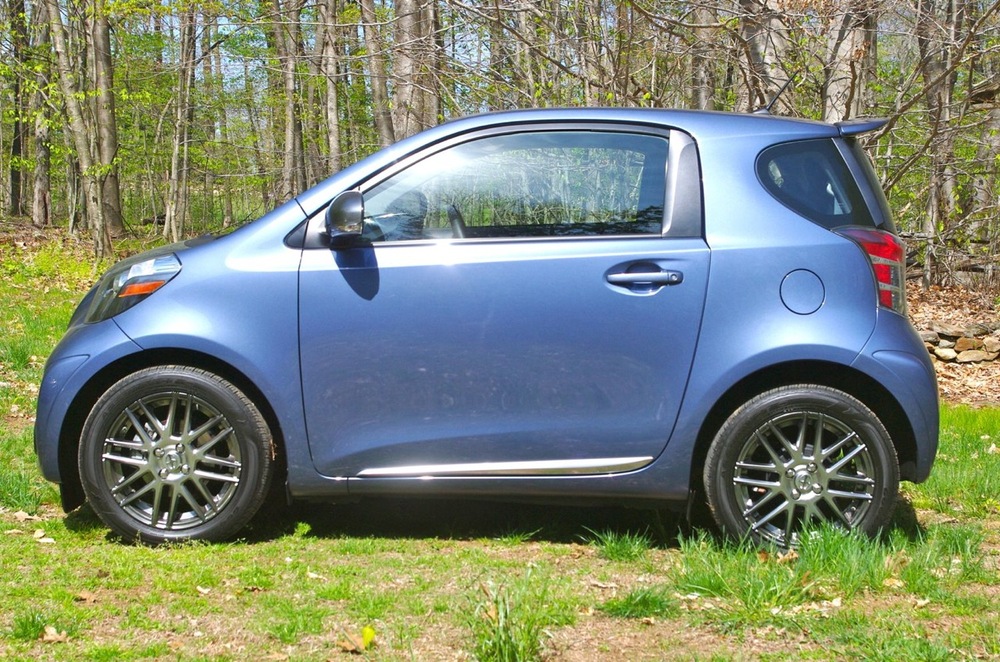
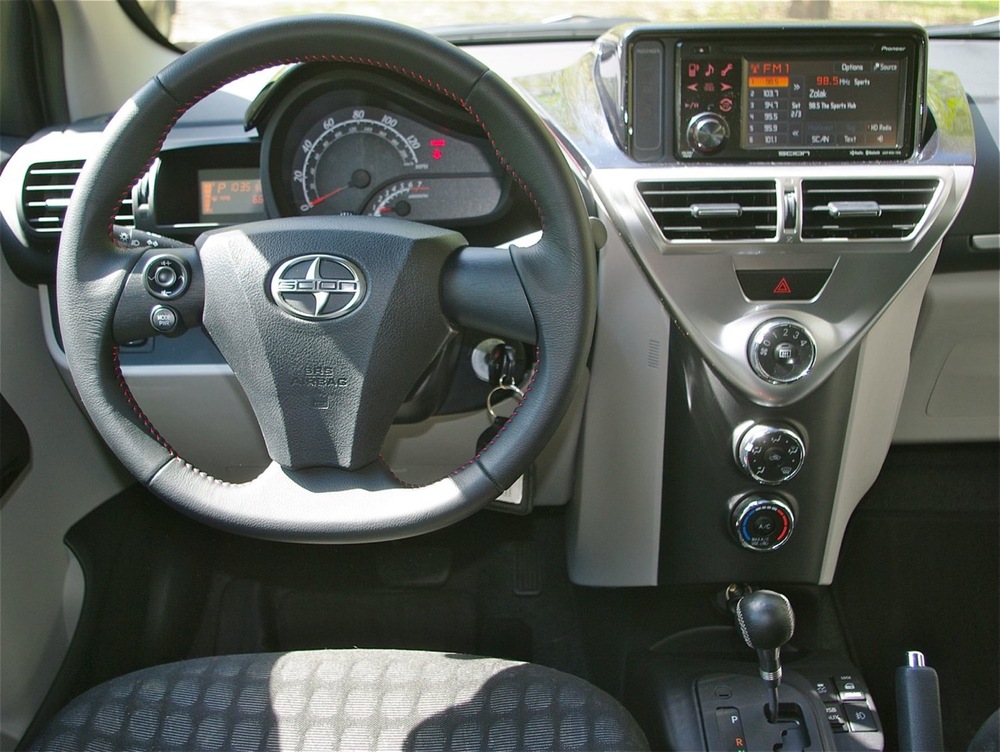
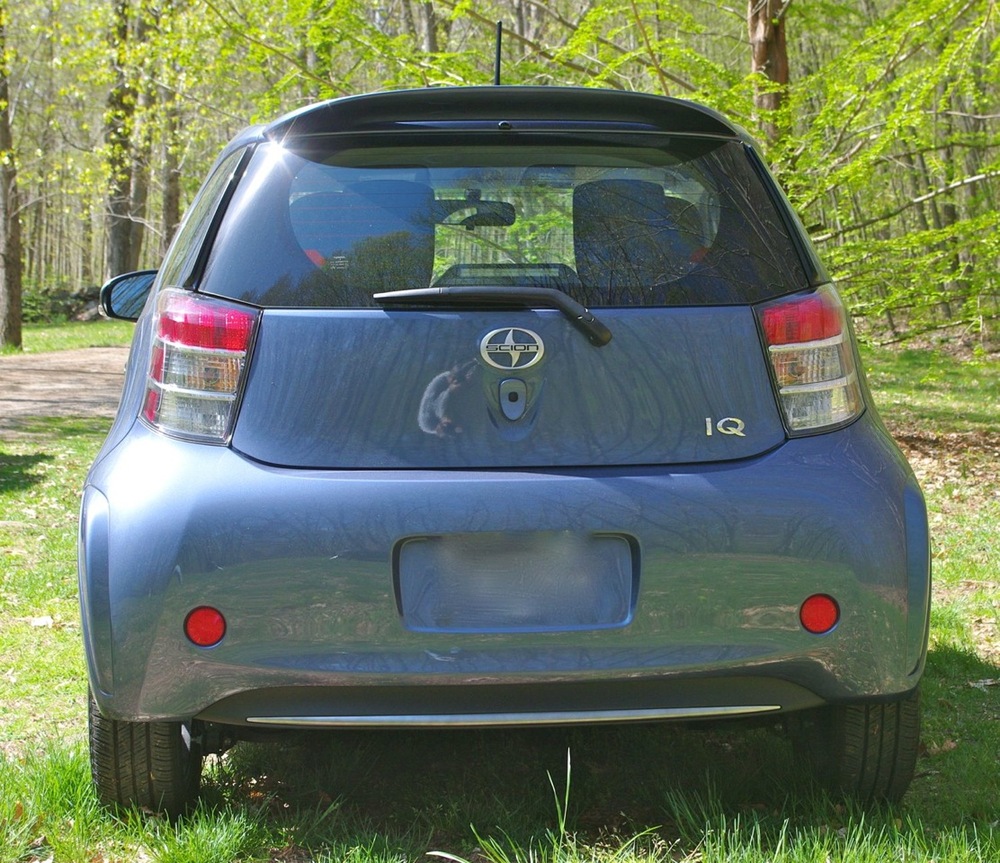
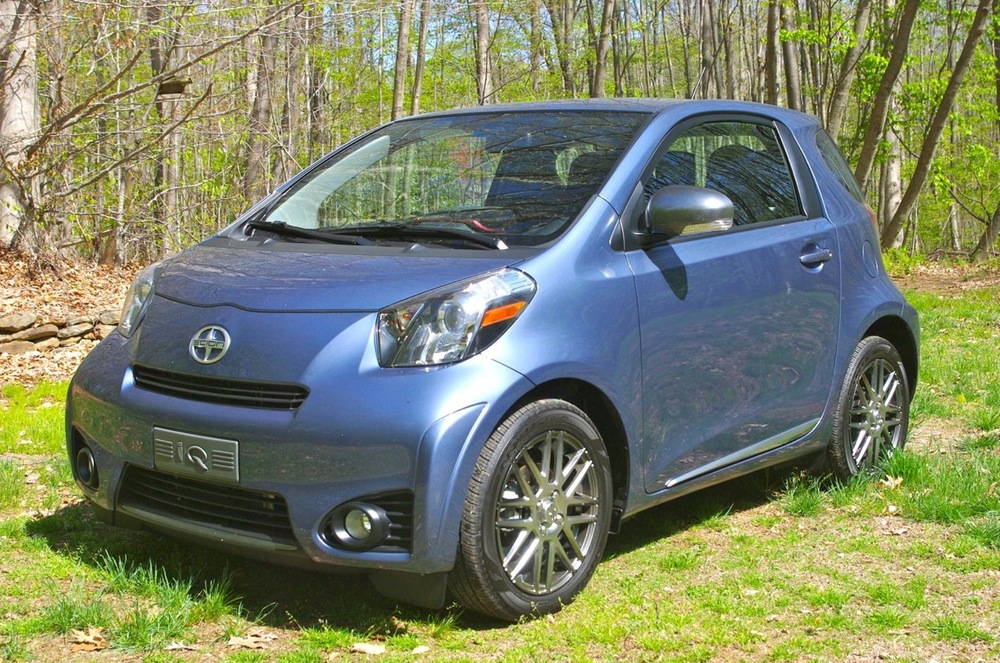
Which brings us to Scion’s new iQ (and yes, you can bluetooth your iPhone into your iQ). It is a microcar along the same lines as the smart, but even though they look quite similar they are as different as they can be when you take to the road with them. While at first glance it’s appears to be same general size as the smart, the iQ is actually a bit bigger and there is one significant difference: the iQ has what Scion calls “3+1” seating which the smart fortwo seats, well, two. The smart one has two seats, designed to accommodate one human at a time. 

Iq_c

It should be noted at this juncture that I am personally unaware of any “crazy college kids” trying to see how many bodies they can cram into a smart, or now an iQ for that matter. Not yet, anyway. But stay tuned. They will no doubt use the latest social networking technology to engage in this silly practice any time now, though. Crazy kids.

So anyway, what is 3+1 seating? “The Scion iQ is only 10 feet long yet seats four people, making it the world’s smallest four-seater,” says Scion. But this doesn’t mean four adults, however. If I may further quote Scion, “The ‘3+1’ offset seating arrangement allows one adult to sit behind the front passenger and a child or small package behind the driver.” Interesting, no? Making the most with a little I guess. It’s tight back there, to be sure. But if you fold the seatbacks you have 16.7 cubic feet of cargo room, and that’s a decent amount for two people on a journey. 

Iq_e

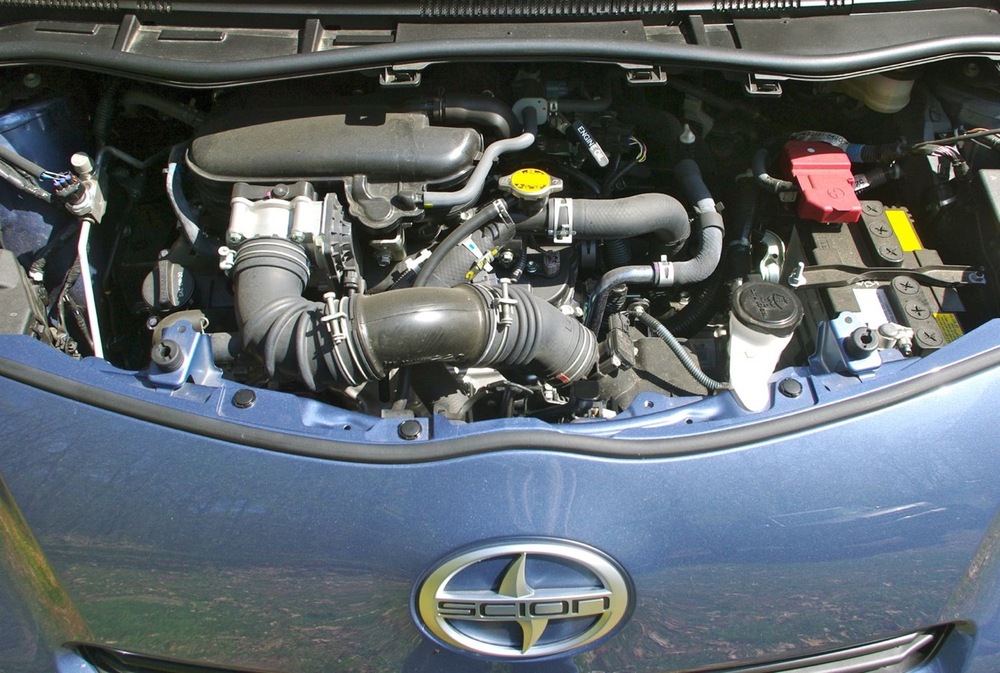
And you wouldn’t hesitate to take this little two-wheeled toaster on a trip, because it drives like it‘s a lot larger than it is. It’s faster and more powerful than the smart (which is a rear-wheel-drive, rear-engine unit as opposed to the front-drive, front-engine iQ) and has a very efficient CVT transmission that seems an ideal fit. A roughly 9-second 0-60 time from its 1.3-liter Inline Four is perfectly acceptable for this type of economy rig, and it is in fact able to get out of its own way. The suspension is firm but not punishing, and the just over 12.9-foot turning radius makes U-turns a doddle just about anywhere. Fun to drive, especially in tight urbane quarters you ask? You betcha. A wide stance helps keep the car stable and when I encountered some fairly wicked crosswinds I discovered the car stayed in its lane quite well. 
Iq_d

So the inevitable bottom line question is, is it smarter than the smart? I definitely think so. But in averaging 38 MPG in a week of mixed driving and costing about $18K with options (and you can’t get cruise control or a spare tire-just a repair kit is on board) it has a lot of larger, better competition at the price/mileage nexus. However, if the area/environment/cityscape where you need to park this elfin transport is really tight, then the car makes a lot of sense. It is also a great pick if you like a lot of attention, because this is a very distinctive machine that stands out in the world of large cars and SUVs. It really is that different, and when tuners and customizers get their wrenches and paint guns on it, the possibilities are intriguing to say the least. 

It’s Happy to See you

Evoque_b

Great Britain and India have a long and complex history in terms of their relationship to each other, and it is likely to continue for ages to come. There’s been a lot of back and forth (which is a mild way of putting it) and while Britain ruled ages ago India now the relationship is vastly different. Who would have thought 100 years ago that in 2012 an iconic British company like Land Rover would be owned by the Indian company Tata? But that is the way things are now, although brand purists would be pleased to know Land Rover (and its upscale Range Rover division) are still very British in design and construction. And while there is a great deal of tradition in their new products, the company is certainly not shy about embracing the latest in both style and technology.

Evoque_a

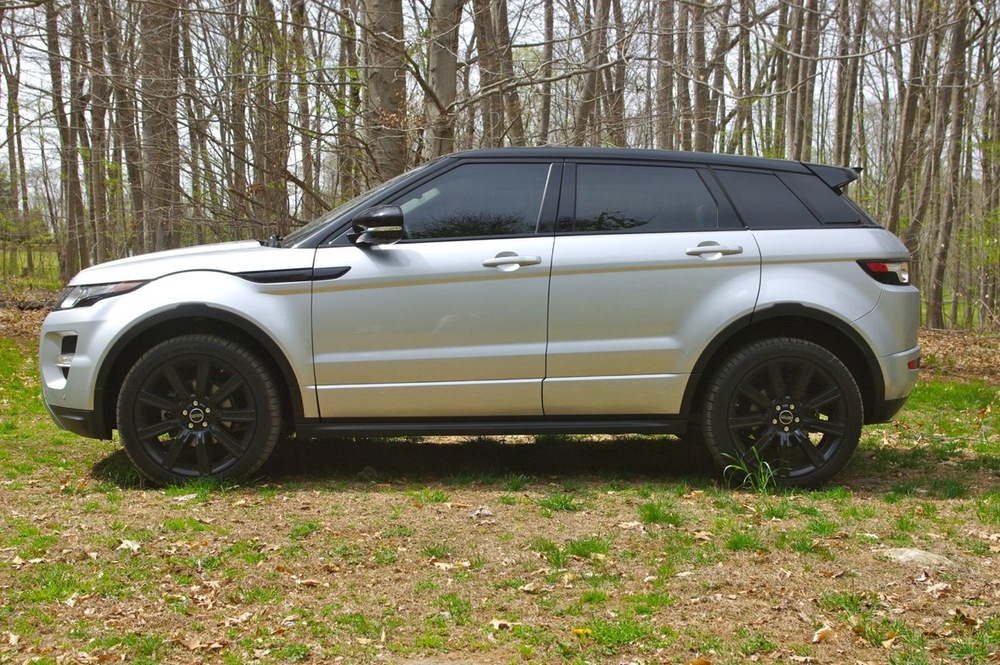
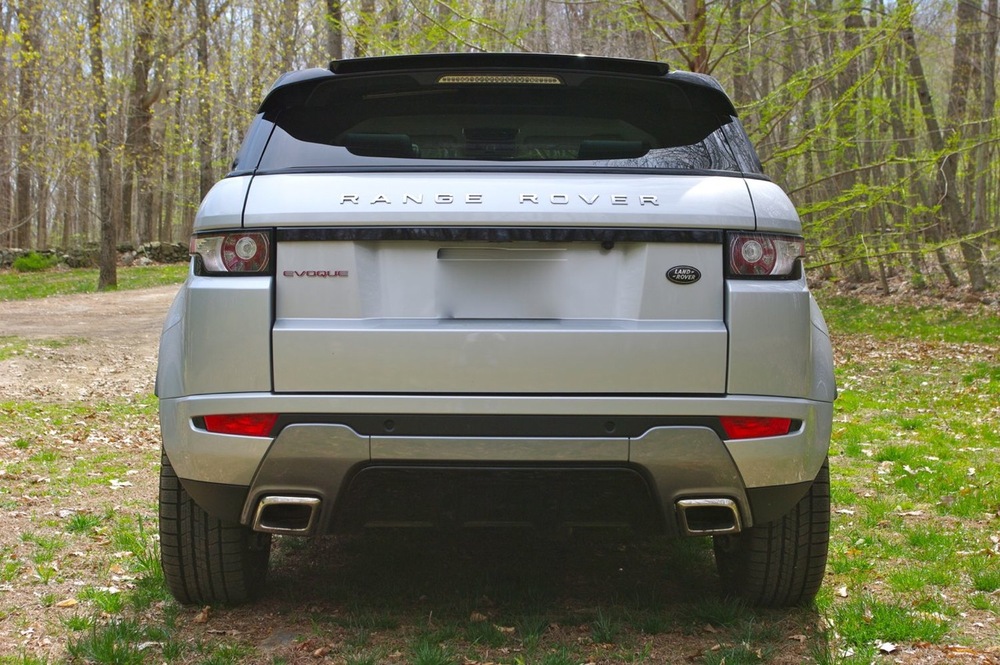
The Range Rover Evoque is the lightest of the range, and one of those distinctive new models that bears a near-as-dammit resemblance to a concept vehicle (the Range Rover LRX) seen on the auto show circuit back in 2008. Available in two or four-door variants, it’s pretty amazing to see the production version in the flesh and realize this is not a show car, but a very stylish machine you can drive to work (or into the bogs-n-boonies, if you so desire). It has a very distinctive look; adopting the squished profile philosophy where it looks like a very large, heavy object of some sort was placed on the roof when the Evoque was still young and growing and therefore stunted further upward roof development. This is in direct contrast to usual Range Rover practice where you typically have a big greenhouse and a low beltline for excellent off-road visibility. The Evoque’s lower roofline would actually seem claustrophobic if not for a brilliant engineering solution: a panoramic glass roof. Naturally there’s a power shade if you want more of a “hardtop,” but I never used it as the sun didn’t cook the interior unduly while I had the vehicle. It a very clever feature that is getting more and more popular on a variety of vehicles these days. “Wheel at every corner” architecture almost gives the machine a Giant Mini vibe, and helps reduce front and rear overhangs for those who actually do wander off the beaten path from time to time.

Evoque_e

There’s an amazing amount of stylish detail inside and out so there’s something interesting everywhere you turn. A favorite such attraction is the shifter, which is actually a dial in the center console that rises up hypnotically out of the surrounding substrate to meet your hand when you hit the start button. This is the kind of thing that drivers will love to show virgin passengers (any sexual references are purely coincidental, of course).  Near this transmission interface you’ll find a mode selector that includes the optional Adaptive Dynamics Ride Control system with MagneRide. This is an ultra-techy on-the-fly damping adjustment system that helps tame the Evoque’s long-travel suspension instantaneously thus reacting to any and all road conditions. It seems to work quite well, for the ride is firm but never punishing and the famous Rover rock-gobbling compliance is well-represented. 

Evoque_d

So what’s eet got under the bonnet, then? Here again we see that there’s nothing on the new Evoque that you could call commonplace. It’s powered by a 2-liter turbocharged Inline Four, that despite it’s modest displacement doles out 240 horsepower. There’s plenty of get up and range, but like many turbos power delivery can be a bit abrupt at times. Overall it’s a great mix of performance and fuel economy as I got around 21 MPG while I roved about. The six-speed automatic suited the power delivery well, and the multi-mode intelligent all-wheel-drive system has settings for General Driving (on-road and easy off-road); Grass/Gravel/Snow (slippery conditions, on and off-road); Mud and Ruts; and Sand. Thus spaketh the press release; I myself did not hammer the Evoque in Snow, Mud and Ruts or Sand situations as I preferred to engage its urbane manners in multiple situations the likes of which I think most owners will likely encounter.

Evoque_f

And it is here where is proved to be a very neat vehicle indeed. It’s heavy on style and most of it is absolutely functional. The glass roof in particular is awesome, and really does make the vehicle feel roomier than it actually is which is quite a trick. Complaints included a touch screen interface that had too many menus and was very slow to react in many cases. I also am almost never a fan of 20” wheels/tires (18″ are standard) as they can introduce some bump-steer in smaller vehicles. But en toto, the Evoque is a great pleasure to live with and is fly (and all the way live), innovative and interesting. It’s no surprise to me that the Rover folks are promoting the hell out of the thing, and who can blame them? It really is worth making a fuss over. 

Evoque_c

The Bowtie and the Beast

Vette_a

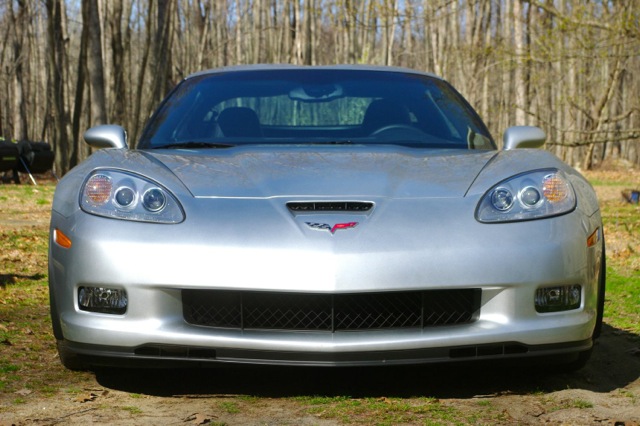
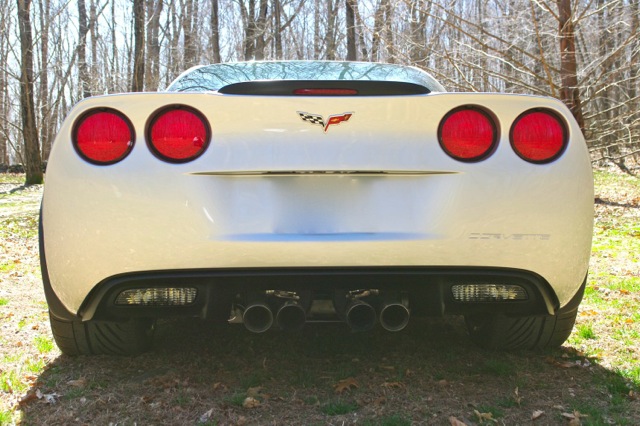
Once upon a time there was the Chevette, but there was, at the same time, the Corvette. Verily I say unto you the day came where there was the Aveo, and yet over there, in a different part of the lot, was the Corvette. You see what I’m saying? It’s an auto manufacturer yin and yang thing; a wild phenomena that stretches the whole balance-of-opposites concept to extreme proportions. On one side of the spectrum resides a rental mule, the other has arguably one of the sharpest sports coupes in the world that can run with the best exotica out there. I mention this because even during its best moments of controlled moto-mayhem, there are still times when you’re in a Corvette and you sense the presence of Chevrolet. What I mean to say is during such moments you feel, albeit briefly, you’re in a vehicle that is a bit less exotic and polished than one might expect for a $70K plus price tag. 

Vette_f

It’s OK, though, because such moments vanish quickly (like reflector markers on the side of the road) and to be honest it’s all part of the Vette’s unique charm. The car (in Grand Sport trim) has a wonderfully vocal and respectfully strong LS3 6-liter V8 that is as much a treat to listen to as it is to open up on an empty stretch of curvy tarmac. The engine audio was especially tasty because the Vette I enjoyed had the optional Dual-Mode exhaust that boosts horsepower to 436 and does both the Basso Burble and Banshee Blast with equal vigor. There are more powerful variants of the engine available in more extreme Corvette models of course, but I found this mill (in concert with a very sharp 6-speed manual) to be a fine fit for the chassis as a whole. It’s a balance thing, and involves everything working in harmony to get you down the road with great dispatch. 

Vette_e

This of course is a segue to what makes a sporting automobile worth its salt, which is the handling. Anybody can drop an enormous engine under the bonnet and go like stink in a straight line, but it’s the process of straightening a challenging serpentine road that separates the muggles from the wizards. The Corvette has a very unique chassis, including composite body panels, a hydroformed steel frame with aluminum and magnesium structural and chassis components and the use of composite leaf springs (both fore and aft) to gobble up bumps. This is a really unusual way to suspend the car, and the single leaf at each end is incredibly feathery in mass and transversely mounted so low it nearly scrapes the pavement. The Z16 Performance Package includes stiffer springs and stabilizer bars, specially-tuned shock absorbers, larger brakes with six-piston front and four-piston rear cross-drilled rotors and high-performance AA-traction rated tires. This package also includes extra cooling for the engine, and a Z16-specific six-speed manual (when ordered with six-speed manual transmission).

Vette_c

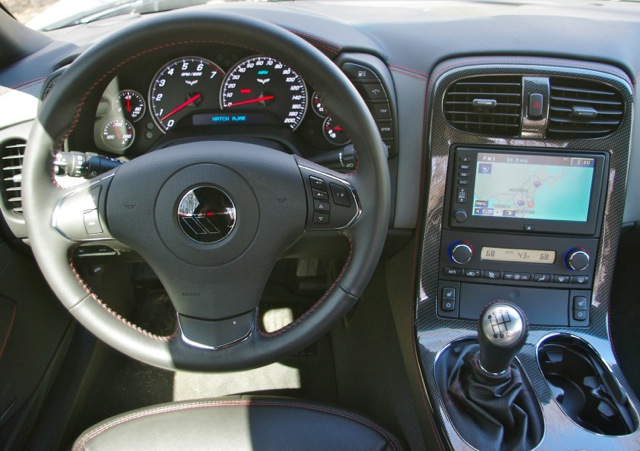
But wait: there’s more suspension goodness. The Magnetic Selective Ride Control option dumps all kind of black-box magic into the soup, including “magneto-rheological dampers able to detect road surfaces, and adjust the damping rates to those surfaces almost instantly for optimal ride control.” There’s Tour and Sport settings but I never messed with them as suspension response was just fine, thank you, and the sophisticated (and adjustable) Active Handling traction control lets you have a bit a tail-sliding fun but does a great job of keeping you going where you’re pointed. Pointing the Corvette is one of motoring’s great pleasures, too, as the steering feel and response is perfect for this package and is an integral part of why the car is such an entertaining ride. The Vette gets more comfortable the harder you push it (at least at the pace I ran which wasn’t near its limits-this is the street after all), and the finely molded sport seats both cradle and comfort your person whether you’re hustling or just cruising along. Some controls (like the turn-signal-mounted cruise buttons and a counterintuitive radio/NAV interface) are annoying and very Chevy-centric, which goes back to that yin/yang thing I mentioned earlier. But hey, that’s all part of the Corvette experience and there’s something strangely nostalgic about this kind of dated hardware. This GM icon is and always has been kind of special, and at its core is a seriously competent sports car that can really get your blood pumping at a pace that only a few serious road machines can achieve. The car is continuing to grow and evolve, sure, but it has managed to maintain the essence of what after all is a very entertaining beast; unique to the American performance ethos and a truly singular driving experience. Some things, it must be said, do age rather well. 

Vette_b

Should you Kiss the SKY?

Mazda_3i_touring

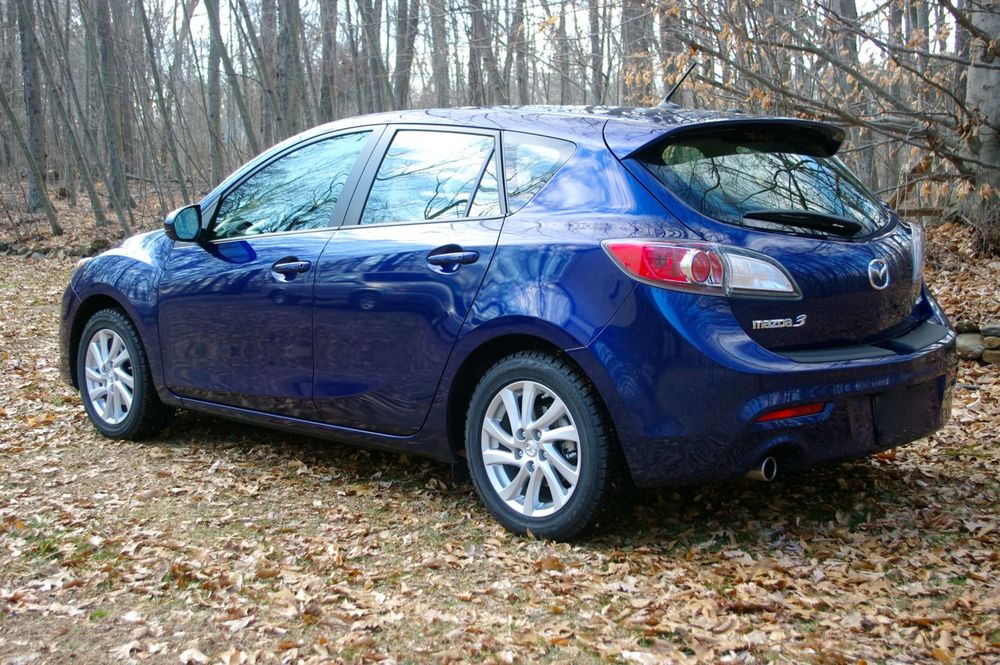
One of the things I’ve always liked about Mazda is even in a highly competitive arena where designs so often mimic what’s been selling best (and is one of the reasons so many modern autos look alike), they manage to maintain their own identity. This doesn’t always translate to sales success in every genre, and as such we have the recent decision to discontinue the RX-8 (which bums me out. I really loved that unique, rotary-powered coupe). But overall Mazda is producing some excellent, unique cars and SUVs that are a success in the marketplace, and in typical fashion the company is going its own way in tackling the challenges of finding ways to increase fuel economy while lowering emissions. They don’t make any hybrids these days (they did sell the Tribute Hybrid SUV, but that was a rebadged Ford Escape and is now discontinued), so they have decided to use a wide variety of other technologies together in a system they call SKYACTIV. I recently experienced this package in Mazda’s excellent 3i Touring 5-door and I have to say they’ve crafted a very frugal, affordable (yet fun to drive) compact at a very crucial time. 

Mazda3i_touring_int

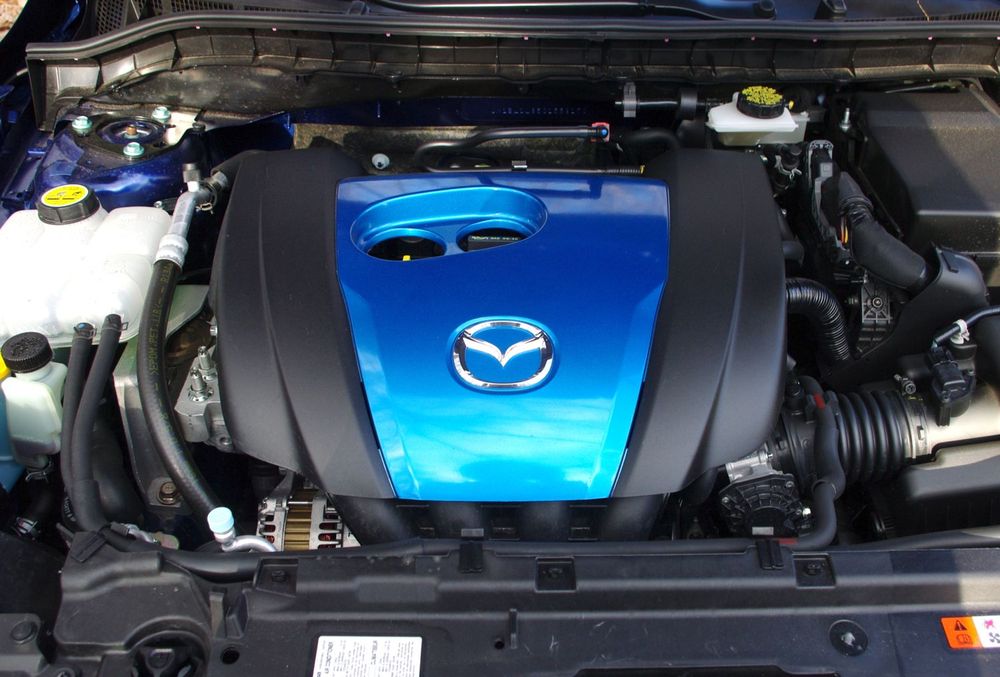
So what is this SKYACTIV strategy, anyway? In the 3i it includes the SKYACTIV-G 2-liter Inline Four, which is loaded with a variety of engine enhancements too numerous to catalogue here lest I meander into the tone of a shop manual. But let it be understood all these wonders are ultimately aimed at increasing efficiency,  yet the engineering (including a lofty 12.0:1 compression ratio) also results in a respectable 155 horsepower and 135 lb-ft of torque. Then there’s the transmission, or rather a choice of two 6-speed gearboxes: the SKYACTIV-MT manual and SKYACTIV-Drive AT automatic. Although the automatic has slightly better EPA numbers (odd, that, but it’s not that unheard of these days), getting 28/39 against the manual’s 27/38, the manual I zoom-zoomed with was an excellent fit and great fun to drive. Like the automatic, there’s a lot of modifications to earn the SKYACTIV name and help squeeze every mile out of a tank of gas. 

Mazda3i_skyactiv

So, I mentioned fun to drive so does that mean that there’s no tradeoff in pursuing the best mileage possible? It’s no powerhouse, but it’s no slug, either. Should I refer to it as a powerslug? That sounds derogatory. I regularly arrived at 60 MPH in around nine seconds, which is perfectly decent considering the fuel economy numbers that go with it. Shifting action with the manual is light and sure, but be advised the higher ratios are tuned to max out frugality so you’ll need to drop a few cogs to blast around slow traffic on hills. The steering is hella-quick and the suspension strikes a great balance between compliance and stability. Like all the Mazda3 family, it’s just an excellent all ’round compact chassis. The company likes to call a balanced response to acceleration, braking and handling transitions as Toitsukan, and it’s a design philosophy that’s put to good use in this car. 

Mazda3i_rear

So, you think we’re done with all this SKYACTIV ACTIVITY? You are in error. Even the body gets the SKY treatment, and they definitely leave no stone unturned. From Mazda’s press release: 

 “Aerodynamics plays heavily to a vehicle’s carbon footprint, and improved aerodynamic performance yields greater fuel economy and further reduces CO2 emissions while also contributing to handling stability. With this in mind, the front bumper design was optimized, as were underbody parts, to more effectively streamline the flow of air traveling beneath the floor. The shape of the lower sections of the front bumper’s sides were redesigned to protrude forward and the fins beneath were made larger. This adjustment effectively distributes the flow of air hitting the engine compartment and the front tire deflector, suppressing turbulence in cooling the
engine as well as along the sides of the body. Other aerodynamic aids that further streamline airflow throughout and around the vehicle include: a larger, smoother engine cover (on models equipped with the SKYACTIV-G 2.0-liter engine); increasing the floor under-covers by approximately 10 percent and eliminating vertical grooves for a smoother design; increasing the rigidity of the front tire deflectors to prevent deformation and establish a good balance between brake cooling, aerodynamic performance and handling stability; and an added clamshell shaped silencer to sit on angle with the road surface.”

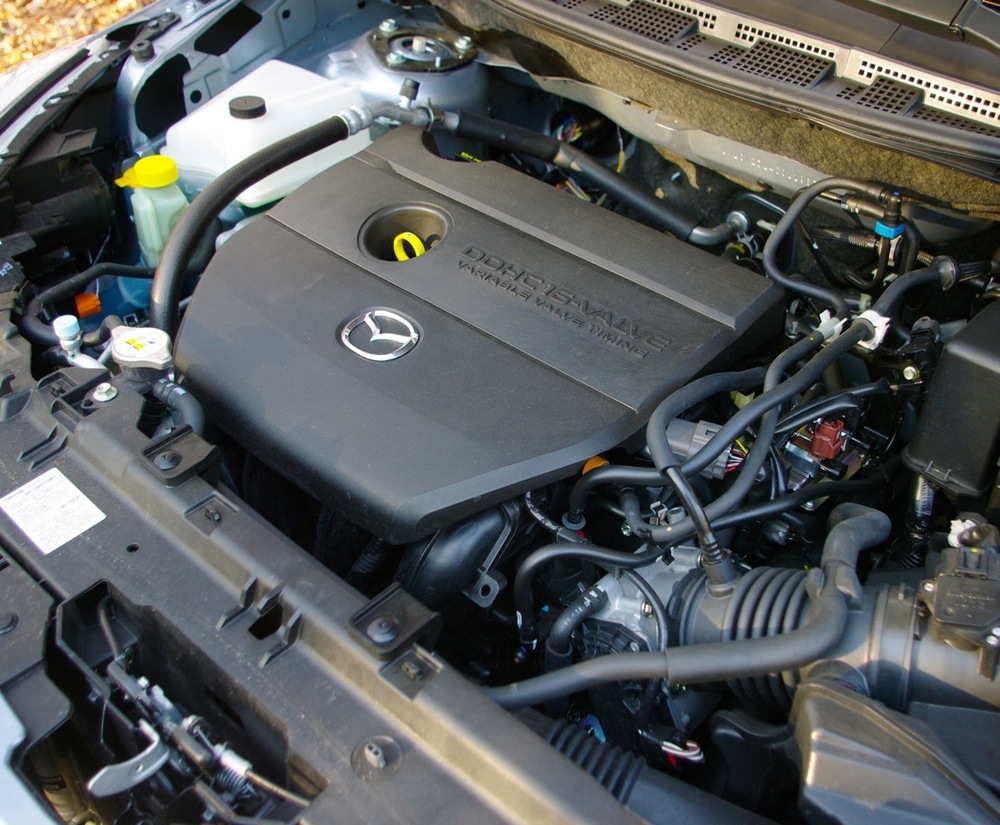
Yup, even the engine cover is part of the magic. How did they do, by the way? I averaged 33.7 MPG in a lot of aggressive mixed driving, so I think they did a fine job. The fuel efficiency has increased and the car is still a great driver. Like so many other outstanding fuel misers out there, hybrid and non hybrid and diesel alike, the SKYACTIV Mazda is a genuine “smart” car. As the price of fuel shoots up there are more good choices than ever to help driver’s cope, especially if you need a car with some room in it. Good times? Why not? Efficiency is always a good idea, whether it saves you money or not.  

The V in the Prii

Prius_v_a

The Toyota Prius has been a pretty amazing automobile, what with the fact that it has delivered superb gas mileage, low emissions, and excellent reliability for well over a decade all over the globe. Interestingly, it has also been a target for people who apparently hate the idea of superb gas mileage, low emissions and excellent reliability. Either that, or they’re just a certain type of individual who apparently ties their man/womanhood to the size of their carbon footprint, ultimately making the quantity of the resources they consume and the waste they spew an expression of their “rugged individualism.” You know the type. They’d be laughable, if not for the fact that their lifestyle choice has a negative impact on pretty much everything around them. They also like to ridicule people who try to be responsible, and accuse them of being smug and arrogant. Some green types may indeed be a tad self-righteous, but in my experience they are a miniscule minority and even these people are ultimately doing something of benefit for everybody (even their detractors). Waste and inefficiency are things to be avoided, and why this is somehow controversial is more of a measure of sociopathic neurosis than a desire to advance some sort of rational “alternative” strategies.

Prius_v_int

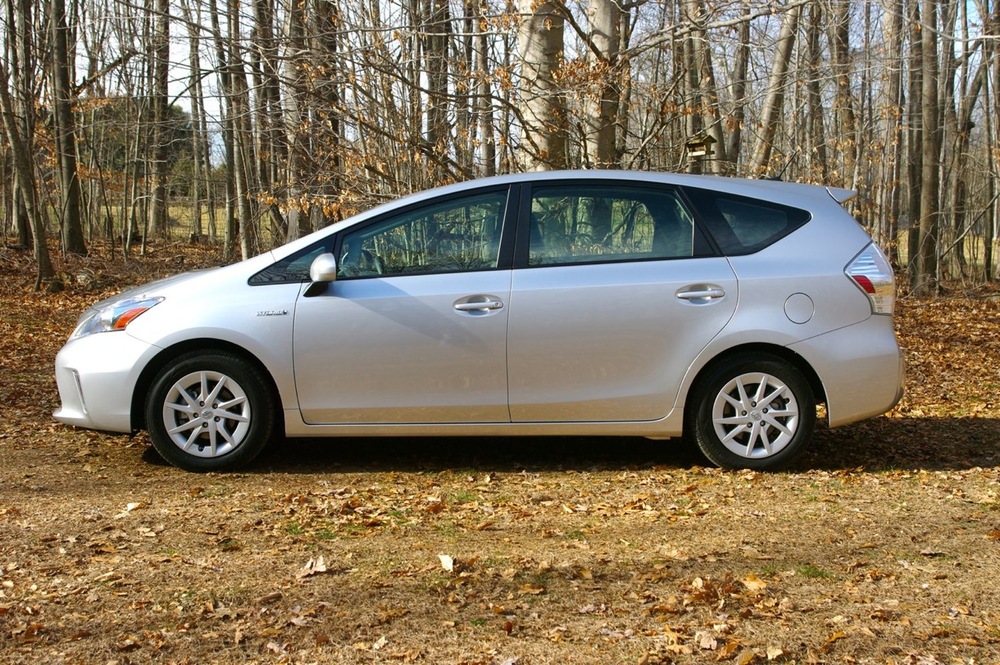
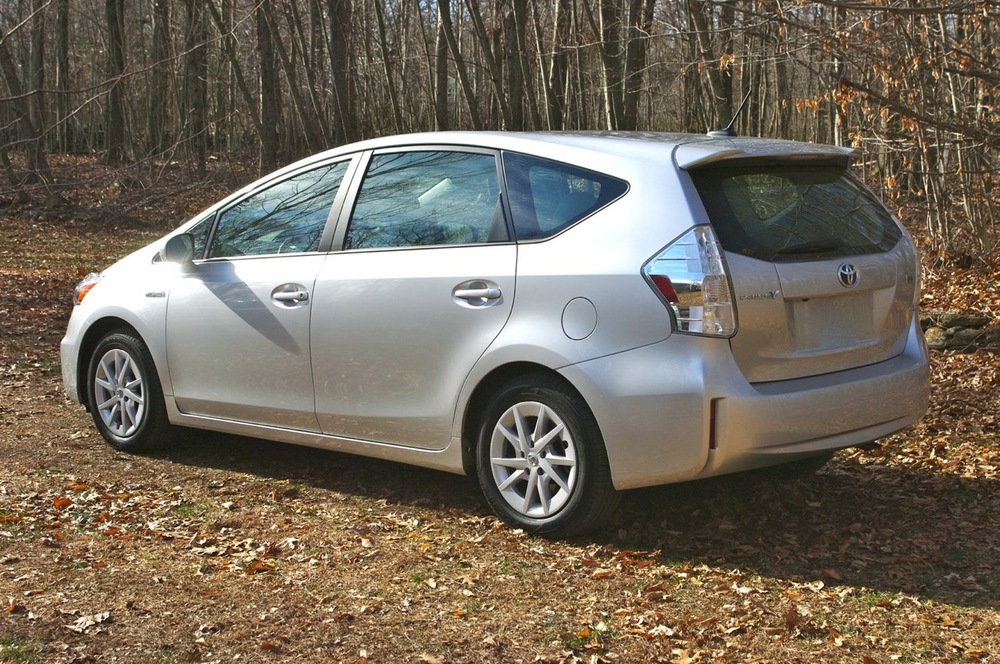
But the conflicted sociology of the pros and cons of environmentally conscious living is another topic for another time, as this entry aims to welcome the latest member of the ever-growing Prius family to the market. The Prius v is a wagon version of the 3rd generation Prius 5-door hatchback sedan, and it’s not just a modification of the body to include a bigger cargo area but also a substantial makeover of the chassis to accommodate this new capacity. Allow me to quote from the Book Of The New Prii: “Because the Prius v is a larger vehicle more likely to carry loads and passengers, front and rear suspension components have been redesigned to improve handling and ride quality. Front coil-over spring and damper capacities have been significantly increased and a new upper support has been designed. The steering gear has been attached to the front suspension member, and the stabilizer bar repositioned for more responsive steering feel and enhanced ride comfort.”

This reengineering also includes what the company calls Pitch and Bounce Control that, “uses the torque of the hybrid motor to enhance ride comfort and control. The system, working with wheel-speed sensors and in tune with the suspension, helps suppress bounce and toss motions to improve comfort for occupants. Because it helps control the balance and posture of the vehicle as a whole, it also functions to improve handling response.”

Prius_v_b

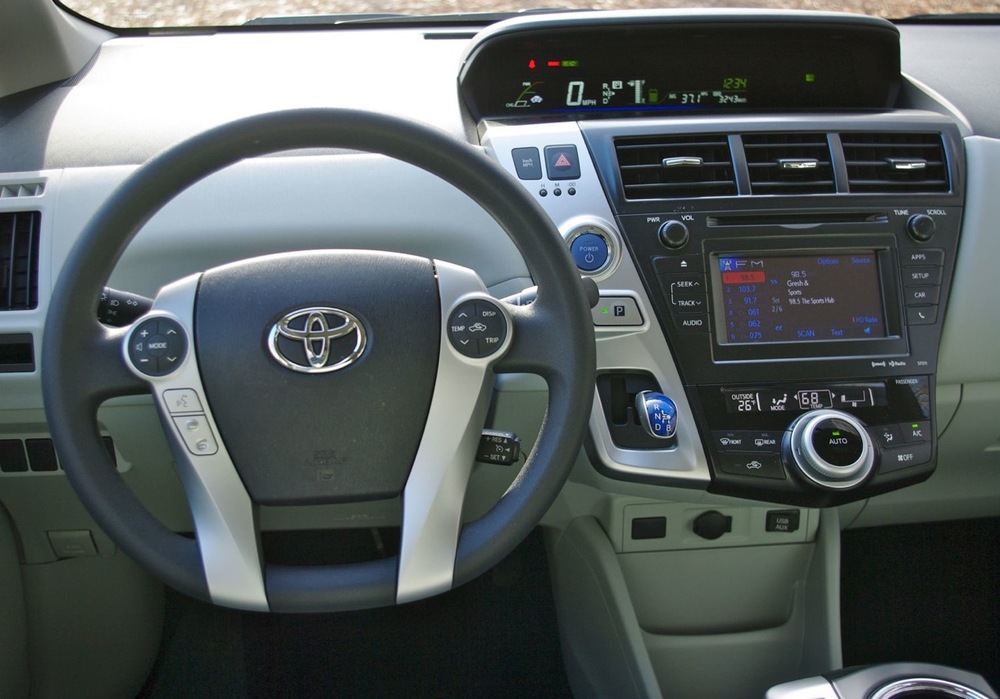
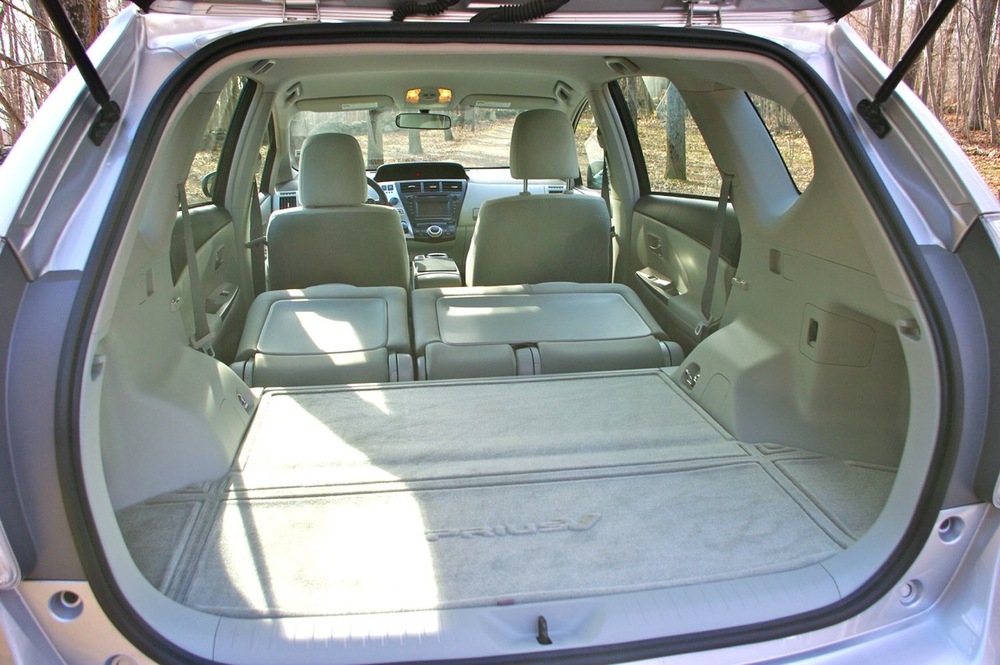
Neat, huh? Does it work? Hell if I know. I will say the car feels great to drive, very solid, planted, and steering is responsive and tight. The car doesn’t really feel bigger than a regular Prius, but it does feel more substantial even though I never had a problem with the structural solidarity of any Prius (and in the interests of full disclosure I should point out we own a 2008 model). The new v is indeed a roomy thing, with abundant rear seat passenger room and when you fold forward the seatbacks cargo capacity swells to 67.3 cubic feet. Even with the seat deployed you have 34.3 cubic feet of luggage-swallowing capacity, making this new bus a great choice for road trips.

Prius_v_engine

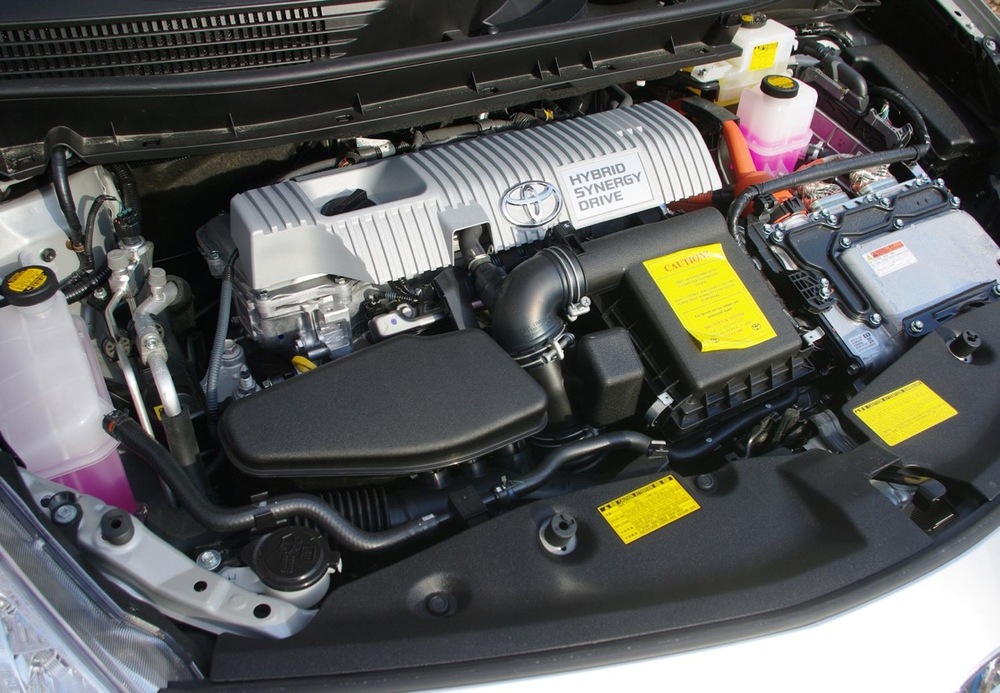
As for the performance of the Hybrid Synergy Drive, it’s basically the same drivetrain as in the current Prius sedan and has a total system horsepower rating of 134. This four-mode propulsion unit (Normal, Sport, Eco and EV) got me to 60 MPH in about 10.8 seconds in the Normal setting, so it’s no McLaren but it can merge with traffic just fine. There’s a lot of very cool technology in this system, including the ability to run further and at higher speeds on electric-only power compared with previous generations. The battery pack is still a nickel-metal-hydride unit as opposed to lithium-ion, and I’m totally in approval of this decision as these batteries have proved pretty bulletproof in this application. I still think the lithiums are a tad unperfected (although they’re certainly getting there); therefore by choosing the more-proven battery technology Toyota is insuring excellent reliability and long component life.

Speaking of which, this latest generation 1.8-liter Atkinson Cycle gas engine has no belts to replace (even the water pump is electric), further lowering the Prius v’s maintenance requirements. In concert with the electric motor, the EPA ratings are 44 MPG city/40 highway and I’ve been getting in the low 40s in mixed winter driving. I think that’s excellent, especially considering in cold weather absolutely everything gets lousier mileage than when the mercury is in the higher realms of the thermometer. That said, it should be noted that Toyota has imbued the Prius drivetrain with many clever tricks (like really innovative Exhaust Gas Recirculation plumbing) to maintain engine heat and therefore minimize cold weather mileage deterioration.

Prius_v_rear

The mileage is also great considering how much space the v is packing, which is pretty substantial. I’ll be really interested in how the wagon sells, as I think it could easily become really popular especially with growing families, musicians, sales people, tradesmen, and especially musicians, sales people and tradesmen with growing families. Our well-equipped Three model (which included Navigation and Toyota’s new Entune infotainment interface) had a sticker of $28,150. As the wagon-master said to his caravan: “Hybrids. . . Ho!”

A Pad for the Pony

Ipad_posterous

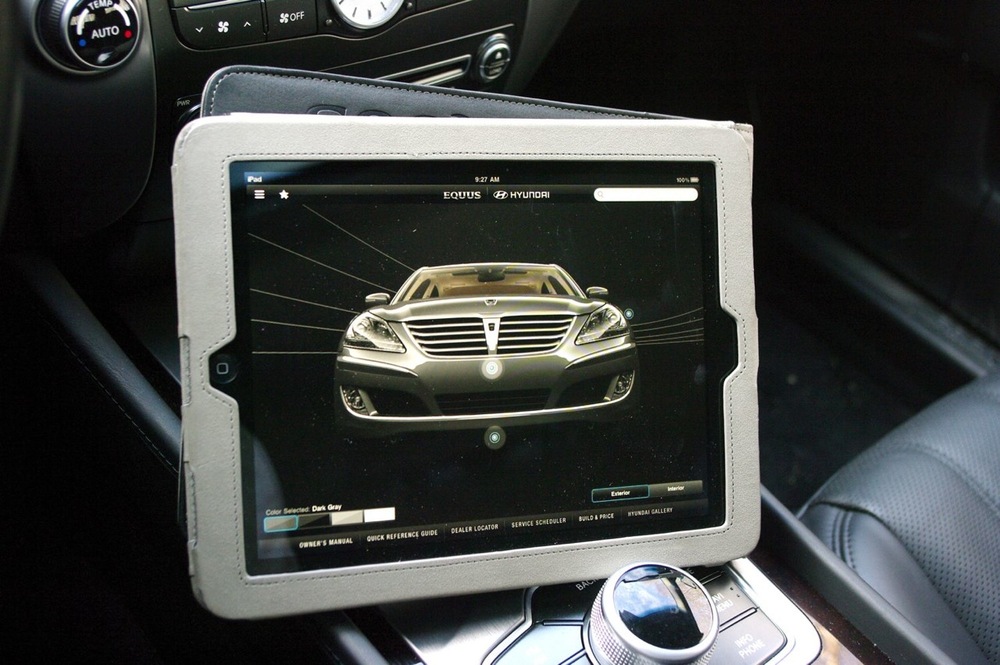
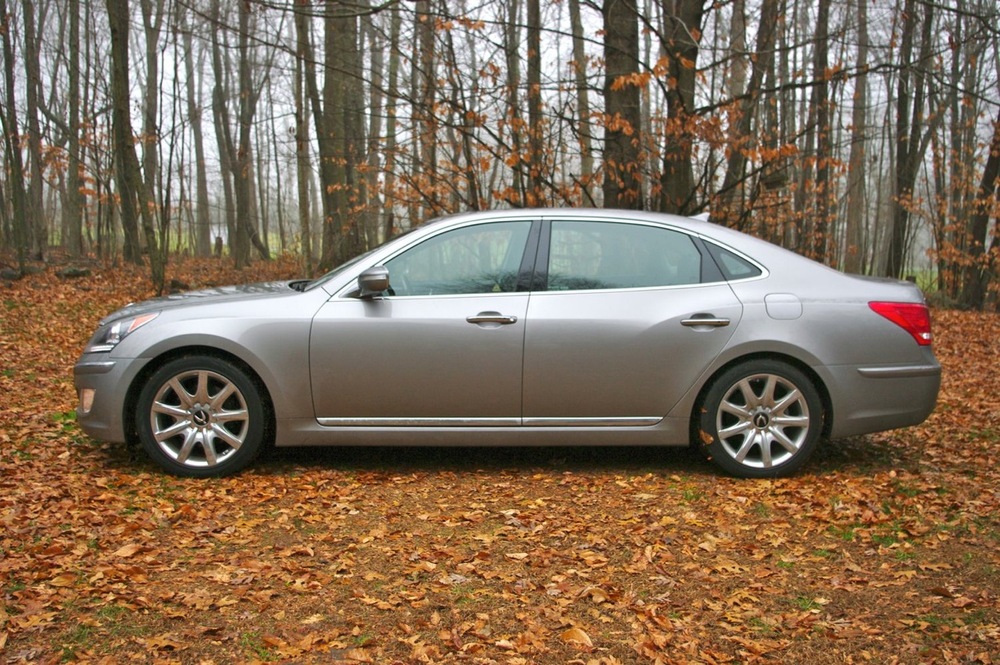
As I think so much of the new touchscreen integration (and voice, for that matter) popping up on new cars is more shite than Shinola, when I do encounter what I consider to be good use of the technology I need to deliver the appropriate kudos. The Hyundai Equus is a very nice full-size, especially in terms of its inclusion in a very upscale genre of cars for thousands of less than the competition. In addition to a regular owner’s manual (which are getting pretty enormous these days, thanks to all the new technology don’t cha know), there’s also an iPad that comes with the car and it’s wrapped in a handsome leather case. This is in addition to the Equus itself, which is kind of like an enormous iPad enclosure you can drive coast-to-coast in extreme comfort. The contents of the owner’s manual is also found here, along with some other goodies like features and benefits (with great 3-D style graphics) and other proprietary materials.

Equus_int

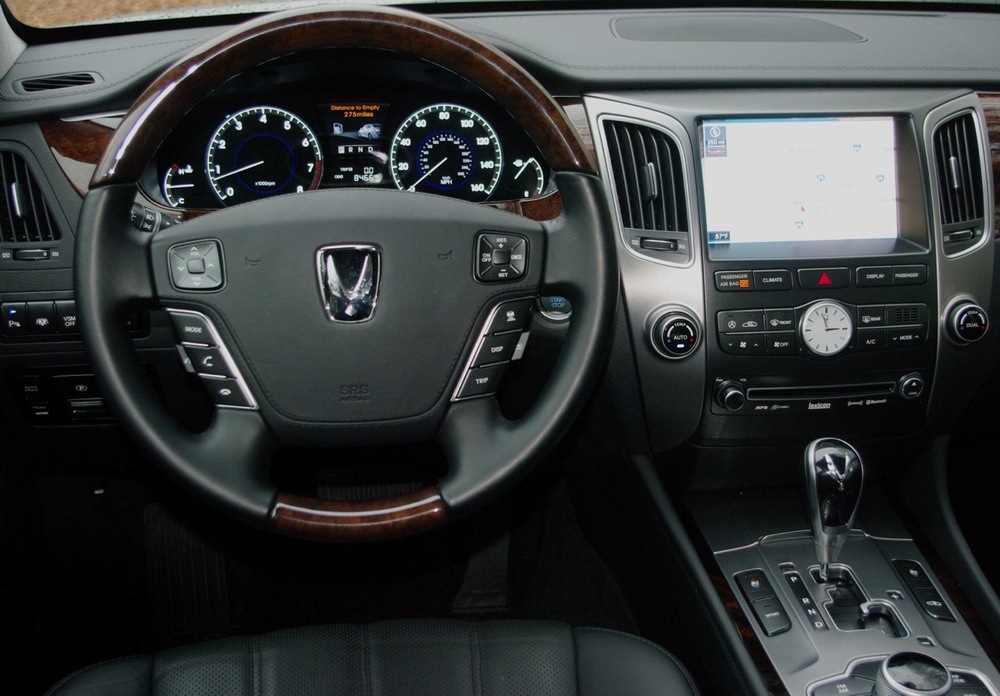
Anyway, this is brilliant use of the device, and it is a pleasure to use. It makes great, logical sense to put this information in this format, although you will have to charge it on occasion. As for so many of the other touch screens on the latest autos? Not so much. The rest of the Equus is much more reasonable in this regard (with more conventional controls and interfaces that work better, all though voice recognition stuff is available). Nice job, Hyundai.

Equus_ext

Wheels for a Celebrity Hedgehog

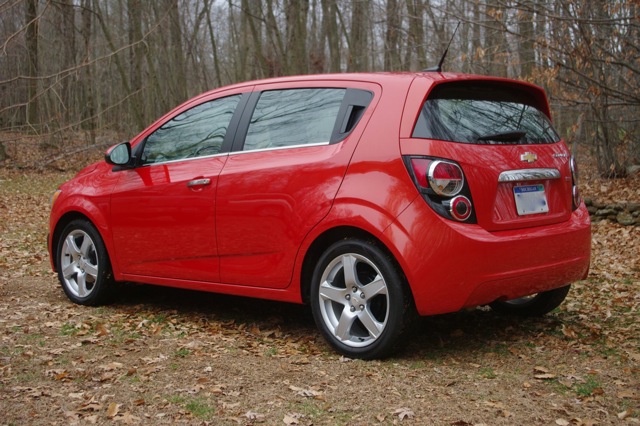
12_sonic_copy

In recent years, GM has had great success with their larger passenger vehicle offerings such as SUVs and pickups. But the subcompact class has been less than solid for the company, largely because the competition has had much better machinery that made the likes of the Chevy Aveo look a bit lacking. Feeble, in fact. Craptacular, some said. OK, that was me. But the esteemed folks at Consumer Reports in their review of the car listed only one high point: turning circle. Sad, really.

So when I heard that GM is replacing the Chevy Aveo with the all-new Sonic, I was curious but not really all that optimistic. I mean, these were the guys that gave us things like the Chevette, Monza, Sprint, etc. and they have been on less than a hot streak when it comes to things without a truck frame underneath. But Dayum, the new Chevy Sonic turned out to be a bit of all right, as they say. Somebody does say that, right? Maybe that’s just Austin Powers. Sad, really.

12_sonic_int_copy

But the Sonic does not bring sadness, or at least the one I sampled didn’t. The 5-door turned out to be my entertaining Inferno Orange friend while I drove it semi-aggressively for a week, and I really liked the little hedgehog (I have now officially finished with the Sega reference, by the way. It has run its course. You’re welcome). There are a couple of reasons why I like GMs new very small car, and one has to do with its overall driving dynamics. It’s a nice, taut package that handles well and is a lot of fun hustling around tight backroads. In this regard it’s much like the Ford Focus, although I liked it more than I liked the 2012 Focus (or the 2011 Fiesta for that matter). It just made me happier, as if every drive was a fiesta, and it somehow seemed a bit more focused.
(Sorry. Couldn’t resist. I know, I should have).

12_sonic_engine_copy

The engine is a real corker in that it revs really cleanly to its 6,500 RPM redline, and as I tested the turbo model it’s important to note something about the boost the engine gets from this tiny turbine. Observe ye specifications of the two engines available for the Sonic: Normally aspirated 1.8-liter Inline Four, 138 horsepower and 125 lb.-ft. of torque. The 1.4-liter Turbo, 138 horsepower, 148 lb.-ft. of torque. Interesting, no? The main advantage the smaller-displacement turbo gives is increased torque, so is this maybe some strange, invisible homage to diesel engine lovers, who constantly claim torque is everything?

Well, no.

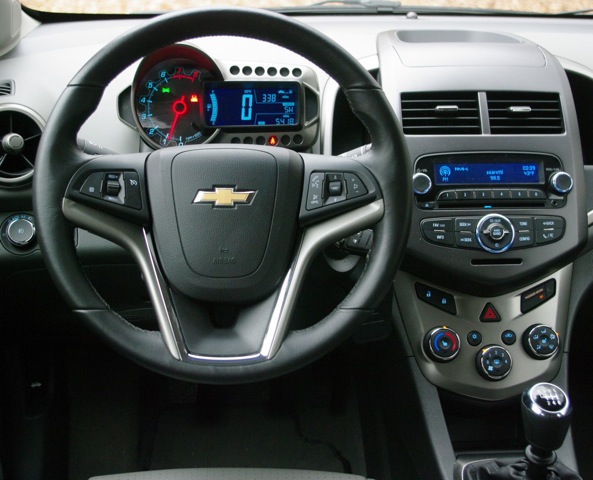
But it does make for some sporty response from the little mill, which is accented by a very nice 6-speed manual transmission. Good suspension compliance and that great wheel-at-every-corner architecture that makes so many subcompacts a blast to flick around are things that you can grow to love (especially if you’ve never experienced them before in such an entry-level car). And speaking of its eco status, the Sonic LTZ had a lot of very cool kit on it, including “leatherette” seating surfaces that are much like leather and they were heated, too, which is always a cool thing. Yes, warm is cool, sometimes. The wee auto is full of little amenities like that, and unfortunately some other things like GM’s goofy interface for the trip computer that requires you twist a ring on the turn signal stalk to go through the menu. It’s awkward, man. This little car deserves better.

12_sonic_rear

The five-door hatchback configuration is still one of the most versatile ones around, and rear seat room is pretty decent and if you fold the 80/20 seatbacks forward you boost cargo capacity to 30.7 cubic feet. Some econobox woes remain, like a fair amount of wind and road noise and no back up camera (which would be very useful as rearward visibility is poorish). Also, even though the car is EPA rated 29 MPG city/40 highway I only managed 28 MPG in mixed driving. True, it was cold, and winter, and these things tend to knock the crap out of mileage no matter what you’re driving (even hybrids and electrics). But still, I did expect better.That said, this is a pretty nifty package overall and easily the most fun to drive of any GM subcompact in recent memory. I came away from the week we were together impressed, and if you’re digging around for a car in this class you should definitely take one for a spin. The MSRP of the nicely-equipped tester I hammered was a charming $18,890. B’bye, Aveo. Hello, Sonic. Things are looking up already in 2012.

Behold the Stealth Hybrid

Lac_a

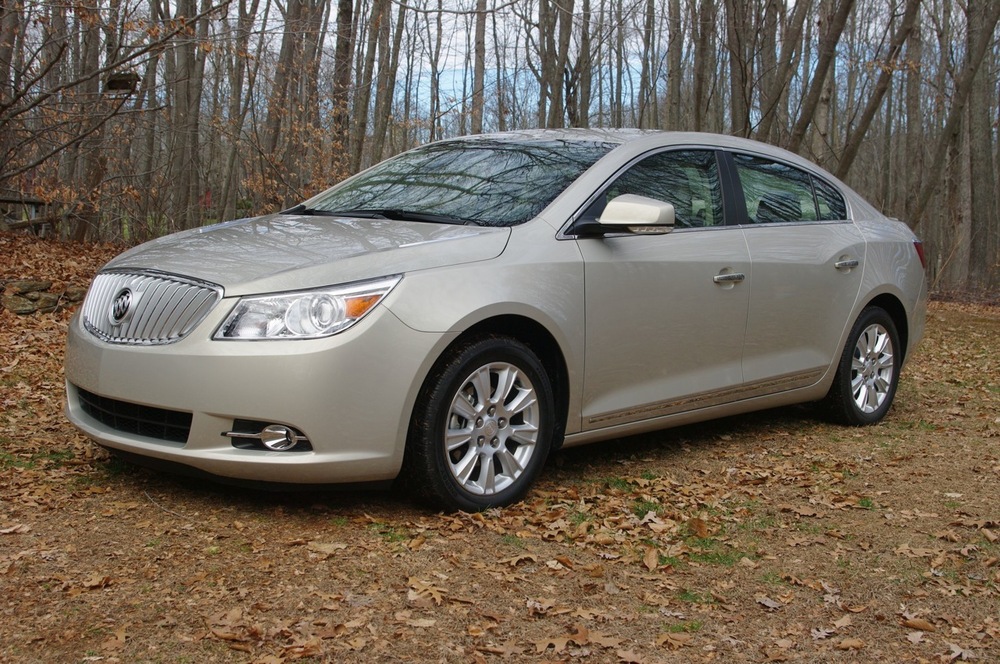
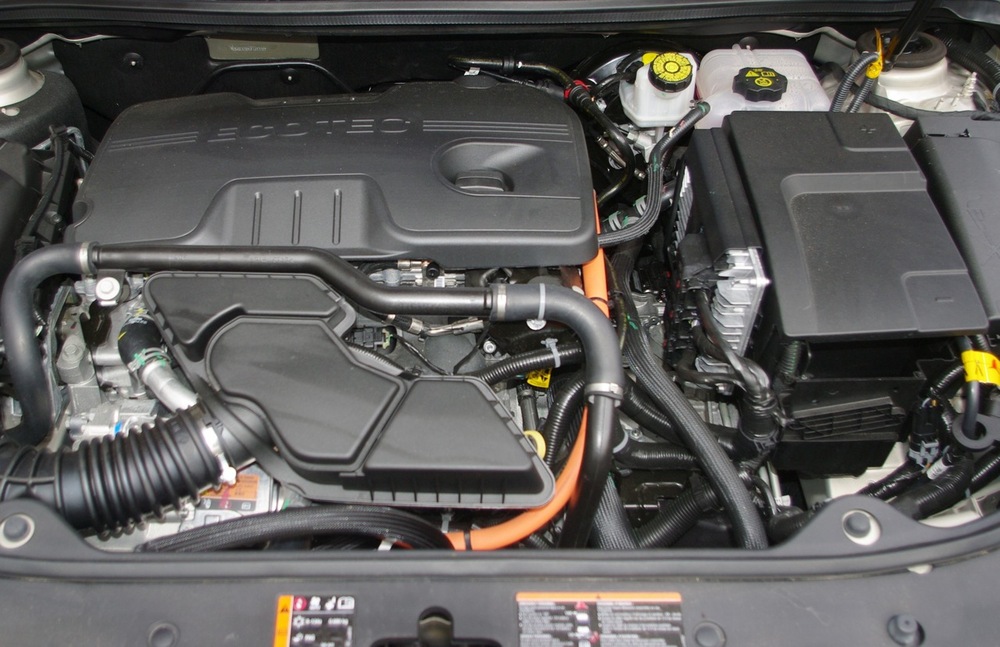
Well, I tells ya, you can never predict what the Minds of Marketing are thinking. Once you raise to the level of securing a huge contract like a major auto manufacturer you clearly know what you’re doing, so far be it from me to question their judgement. True, not every marketing plan works but my point is nothing like a new automobile goes on sale without a well-considered plan for its image. So the new Buick Lacrosse eAssist must surely have undergone careful scrutiny as to how GM wanted to promote its newest hybrid, and the decision they apparently made was to make the electrically-assisted powertrain almost invisible. I find this fascinating, because it’s a very sophisticated system and you’d think they’d want to advertise it all over the car. But, aside from a few instrument acknowledgments there’s nothing here to tell you there’s an electric motor powered by a 15 kW lithium-ion battery pack helping to boost fuel economy and lower emissions. Strange, that. But then again, there’s certainly nothing wrong with keeping a low profile I guess.

Lac_c

There’s a dandy engine stop feature that (when conditions allow it) shuts down the 182 horsepower 2.4-liter Inline Four at stops and then fires it back up immediately when you release the brakes. The electric motor can add as much as 15 horsepower during acceleration to boost performance, and I managed to get to 60 MPH in an average of around ten seconds. Other than a bit of weirdness on occasion from the 6-speed automatic transmission when coasting to a stop, all hybrid transitions are very smooth which help keep the presence of all that additional e-juju a secret.

Lac_b

The big car (they call it a midsize, but there’s tons of room in them there back seats) handles well and gone is the floaty Love Boat wallowing behavior of Buicks past. Overall the driving experience is quite pleasant, and you get the kind of pampering the nameplate is famous for, along with some very comfortable seating. The EPA fuel economy numbers are 25 MPG city, 36 highway but I only managed a mixed averaged of about 27.4 MPG. Not bad at all for a sedan like this, but not game-changing either. But the bottom line here is I enjoyed my week with the car a lot, and overall thought it was a pretty solid piece. Loaded with goodies like a Navigation System, our sticker came to $36,685.

Lacrosse_dash_b

Roomy Enough For Santa’s Sack

M5_a

There is something flawed with the male ego in that so much of it gets tied up in the perception of how their associates (and the world at large) interprets their manhood. For this reason they obsess over a car’s appearance and image-enhancement capabilities, regardless of whether or not said transport makes sense for them from a practical standpoint. This is a shame on many fronts, because getting the right vehicle for your real-world needs can be a beautiful thing, all while providing a satisfying companion for your day-to-day transportation chores.

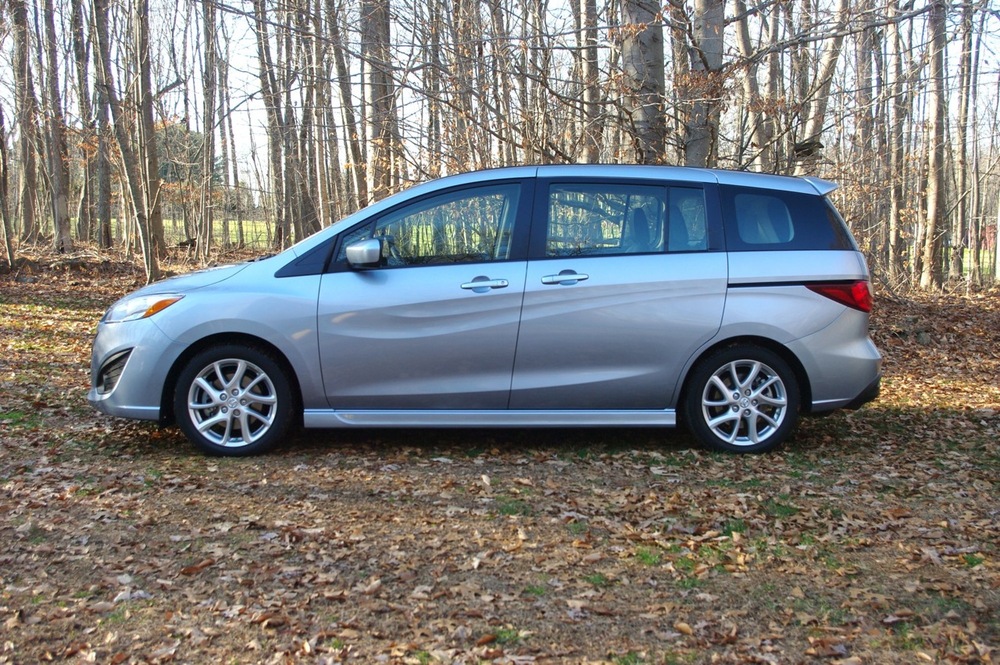
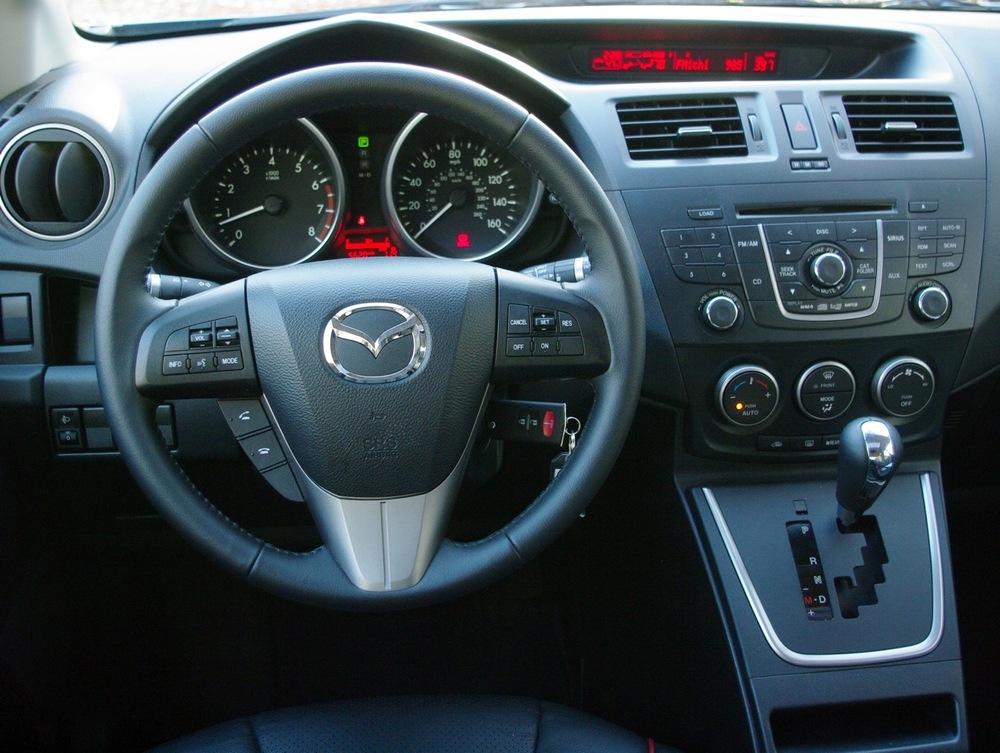
I say all this because minivans are routinely being trashed by individuals who don’t appreciate their utility, versatility and unique persona. I’m not saying anybody has to like anything, nor do I claim to be a champion for van-based motoring that the masses seem too dim to appreciate. I just hate to see something being excluded purely for reasons of perceived image. Minivans are rockin’ good vehicles for moving surprising amounts of people and kit, and can be a veritable base camp on wheels for when you need it. And here we have (as I mentioned on this fine forum a year or two ago) a true mini-minivan in the Mazda5 that is brilliantly useful and surprisingly affordable.

M5_c

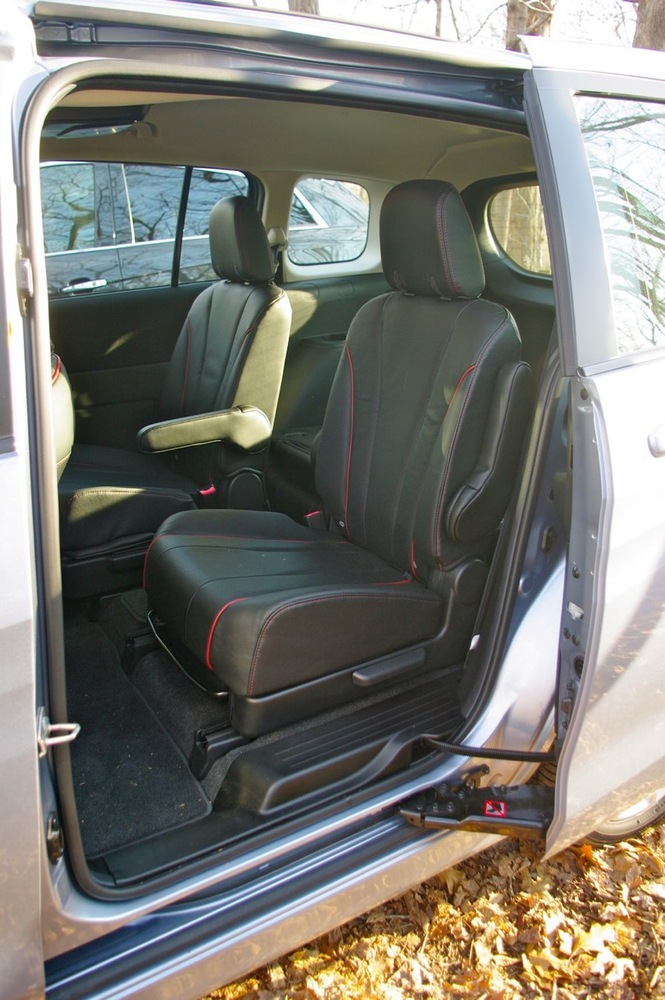
This clever busette is not only a genuine study in efficient interior space utilization, it is really easy to live with even in urban environments. A tight exterior makes parking a simple affair even in a smaller garages, and a sliding door on each side makes access to the second and third row seats a breeze regardless of which side of the road you park on. The third row is kind of tight but certainly serviceable for munchkins and pets, and these seats easily fold flat into the floor to open up the cargo area (44 cubic feet worth of space with the 3rd folded; expanding to 97 with the 2nd row folded. That’s nearly enough room for a lame reindeer).  Seat comfort is good and my test mule had heated leather-trimmed seats up front that were much appreciated in these winter months. Our second row featured Captains Chairs, while the third had the 50/50 third row seats. 

M5_e

The engine is new for 2012; a smooth-idling 2.5-liter Inline Four with 157 horsepower mated to a 5-speed automatic gearbox. As you might surmise this is no drag racer, but it gets the 5 around fine as long as you’re not climbing grades with a load of Sumos (and in return, it’s very stingy in the fuel consumption department). Features and storage are generous, including numerous cubbies and an unusually deep glove box.

M5_b

There is room for a lot in this modestly-sized vehicle, but despite it’s clear mission of hauling efficiently it’s actually a lot of fun to drive. Steering is light, and it’s no RX-8 but it can be entertaining once you learn its tendencies. And check this out: the Grand Touring model we enjoyed had the optional rear-seat DVD Entertainment System and we still had a sticker that was barely over $26K. This is with an already very nicely-equipped trim level, which included Automatic Climate Control and a very serviceable standard audio system. Of course, the big thing about this little minivan is how they’ve built so much room in such a small package. EPA numbers are 21 MPG city/28 highway, which are pretty great when you consider how much caboodle you can cram in the sucker. Real Men, and Real Women, appreciate such things.

M5_d