Bianco Perta, Baby

500_a

Everybody in the USA of a certain age (don’t you just hate that phrase? What, you’ve never heard it before? You are soooo young) has a Fiat story from their youth. That is, they have one if they grew up in a car culture (like Texas or California or. . . ) and there were a wide variety of hand-me-down autos rumbling around when teenagers got their driver’s licenses, often as a rite of passage on their 16th birthday. Back when I was high-schooling in Texas, I encountered everything from Triumph Spitfires to badly beaten original VW Beetles, and yes, the occasional Fiat convertible was all part of the mix. But then the fleeting youth fled, and, a bit later, so did Fiat from the US market. It was the early 80s, and I had an odd soft spot for the Italian autos and then they vanished from these shores like a chef’s special off a menu. 

500_d_copy

Well, it took over two decades for the Italian marque to find its way back to the American market, and the complexities that surrounded the company’s recent history (and even not too recent history) is the stuff of business school lectures with state-of-the-art, 3-D H-D flow charts and freshly laundered sock puppets. What I’m trying to say here is, it really is a pretty convoluted legacy. But while I really can’t wade though all that history, I can tell you about the new Fiat auto that is just now becoming available here. Danged if I don’t quite like the little bambino, too. 

The first comparison you make with a car like the 500 Cabriolet is to place it against other sub-subcompacts, like the Mini Cooper and even the oh so minuscule Smart Car. The Fiat is similar to the Mini, but I was intrigued by how it seemed to be a whole ‘nother kettle of fish despite similar dimensions. It feels very different, and while it doesn’t have the “wheel at every corner” go-kart personality to the same extent the Mini does it is a blast to drive in tight quarters. The engine is no Mighty Thor but neither is it a Frail Wheezer, and here’s a shocker: my sampler was saddled with an automatic transmission and this extra-cost minus usually pushes small cars into lawn tractor status in terms of response. 

500_b

But not this time, though, for the six-speed unit works really well and is (yes, I may wear this term out in this discussion) a pleasant surprise. The suspension seems better suited for delivering a comfortable ride than either the Mini or Smart, and overall the car felt more solidly constructed than most of the microcars at this point in time (Scion’s iQ is poised to strike very, very soon, so we’ll see). It doesn’t quite carve up apexes like a Mini, but it feels more substantial to me which is a decent trade-off as it’s still a ball to toss around on a stretch of curvy blacktop. The convertible top is slick and clever, and basically is a retractable roof. Even with said roof open the 500 is reasonably quiet for a car in this class, which is all part of this whole refinement thing that turned out to be such a pleasant surprise. Mind you, this particular Cabriolet was packed with lots of optional classy bits including the Luxury Leather Package (heated leather seats and the like), but still the overall impression is of focused design and decent workmanship all through the car; even under the hood. 

500_c

Neat Stuff: the tachometer rides inside a circle that’s inside the bigger circle that is the speedometer, and it looks cool. This is far better than the Mini’s massive manhole-cover-in-the-middle-of-the-freakin’-dashboard speedo that has always bothered me. The rear seat can actually accommodate two humans, and although it’s tight to get into it is habitable. The exterior Pearl White Tri Coat paint (Bianco Perta in its native tongue) is lovely, and with the cool blue/white/red racing stripe makes for a very classy exterior.

500_e

And, the car is just plain fun. It definitely gets noticed if you’re into that sort of thing, but better yet it uses little fuel (I averaged 32 MPG) and if it proves to be OK in the reliability department might be a really good choice for those needing wheels in crowded urban environments. Oh, and it’s a pleasant surprise, just so you know. I wanted to make sure I got that across. Loaded with goodies, the price of admission was $26,050. Bon Appetito. 
The Hyundai That Howls

R-spec_a

I have a problem in that, until very recently, the first thing that would come into my tiny, tortured mind when I saw the word Genesis would be the movie Star Trek II: The Wrath of Kahn. Sad, really. Although, it should be said the film had its moments: “I’ve hurt you. And I wish to go on . . . hurting you.” Ah, Mr. Montalban, you were a unique treasure.

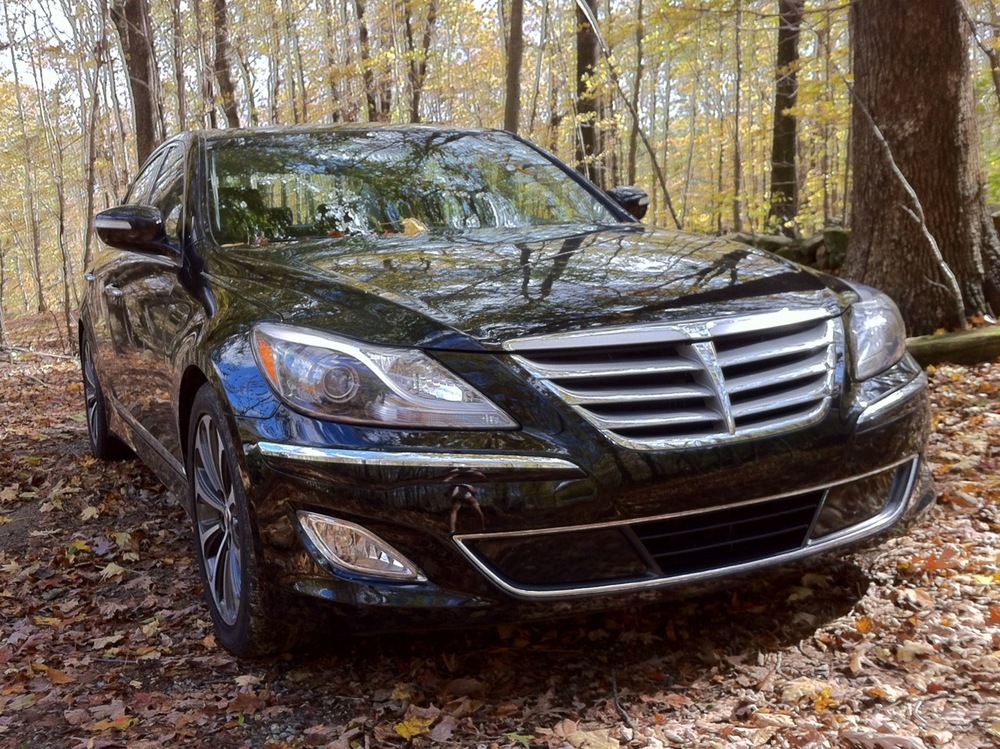
Anyway, in this flick Genesis was of course a really wild torpedo-shaped technological miracle device that could create a live planet from a dead one, or something like that. These days, when I see Genesis I think of a really nice sedan from Hyundai that goes after the cream of the luxury car market (like Lexus, Infiniti, Mercedes-Benz, etc.) by offering similar features at a much lower price. It’s a very nice effort, and a pleasure to drive even equipped with the standard V6 which is a very refined engine. A V8 can also be had, but really isn’t that big a step up merely because the V6 really is that good.
But, as you no doubt are aware, car companies can’t ever leave well enough alone. There have been Korean elves at work, and they have been laboring really hard on something really surprising, and ultimately very cool. No, it’s not a torpedo-shaped miracle device than can create a live planet from a dead one. At least, I don’t think it can.

R-spec_c

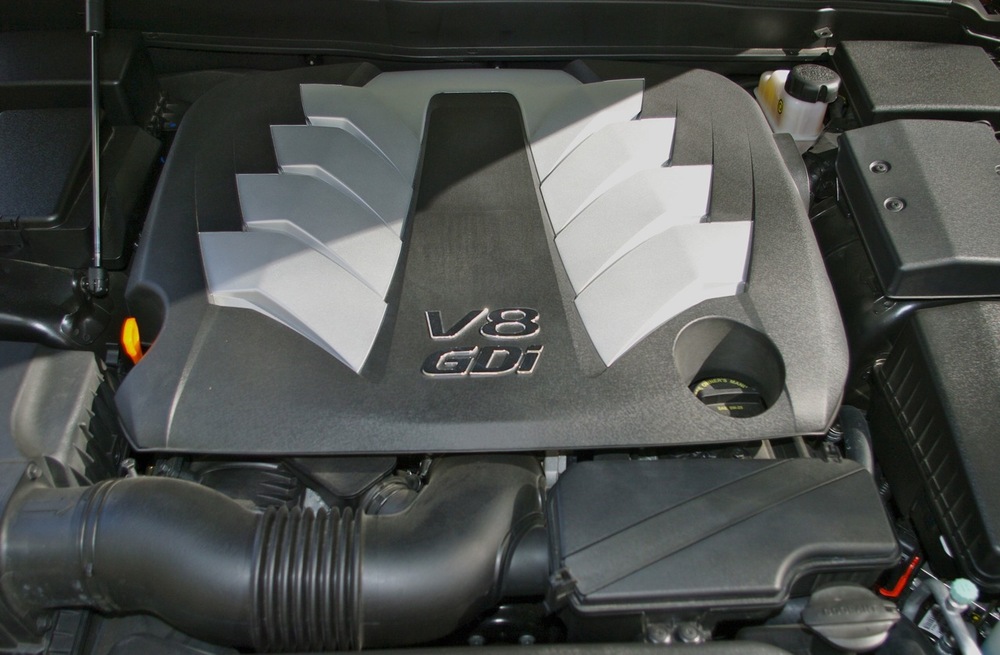
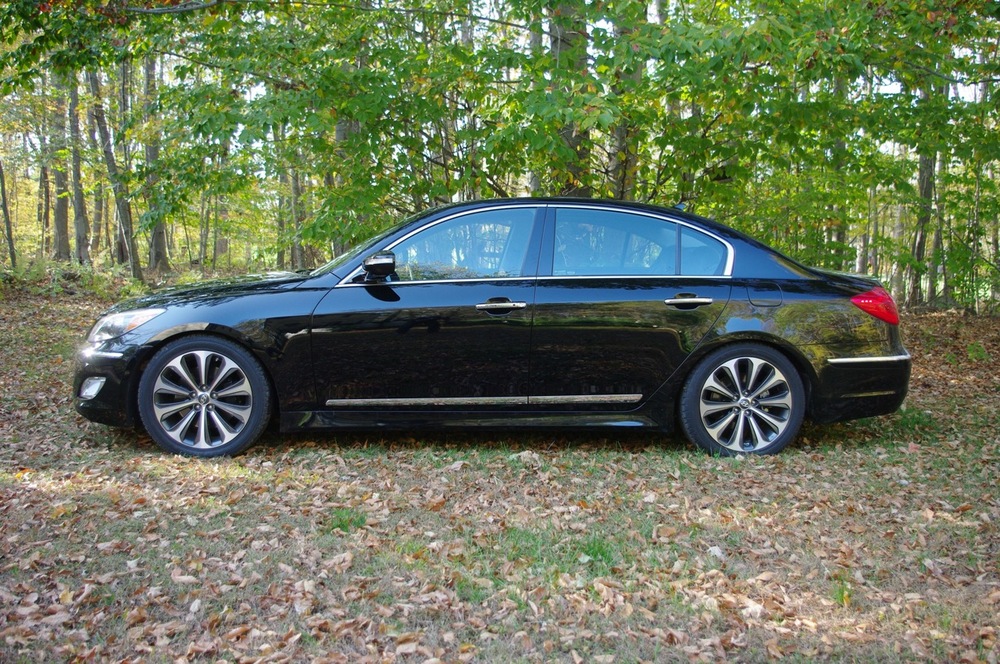
No, this creation is a sedan. As if it wasn’t enough that Hyundai built a very decent luxury ride in their Genesis; now these upstarts have really poked their robotic finger in the eye of the other guys by building a performance version of the car that they call the R-Spec. This beautifully understated machine is powered by a lovely 5-liter ‘Tau” V8 that generates a very respectable 429 horsepower. This veritable herd of hosses gets to the rear wheels via an 8-speed automatic with a Shiftronic manual mode, and I was able to regularly get 0-60 runs in the sub-6 second range (with commendable smoothness, I should add). Larger brakes and clever Sachs Amplitude Selective Damping shock absorbers help keep all things chassis in control, and while the ride is still pretty soft (and the steering is a tad too light for my tastes), control remains good when you exploit some of the muscle. The car feels solid and leans more towards ride quality than all-out cornering competence (or more on the Lexus side than in BMW’s neighborhood), but it’s definitely more athletic than the “ordinary” Genesis. Lovely summer 19” performance Bridgestone Potenza Pole Position rubber helps all ‘round, and managed to just avoid the first snow of the season when the R left my possession which means they are very clever indeed.

R-spec_d

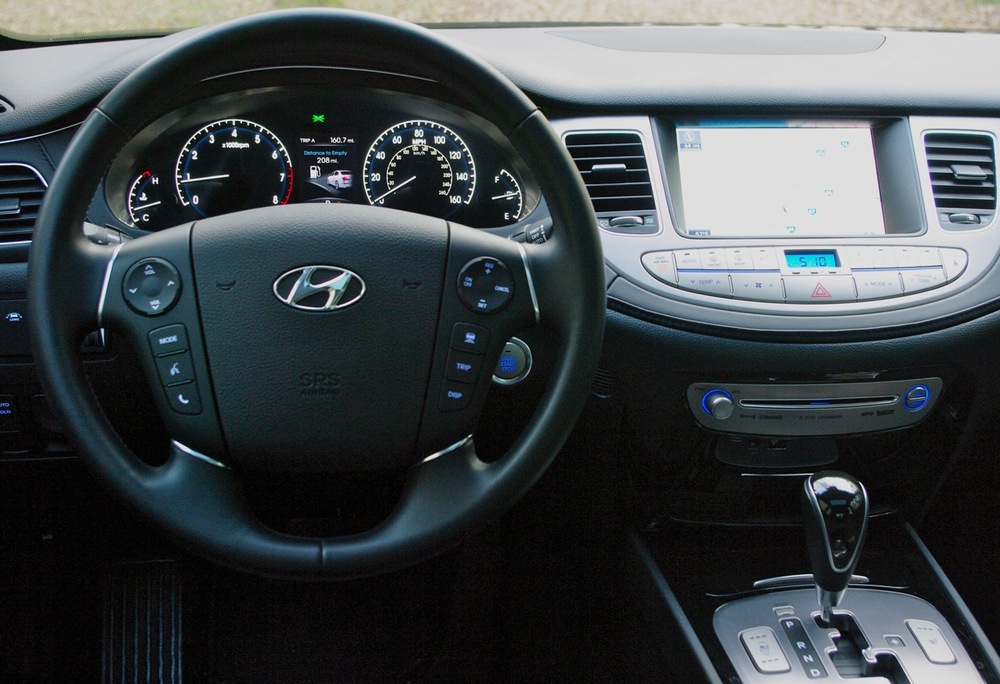
The interior is as brilliantly understated as the exterior, meaning it’s classy and well-finished without drawing undue attention to itself. All the latest bells and whistles are present (even one of those heinous control knobs similar to BMW’s iDrive or Audi’s MMI), but overall the controls are refreshingly logical and conventional. A great sound system, Smart cruise control, a Lane Departure Warning System and many of the latest tech is well represented, but again in an interior that is more conventional than many in this class these days and therefore (in my view) smarter.

R-spec_b

The R-Spec is also a bit of a screamer, what with nearly half a grand of horsepower under the superbly sculpted hood. It’s another case where (like the Boss 302 Mustang I talked about a week or two ago) the machine really turned out to be pretty much exactly what they, being the Hyundaites, wanted this car to be. It’s a very potent, pleasurable rocket ship that will pamper you and your passengers while undercutting a lot of the competition in terms of price. My guess is it will prove ideal for a lot of buyers, and that’s quite an achievement in a very demanding class of cars.

The Goose with Six Gears

Norge_c

There are a whole mess of touring motorcycles out there these days, which is in contrast to the recent past where there were just big tour rigs that were designed to comfortably to go coast to coast with a good deal of stuff, including a passenger. If you wanted a different kind of machine to take a huge trip like this you could certainly do it, but it typically meant buying a lot of aftermarket accessories and fashioning your own mile-muncher. Such rides are often brilliant, but in some cases they don’t exactly handle the way they should because they really aren’t designed to carry all this stuff long distances. Comfort can be a less than stellar as well, as many of these starting platforms are more focused at around-town putting (and in some cases designed more for style than over-the-road functionality).

Norge_d

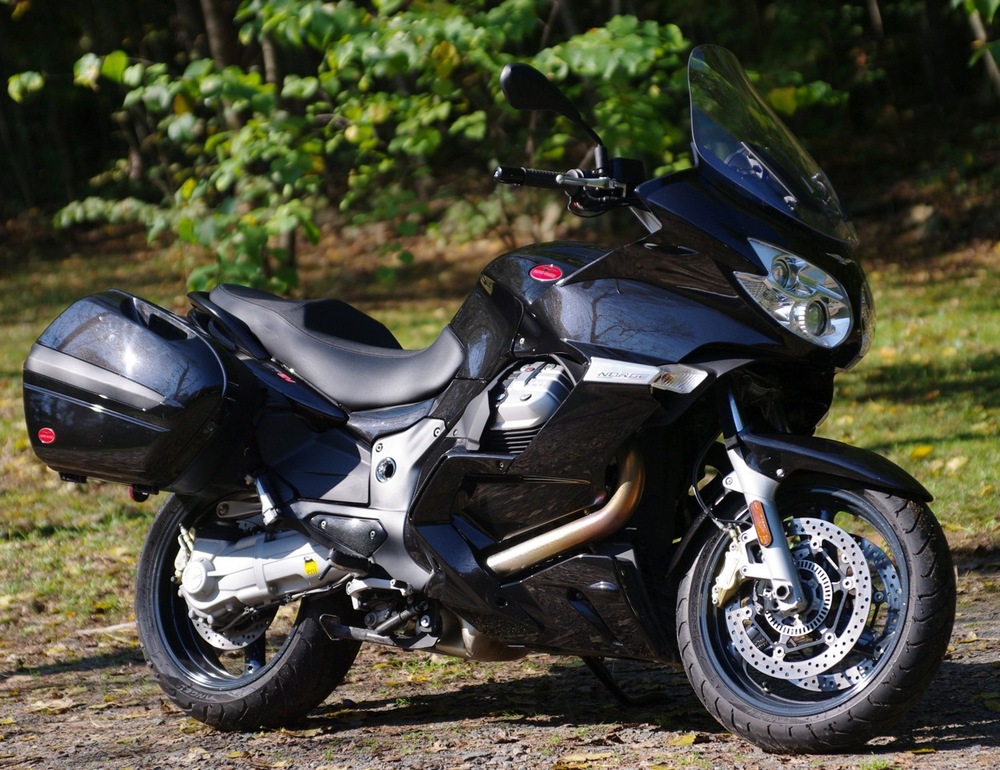
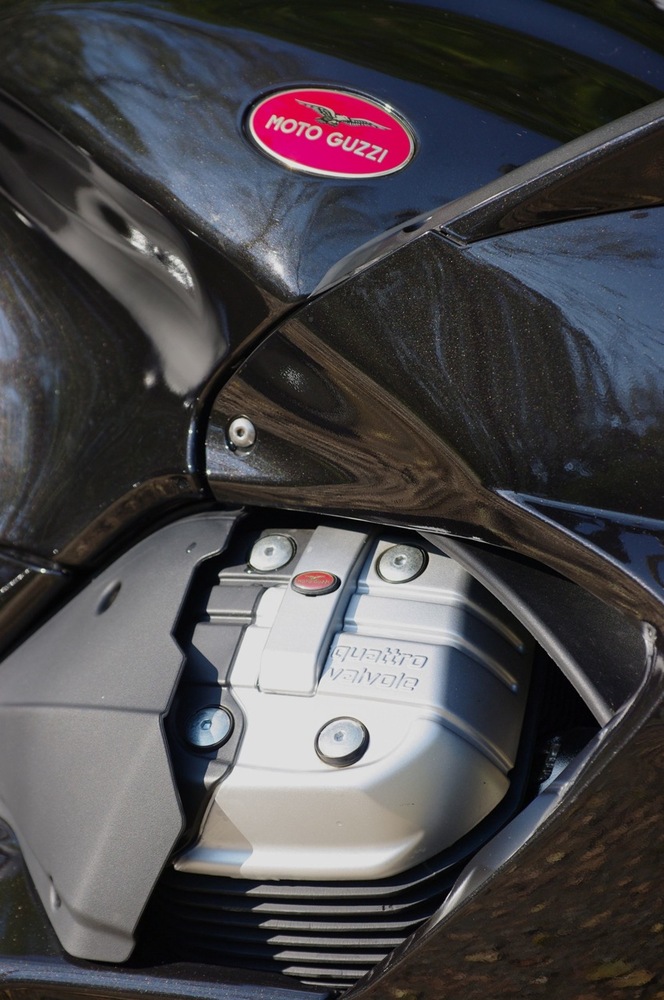
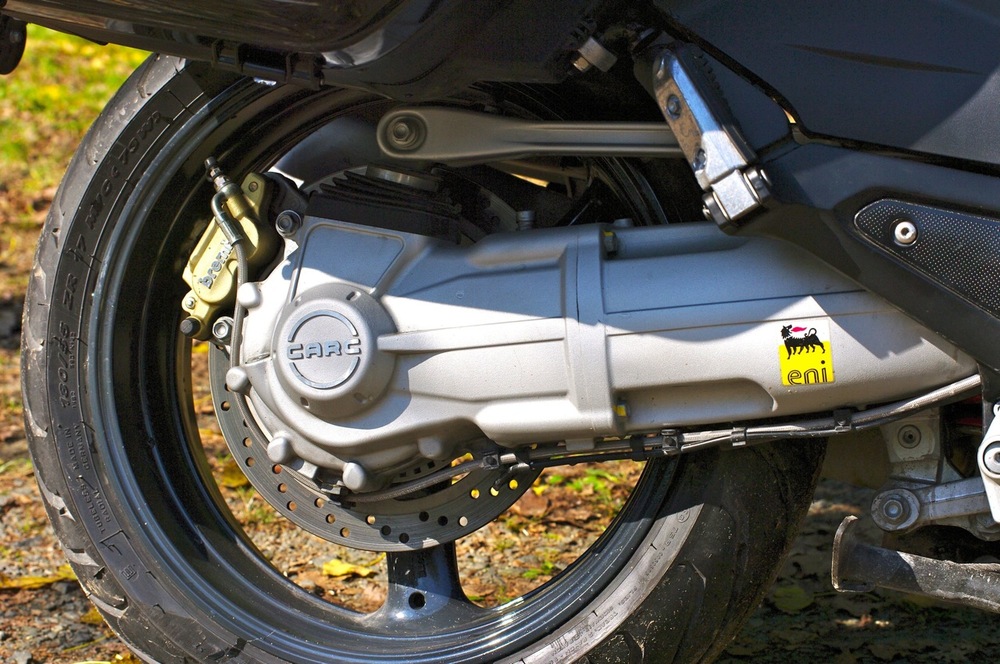
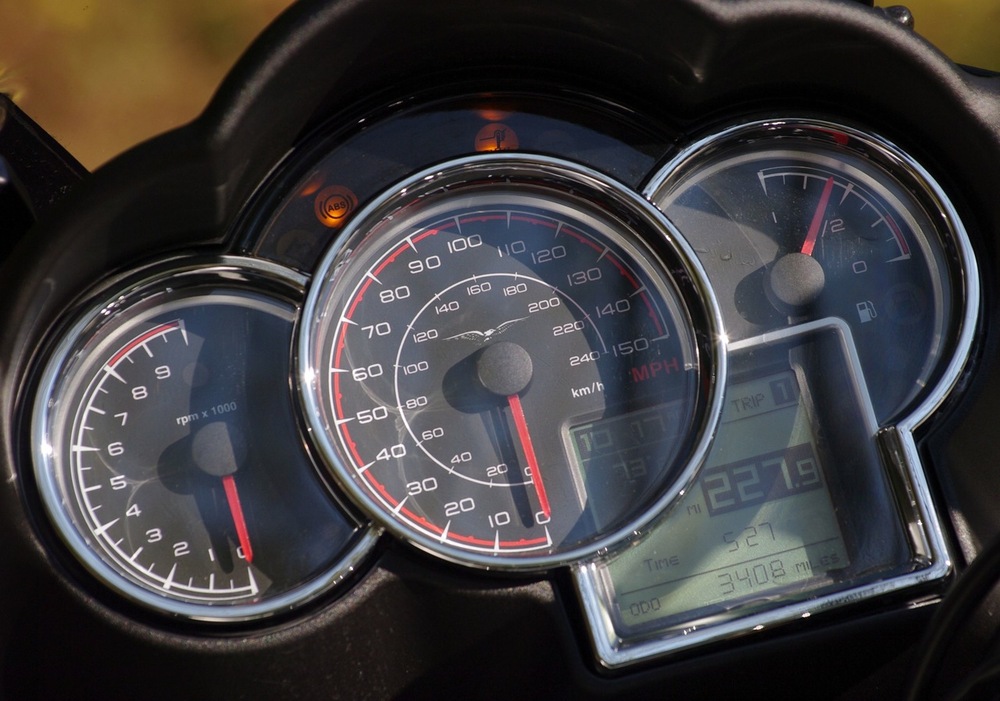
But now every genre of motorcycle has a turn-key touring version including cruising, standards, convertibles, and (my personal favorite) the sports tourer. Moto Guzzi has a good un’, too, in the form of the Norge GT 8V. This is a big touring bike that while not quite a full dresser, has big, detachable panniers that are easy to lock and secure (and capacious enough to swallow a full face helmet). The big 1200c air-cooled transverse 8-valve V-Twin has the familiar Guzzi “feel,” but is never annoying and has a generous supply of power in a broad, flat torque curve. The six-speed gearbox has good ratios to match the power output, and 70 MPH in top gear comes at a leisurely 4,000 RPM. The riding position of the 570 lb. (dry) bike is sporting in terms of the knee bend to the pegs but the bars and high and wide enough to make all-day riding comfortable. This comfort thing is enhanced by a really well-designed saddle (31.9 inch seat height; a lower seat is available as an option) and further helped by an easily adjustable rear shock that is perfectly suited for a sport touring rig such as this. Rough-road ride quality is superb, and the shock seems to hold its composure during aggressive cornering as well. The front forks are likewise sorted, and have preload adjusters on the the top of the stanchion as is standard practice these days. As it is basically a Guzzi trademark, there’s shaft final drive that uses sophisticated engineering to reduce “shaft effect” if you get ham-handed with the throttle. 

Norge_a

Cool things: standard heated grips and an electrically-adjustable windscreen, although on the latter the up and down buttons are located on different sides of the handlebar and a loooooong reach for your thumbs. The aforementioned hard saddlebags are very capacious and once you learn the drill are easy to deal with and seem very weatherproof. A stout side and centerstand are always the traveler’s friends as are the 6-gallon fuel capacity and decent fuel mileage (I saw around 42 MPG in fairly spirited riding). 

Norge_b

So all in all this is a pretty fine sport touring ride that has the size, power suspension and goodies to make long days on the road a pleasure, especially if your tastes lean towards taking the roads less traveled. Prices start at $15,990. www.motoguzzi-us.com

Norge_e

The New Boss is Hot

Boss_a
Well, it is a great thing when you get surprised by a pony. It’s especially satisfying when, instead of being a 9-year-old girl at a birthday party (and it’s a 1-horsepower horse), you’re old enough to have a driver’s license and the equine surprise is a Mustang with 444 ponies under the hood.  Ford’s new Boss 302 allowed me to channel my inner 9-year-old girl (a strange experience for a male of my advanced years), as I was both giddy and surprised because to be honest I’ve never been a hard-core pony car kind of guy. Oh, they’re fun, sure, and the latest crop of retro hosses are well done. Of the group I’ve preferred, in this order, the Challenger SRT8 (wonderfully over the top) the Mustang (something just seemed to be missing, somehow) and then the Camaro (too claustrophobic). 

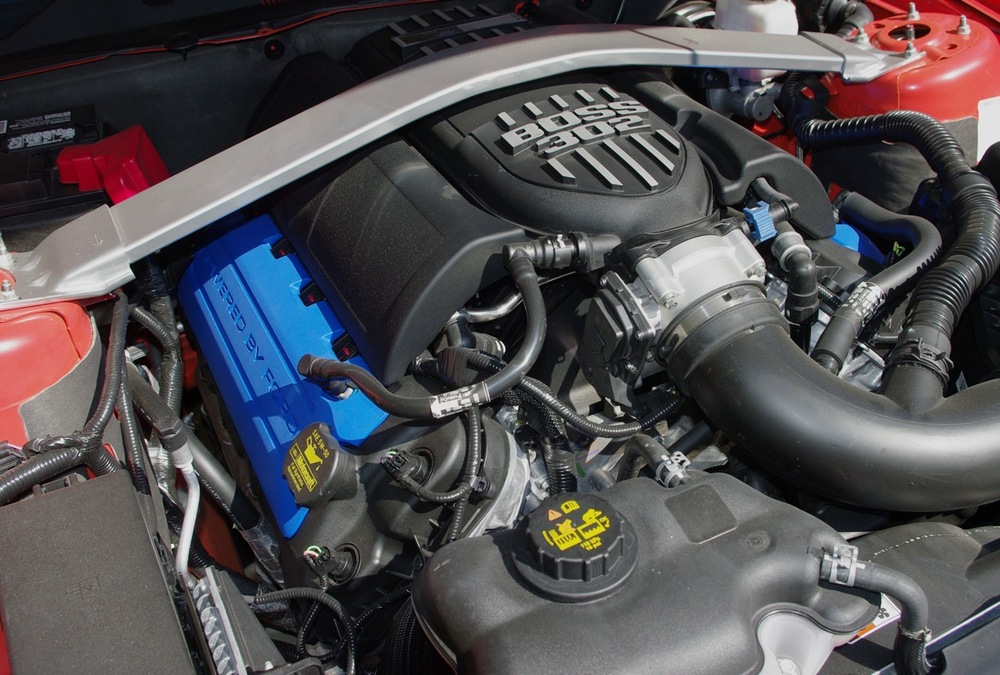
But Ford’s new 5-liter has altered this ranking, for it is one of those cars that they just got right from headlight to trunk and ends up being a wonderfully integrated, entertaining package. First there’s the engine, which has the right power curve, makes all the right noises, and, wonder of wonders, is even dressed properly out of the box to invite those who appreciate such mills to gaze upon it. True story: I guy approached me at the gas station and asked to if I would crack open the hood as he had to leave his beloved Mustang in Puerto Rico years ago and was homesick. These days I would be uncomfortable with such a request, as opening the hood on most cars reveals a sea of plastic shrouds that might cause the enthusiast to not only be disappointed, but sink into a deep depression. 

Boss_c

Not the might mill of the ol’ Boss 302, though. It looks great, with plenty of detail work and even the spring tower bridge strut is properly finished so as to welcome inspection. The Mustang fancier approved, and went into detail as about modifications he’d done to his car including fabricating his own spring tower strut years before it was a factory item. So kudos to Ford for sweating the details on this one. It actually should be an important part of the allure of a car like this, and they came through impressively.

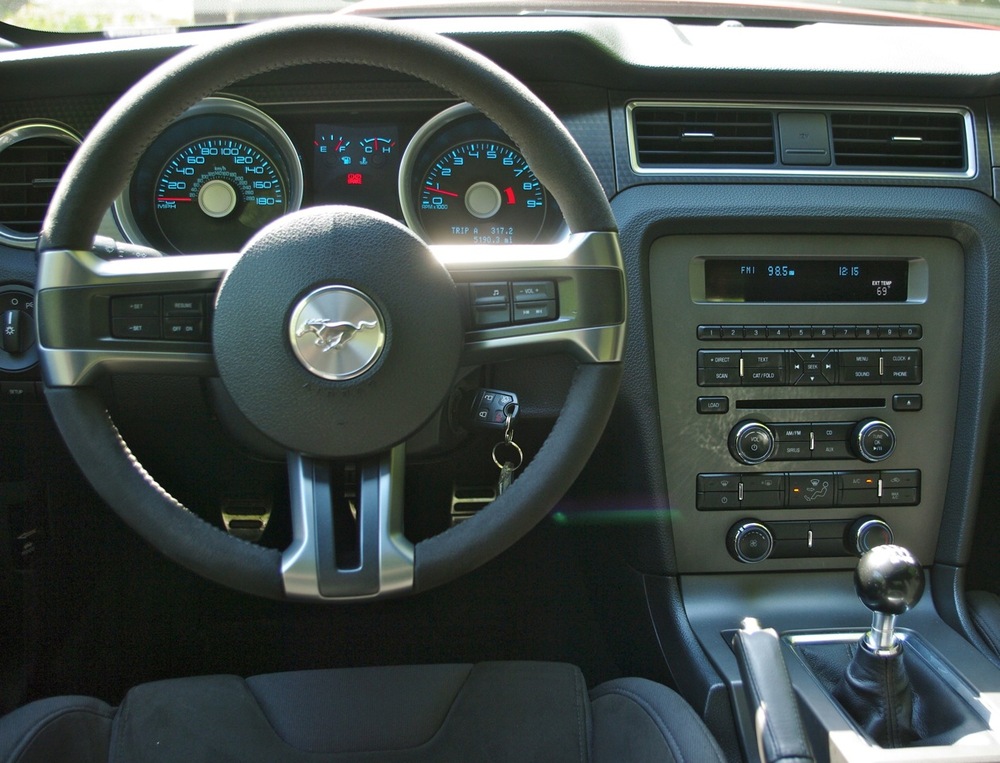
This attractive V8 is bolted to a really sharp 6-speed manual transmission, which whether called upon to cruise for burgers or play Bullitt turned out to be a true snickity-snick delight. Great ratios, nice shifter action, and a really well-balanced clutch. Perfect, really, except for the placement of cup holders just behind the shifter which cause ergonomic interference when occupied. Man, I seem to encounter this foible a lot on new cars, as if the interior designers forget that certain models actually come with manual transmissions. You don’t suppose some of these folks have never actually driven a car with a manual gearbox, do you? Nah . . .

 We continue our trip aft and find the same old funky live rear axle, which is still a straight non-independent beam of a thing (as if borrowed from an F150) that is not exactly stellar on bumpy corners but is as well-managed as such a design gets. All the suspension rates are spot-on for aggressive driving and manage to avoid beating you up on rough stuff, which is very cool. The car feels both balanced and solid, with its 3600+ lbs. pretty much negated by light, responsive steering (probably the best weighted electric-boost steering I’ve encountered, excepting the Honda S2000). Also most excellent are the Brembo brakes, which are easy to modulate and hauled the car down from 60 MPH in an average of 114.5 feet. That’s an excellent performance from any car, especially something like this that isn’t priced like an exotic. 

Boss_b
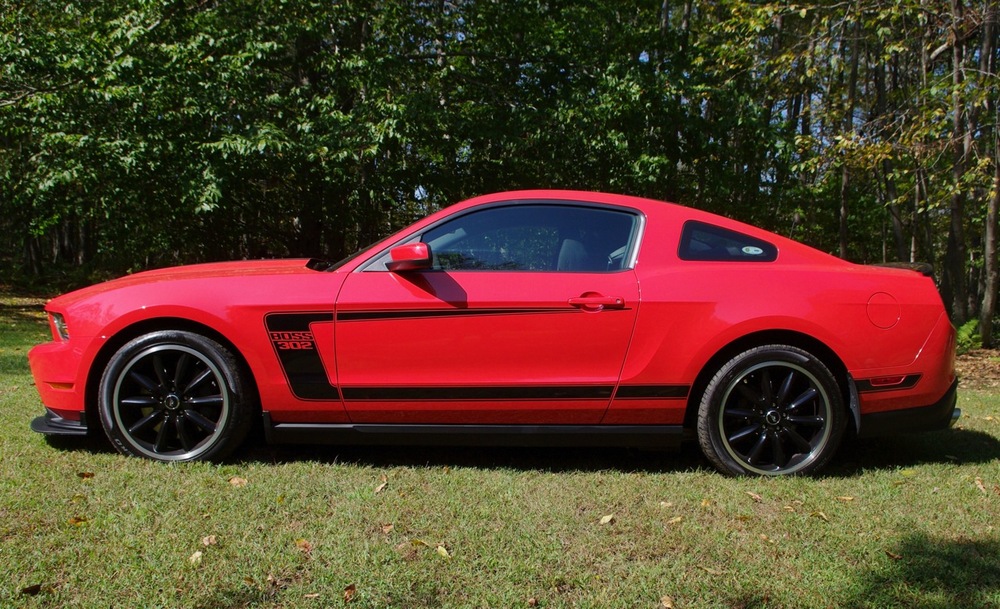
Other great parts choices include superb Recaro seats that are so typical for the brand in that they offer peerless support and comfort wrapped in attractive, durable style. They work better from an ergonomic standpoint that their pony car competitors, and really tie the whole machine together. The hot fudge on this ‘Merican sundae is exterior styling that’s pretty understated, with Boss 302 graphics that walk right up to the mountain, think about going over the top but doesn’t quite get there. The Competition Orange finish on my (Sorry. Wishful thinking. Ford’s) test mule was pretty much flawless with a rich, deep quality to that was very striking. Again, it’s not flashy or overstated; just executed with what appears to be great care. This great coupe was a pleasant surprise in that it’s such a home run in terms of what it’s supposed to be, and easily the best Mustang I’ve ever driven by a margin. Remember, this is coming from a guy who’s really not that into the genre, too. But hey, when push comes to shove who doesn’t like a pony, especially one that can run like the wind? 

A Touch Too Much?

Explorer_int

“Toucha-toucha-toucha Touch me, I want to be dirty.” 

Ah yes, the immortal words of Janet, who, like her fiancee Brad Majors, was a young, ordinary, healthy kid. And it’s a sad day indeed when a bit of healthy touching is frowned upon, but as I do enjoy playing the role of Old Coot (even though I like to think of myself as a middle-aged Coot) I must criticize a bit of touching going on out there, in some of our latest automobiles no less. As we all know, there’s a horse race taking place in what is euphemistically called the “tech” industry (but is actually just the personal computer industry, which now includes mobile phones) to see who can get the most touch-screen interface products on the market the quickest. This exploded with the arrival of Apple’s first iPhone, which for the first time utilized touch in a way that worked better and more logically than ever before. This was the first true mass-market application of a nearly buttonless and switchless operating system for mobile devices, and it spread like a Texas wildfire. 

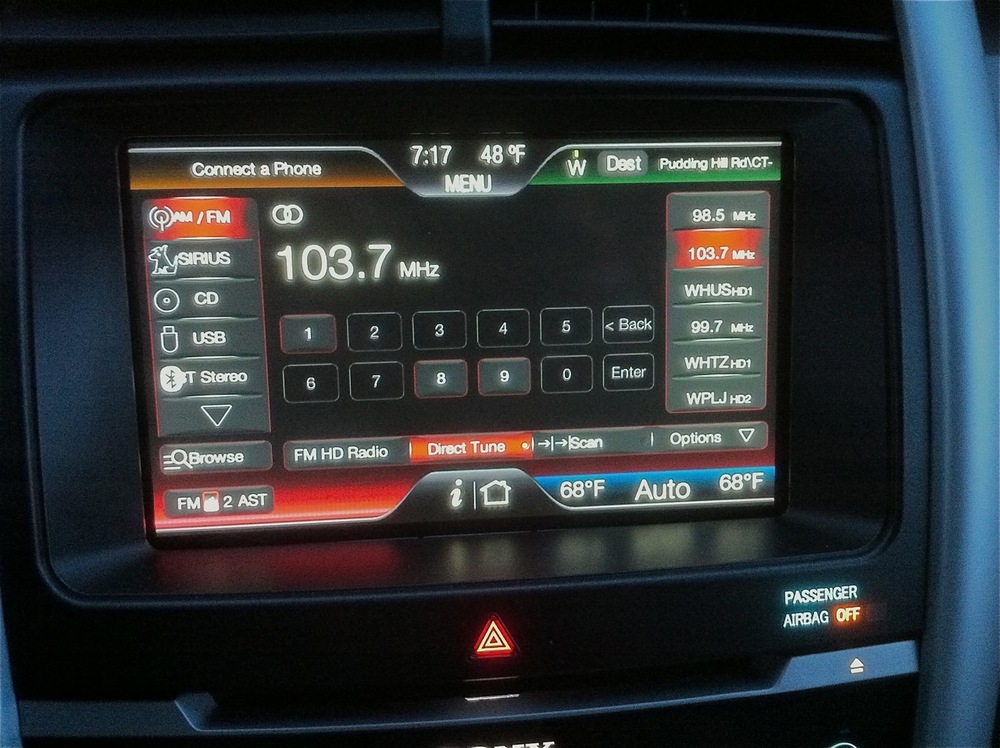
Quicker than you can say “Sync my ride,” the touch screen was off and running in other areas. On the automotive front the limited use of the touchy-feely way of changing audio and HVAC settings was quickly launched, especially with navigation systems (as there was already a screen ready, nay, aching, to be touched). But Ford has really gone after the technology aggressively in an increasingly inclusive arc, with mixed results in my view. But rather that give you a blow-by-blow account of what I like and don’t like about Ford’s new MyFordTouch interface, I’d rather focus on the big conceptual picture instead as I think it’s more important at this stage of the game. With all the new ways we have to operate electronic devices, and by extension, the devices these devices operate, what are our objectives exactly? 

Here’s the thing: what goes on in the tech field regarding things like desktop and laptop computers, tablets and even our phones is pretty amazing, and change is accelerating at a staggering pace. This technology is having an effect on everything around us, and when it comes to automobiles the introduction of the latest in e-interfaces is being introduced in a slightly more incremental fashion, true, but nevertheless it’s happening quickly compared to the way things have typically been done in the past. But the important question is, is this inclusion of this revolutionary way of operating things going to make our cars work better and more intuitively, or just insure that touch expands into (and permeates) every last corner of our lives? Is the way we control our phones, pads, desktops, laptops, etc. really the way to go when it comes to the cockpits of our cars (which are, after all, the ultimate mobile devices)? True, one of the reasons the iPad is such a smash success is its simplicity in terms of user interface. But is what works for a tablet PC the best form factor for automotive operation? 

Here’s another way of looking at this situation that I find equally perplexing, and even troubling (I’ll call it trouplexing). Right now, PBS is running a Ken Burn’s documentary on Prohibition, and while I haven’t seen any of this program (although I’m sure it’s probably very interesting), taking this history as precedent are we seeing a new type of struggle to regulate something very powerful in the form of bringing the tech communication world into our cars? Here in CT it’s been against the law to use your mobile phone in your car without a hands free device for years, yet just from my own observations it looks like more drivers have their phones planted on the side of their heads than ever before. Much like the masses insisted on drinking alcohol in the USA which killed Prohibition; banning cell phone use in cars w/o the prescribed headsets apparently isn’t going to work, either. So, arguably, there is a certain logic in saying, look, people are going to use their phones, text, use navigation systems, stream from their portable devices, etc. from now on and there’s nothing you can do to stop them. Therefore, we need to use technology to allow drivers to use their technology safely. Right? 

Of course. Such is today’s conventional wisdom.

Mft

To address this, we now have technology like Ford’s Sync, MyFordTouch, and all the other competing (primarily bluetooth/voice recognition) systems out there that aim to keep your hands on the wheel while you dictate everything, therefore keeping you focused on the road. It makes sense in theory, but then there’s the dark side that I observe especially when I’m riding a motorcycle in the same environment as people driving their highly teched-out cars. In a way, I see all these miraculous developments as enablers of distraction and see people doing stupid things on a daily basis. Hey, their Ride may be Synced, but their attention is still elsewhere and driving in a safe, responsible manner on the public roadways is suffering for it. 

Here’s an intrigue: remember the extraordinary brouhaha over Toyotas suddenly accelerating by themselves? I smelled a rat from the get-go, especially since the reporting on the alleged phenomena was incredibly one-sided.  As we now know, with the exception of floor mats becoming lodged under accelerator pedals (because said mats weren’t properly installed, BTW), there was nothing seriously wrong with the cars at all. So why was it happening? Funny thing: the time frame information that traced the increasing number of these “unintended acceleration” cases fit nicely on a graph of increasing popularity of cell phones, yet I never saw anybody make this connection in a major media expose´.  And when somebody plowed into another car because they were dialing, taking, texting, eating, fornicating, etc. it was much more convenient to just blame the car. This looked familiar to me, as whenever somebody turns left in front of a motorcycle and causes an accident, they claim they never saw the motorcycle. They are no more likely to admit they saw the bike but pulled out anyway than they are to admit they were dialing their cell phone when they rear-ended some nuns in a van, or took out the front window of a Dunkin’ Donuts because they mistook the accelerator for the brake pedal because they weren’t paying freakin’ attention to what they were doing.

Of course, to help counteract this new phenomena we have more technology thanks to collision avoidance systems (that will activate your brakes when you won’t because you’re updating your status) and even cars that monitor us and tell us when we’re not paying attention and/or falling asleep. Google, a company you may adore but I avoid interacting with as much as possible, is even pushing autonomous cars. They say it’s for safety reasons; I say it’s because they don’t want to have to pay and insure people to drive street-view camera cars. They really are pure Evil, by the way. You have been warned. 

But I digress.

The bottom line here is, the light-speed thunderbolt mega zoomdragon that is today’s rate of technological advancement is a runaway train that is messing with us more than we realize. Everybody’s trying to keep up, and I think the engineers in the auto realm are some of the brightest and hardest-working out there. They are also hip-deep in change trying to wade through how we interact with the world of ever-changing instrumentalities, and find the Way Forward.  But I think they need to slow down and ask some very basic questions. Most important is this: are the changes they are making to the human/control interface making the car easier and simpler to operate, or more complex and more difficult? Are we safer as a result, or just more detached while operating our cars? Funny thing: good mass transit solves an incredible number of these problems, and can let you use your gadgets to your heart’s content. Yet here in the USA . . .  

Well, you get the picture. Now pull over if you want to text it to somebody, OK? 

Hey Irene, Turn Back on the Lights When You Leave, OK?

So, that was certainly an Alternate August, and now it is an Exceptional Early September. The Great Storm of ’11 (I say that in a way that pays homage to a certain episode of Vicar of Dibley that I hope some of you might recognize) did an amazing amount of disruption to the state of Connecticut and more (and less) in other parts of the East Coast. It could have been so much worse, but what this storm did more than anything else was show how incredibly fragile our wired (and wireless) infrastructure is, as this state in particular lost power in a very substantial fashion.

Ireneblocked_b

At our house, we were spared any damage to the structure itself but a mighty limb from a mighty oak from our mighty nice next-door neighbors came a crashing down in the driveway, and felled our power line (already dead, fortunately) our cable/internet line and our phone line. The phone line never quit, though. I found this amusing, for as recently as a few months ago static would render it unusable whenever it rained until a really sharp AT&T lineman finally figured out the problem and fixed it. As my beloved needed to get down said driveway to check on the horses which are six miles from here, I braved Irene’s reduced wrath as she was winding down and armed with my Farm Boss savagely severed the key limbs that blocked our way so we had a clear drive.

Irenetreeline_bIrenetreeline_aIreneblocked_aIrenebroken_aIrenedangler

She got out fine, but then the real obstacle course around our town revealed itself. There were some series Ents blocking roads all over the place, and what was really bizarre to me about a lot of the results of this storm was the almost tornadic (is that I word? It is now) nature of the damage. In this case I’m referring to the contrast between trees left unscathed and trees left seriously scathed. To the best of my knowledge Irene (which was a Tropical Storm by the time it reached us) spawned no tornados or even much lighting around us, but there were certainly some microbursts of wind that took out some pretty serious vegetation. A lot of the new “tree wires” the power company installed recently to help prevent power outages or at least reduce repair time did a pretty impressive job of keeping the trees from hitting the ground and probably did prevent even worse damage, but probably not by that much due to the sheer scope of the storm.

IreneclpIrenehelper

So, let’s talk repair timelines. The storm hit late Saturday into Sunday, and we lost power (according to our standby generator’s log, which incidentally never missed a beat in nearly five days of non-stop service) at 9:17 AM Sunday the 28th. As our land phone line still worked fine (unlike our cell service, which died completely sometime Sunday as towers lost power), I was able to contact various concerns about outages and our need for repair. The power company had no estimate at all for restoration, which is completely understandable at this early stage of the crisis. The cable/internet company was really nice on the phone and said we’d have service by September 6th at the latest. Their tech showed up on Monday the 29th to access damage, and I was initially hopeful we’d have internet back sooner than later. This did not turn out to be the case, as I shall address later. I didn’t even call the phone company until Saturday, September 3rd, to tell them we needed them to rehang the fallen portion of still-functioning phone line. Despite me telling them there was certainly no rush as it was out of harm’s way, they showed up in a couple of hours and did the deed. Oh, and another aside: we started this event with only about 57% propane capacity for our generator, and once it was clear to me we might be without power for days I contacted to the propane company to arrange a refill. This meant stopping by their facility which is 10 minutes from here on Tuesday the 30th, and I was surprised to learn even though they have several massive submarine-sized tanks of propane they have no backup generator, meaning their computers were down in addition to facing unprecedented demand for their fuel. But a nice lady working there took down my information using the tried-and-true pad and pencil method, and assured me they’d be by to fill me up on Wednesday. They didn’t show up until Thursday, September 1, and didn’t even call to tell me they’d be late, but our generator refused to run out before then (word to the wise: you can dramatically stretch your propane if you turn off everything you don’t absolutely need to power yet keep your refrigerator, well pump, fans when it’s sweltering, etc. properly juiced. I know: Duh). When the gas truck did arrive about 11 AM the driver was clearly pretty tired, and told me he’s never seen anything like this week’s mess in his 40 years in the business. I certainly believe him. What I couldn’t believe was the chaos a bit earlier in the week when some gas stations couldn’t pump since they had no power and the ones that did started running out of gas. There were lines everywhere, which is always a weird sight, I figure traffic lights had battery backups, but they finally failed, too, and a lot of people had problems figuring out what to do. Scary, actually. Having an Aprilia Dorsoduro 1200 urban-sport motorcycle proved great at getting around fallen trees, as well as frugal w/precious gasoline (although our Prius was even less thirsty. Think of that: the fact that it uses electricity to help propel it became key when there was not electricity to pump gas. Ironic).

Ireneww_bIreneww_cIreneww_a

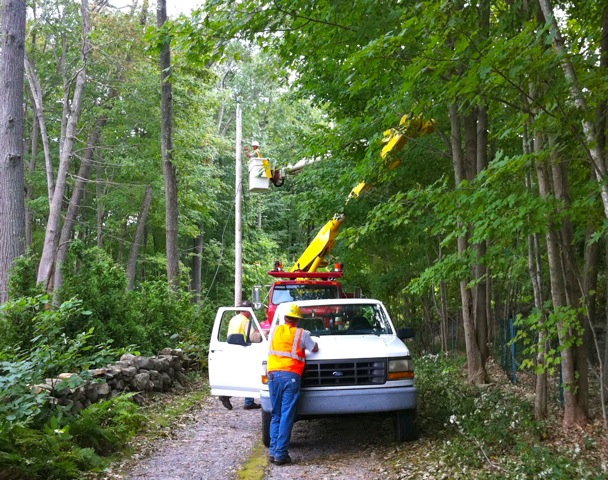
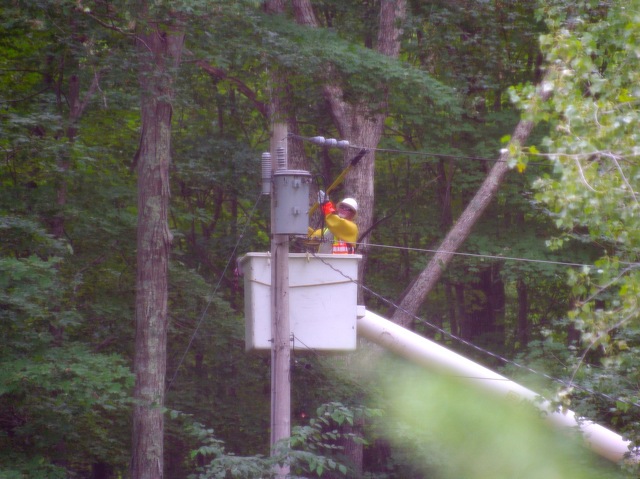
The Big Restore really got cranking on Thursday, and as our own Connecticut Light and Power crews (as well as those from United Illuminating that provides power in certain parts of the state) were understandably swamped there were utility crews from all over the country coming to our aid. Our lines were restored by some wonderful men and women from Michigan, and it’s a really interesting outfit as they go all over when there’s a crisis and help put the grid back together. As every utility company has its own particular way of doing things, think of how much experience comes into play when you arrive from far away to fix a local system. They did a great job at repairing our fallen power line, and I have a lot of admiration for these people. Rescued our electrons, they did. Power was restored (and the Generac got a much-earned rest) at 7:26 PM on September 1st, and there was much rejoicing.

Irenecharter

Friday night at about 9PM or so a truck from the cable company arrived, and re-hung the cable/internet line. As of now, though (Sunday the 4th at 2PM), we still have no service. Bummer. Once again, as it has throughout this crisis, a local Bagel cafe has served me well as they have satisfyingly quick free wi-fi. The smartness of my phone (once the cell service was re-powered mid-week) has also been a major help with keeping the email, texting, surfing, etc. So all in all, we got through this storm with only a bit of inconvenience, unlike countless thousands of others who really got slammed by this bitchy witch called Irene. Hopefully some good will come of this, and steps will be taken to fortify the grid better in the future. I should point out that despite perfect weather starting Monday morning there’s still folks without power here, and God help all those people in parts of New York state, Vermont and elsewhere who are dealing with the flooding we were spared from here, on top of everything else the storm dished out. We take so much for granted while the weather is mild, no?

Irenescreenshot

You Must Go To Gort. You Must Say These Words. . .

Gort_man

Yes, for those of you that may recognize the dialogue in the title of this piece I’m a big fan of the film The Day the Earth Stood Still. I’m referring to the original, not that lame remake with Keanu Reeves. Although the latter was an interesting movie, it just wasn’t even in the ballpark of the original and shouldn’t have had the title because it was such a different beast. But in both films, there was a very imposing robot named Gort who had a very unique look. I have just spent quality time with a vehicle that really reminds me of the original Gort, in that weird way that something visually somehow reminds you of something you’ve seen before.

The Gort-like vehicle that is currently being a silent sentinel out in the driveway is the Infiniti QX56, which is your basic velvet tank that is as massive and powerful as it is decadently luxurious. The styling is very Gortish, and yet the smooth lines also work on another level as it look as if it was carved from a solid block of some rare metal and the quality of the Mountain Sage paint finish is extraordinary. It’s as big as a house, and built on the Nissan Titan’s robust truck frame (with some significant differences, like an independent rear suspension along with other more civilized components). The engine room has a lovely 400-horsepower V8, and this along with a (count ‘em) seven-speed automatic transmission and a 4WD system that includes an Auto mode facilitates your guiding this universal law-enforcement robot bus damn near anywhere it will physically fit. This is a very expensive unit (loaded as ours was it tops $72K), but I have to admit it really feels like a lot of expense and time went into the thing.

Gorst_b

We had the optional Hydraulic Body Motion Control system that (in Infiniti-speak) works like this: “Suspension travel is automatically controlled by hydraulic chambers integrated into each shock absorber. The chambers are cross-linked with piping, allowing for the transfer of hydraulic fluid, managed seamlessly by nitrogen-charged accumulators, from one side of the vehicle to the other. This enables the system to vary suspension travel independently on either side of the vehicle, thereby counteracting body lean and creating a luxurious, flat ride previously unavailable to drivers in this segment.”

This helps what should be a big, ungainly walrus of a vehicle get around in a much more competent fashion, and along with the splendid job they’ve done with suspension isolation the QX flattens road irregularities (and the odd, slow-moving Smart Car) with nary a shudder or rattle in the cabin. It really does feel like the upscale premium SUV it is, and certainly wouldn’t be out of place taking a sheik to dinner in Dubai or ferrying a Royal to examine the moors for stranded ponies. From the crisp acceleration to the surprisingly good brakes there is a lot here to appreciate, and what really surprised me was not just the overall level of quality (including the solid craftsmanship evident all over the cabin) but the fact that I even saw 17 MPG which is actually not bad for a small village on wheels.

Gort_d

So, the QX56 is a pretty successful attempt at being what it’s supposed to be. That is actually not always the case with autos, even when you get to the upper echelons of the pricing pyramid. Yet, the thing that made my day about this rig was the how much it reminded me so much of one of my all-time favorite robots, from one of my favorite films. This is pretty weird when you think about it, but such is the world of the machines we trust with our lives in all kinds of situations. Gort the Infiniti will not only warn you if you stray from your lane, he will apply the brakes on one side to try and keep you inside the lines. The adaptive cruise control actually works well (this technology has been pretty hit and miss for years), and will apply the brakes to help keep you from rear-ending the car in front of you. There’s lots of other black box stuff to help protect you from yourself and others, which means this Gort (in addition to a certain similar visual presence) has a lot in common with the robot version in terms of stopping violence in your own personal universe. Lest you don’t understand the similarity, its a good excuse to watch a really excellent film.

Gort_c

Here’s a Shock: The Volt is GM’s Best Ride in Ages

Volt

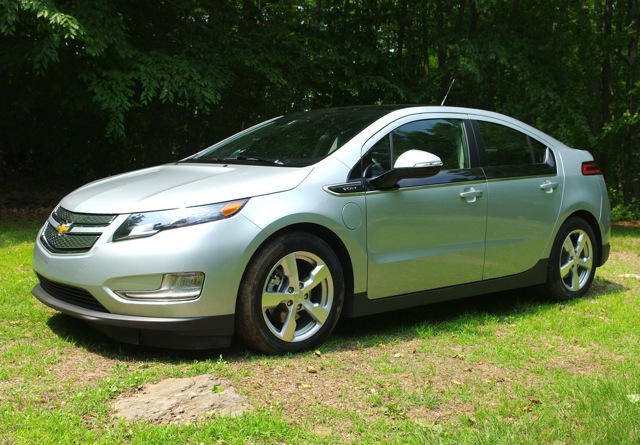
Oh sure, I was a big-time naysayer. The Chevy Volt was vaporware for quite awhile, and yet, ironically, was being rushed to market with blinding speed. This is quite a juggling act, if you ponder it for a second. When you also consider that Toyota and Honda had hybrids on the road nearly a decade before GM even started to adopt the technology (and Ford was also part of the party with the Escape Hybrid), then the Chevrolet Division’s decision to just leapfrog everybody with a futuristic plug-in was certainly grounds for skepticism. To top it off, I quickly grew tired of all the company-generated hype including social network campaigns and some truly tedious “Town Hall” meetings at auto shows. 

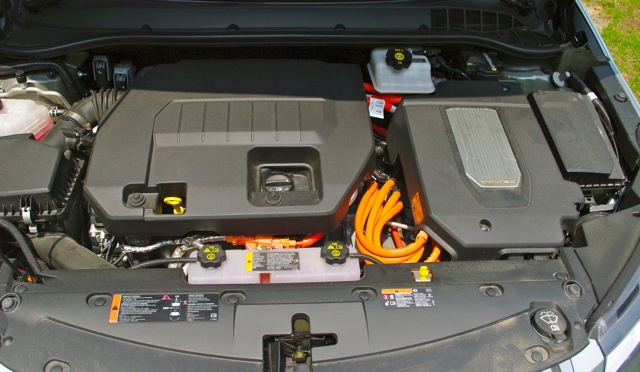
But danged if the General didn’t focus like a laser and develop some serious engineering solutions. Danged if they didn’t manage to build some prototypes that evolved into production models, and double danged if I didn’t just spend a rather entertaining week with this all-new extended-range electric vehicle. To recap what the Volt is, it’s a true electric vehicle that you plug in to fully charge (about 10 hours at 110V; roughly half that at 220V), with a huge lithium ion battery pack that powers the electric drive unit that turns the front wheels. Once this battery is depleted, you don’t have to go commando with an extension cord and steal juice from some unsuspecting residence or convenience store. Under the hood where you usually find an engine there is in fact . . . an engine; in this case a 1.4-liter Inline Four that functions as a generator. This is the “extended-range” part, and with a 9.8-gallon fuel tank you can keep right on going for an overall range of well over 350 miles. 

Volt_engine

I tested a Prius Plug-In hybrid a few months ago (see the post located somewhere in this thrilling collection of prose), and while this is the closest soon-to-be competitor to the Volt they are still very different beasts. The Prius is a plug-in evolution of the science of Priusology, where the already excellent hybrid engineering gets a new twist with lithium-ion batteries instead of the tried-and-true nickel-metal-hydrides. Armed with these more-powerful laptop renegades, you can plug-in the car for about three hours (at 110V) and get 18 or so miles of pure EV range. After that, this SuperPrius becomes Clark Kent once again and operates much like all the other (over a million or so) Prii around the globe. This means it runs on the engine, the electric motor or both until you plug it back in and start over. It’s a plug-in take on an already proven platform, so one big quality in its favor is literally over a decade and millions of miles of real-world durability.

The Volt is a whole different kettle of tech, and a boatload of brand-new engineering from stem to stern. It’s an electric vehicle all the time, for the engine is really just there to charge the batteries when they become depleted so you can keep on rollin’. Another difference is you can taxi your backside down to a Chevy dealer and buy one, for even if you might have to wait a bit they are available right now. It will be spring 2012 for the plug-in Prius is at dealers, so GM actually beat Toyota the market this time. 

So now we have a couple of different approaches to cars that, even though there are internal combustion bits under their respective hoods, require you to plug them in like giant vegetable steamers to achieve full low-emission, high-mileage greatness. This seems odd at first, but in the case of the Volt I got into a routine where it was really not a big deal. The thing is, you need a full ten hour nap at a normal 110V outlet to top off an exhausted battery array which might be an issue for some people. But for most drivers, especially those with a round-trip commute of 40 miles or less, this might work out just fine as charging times would be a bit less because the battery may have some charge left when you plug it in. What you get in return is about $2 added to your electric bill per full charge (that’s here in CT. Your e-bill will likely be less), and more importantly a car that cruises along quite nicely on all-electric power while making little noise and soiling the air with no real emissions to speak of. Repeated 0-60 MPH runs came in at just under 9 seconds, so the Volt moves out just fine without gas engine assistance. It’s also fun to drive with sound handling, excellent brakes and comfortable seating for four because a tunnel filled with batteries relegates the seating to 2+2 status, but there’s decent room at all four perches (a car like this makes me want to call them “seating stations” instead, though). This is basically a Chevy Cruze chassis, but for some reason I liked it a lot more in the Volt application that the plain ol’ Cruze version.

Volt_int

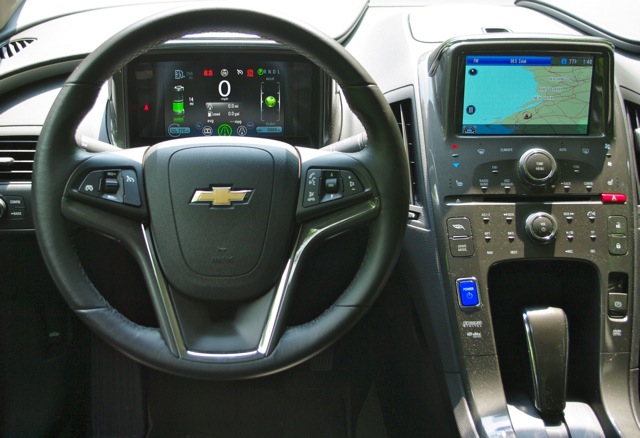
One of the more gutsy (and completely appropriate, in my view) design choices with the Volt involves the driver and control interfaces, for they decided to celebrate the fact that this is a very different kind of car rather than disguise it. I think this is bold because the Chevy brand has always been associated with more conventional U.S. car styling values, and has therefore been tad on the bland side in order to appeal to a huge swath of mainstream America. The Volt gets all touchy-screeney (with touch even on surfaces that aren’t actually screens) to handle all the conventional car operations, and you’ll either love it or think it’s over the top. The driver’s display consists of a 7” LCD screen that gives you an excellent snapshot of the state of your electric and gas-powered devices. It also adapts itself depending on what is happening, such as when you make the transition from full battery electric to engine-generated electricity. Even though the heavy work is going on under the hood, magical things happen right before your eyes. The fuel gauge which is grayed out lights up and becomes a prominent part of the display when you switch over to generator juice, and keeps you apprised on your range. Incidentally, when the engine kicks on it’s fortunately not a wheezy, loud generator like you may be familiar with in the industrial world (with the exception of the big 700kW gennies on the back of the tractors used in the film business-those things are amazingly quiet). This is a contemporary, reasonably-refined mill that seems quite normal and familiar, with one notable (and strangely interesting) RPM characteristic: the engine sometimes revs to increase generator output when you’re not accelerating. This creates a weird auditory/tactile incongruity compared with conventional automobiles, but you soon get accustomed to it. Overall the GM engineers have done an excellent job of keeping the generator’s presence as unobtrusive as possible. 

Volt_dash_a

Ah yes, back to the display/control interface experience. There is a touch screen in the center stack of course thus giving us two LCD screens, but in addition to this there’s touch stuff in the stack itself that deal with Audio, HVAC, etc. I had some trouble with this in that I really had to take my eyes off of everything else to find the switch in question, and found it too easy to engage the wrong touch interface by mistake. Not a huge deal, but something I hope they’ll tweak a bit down the road. 

Volt_cargo

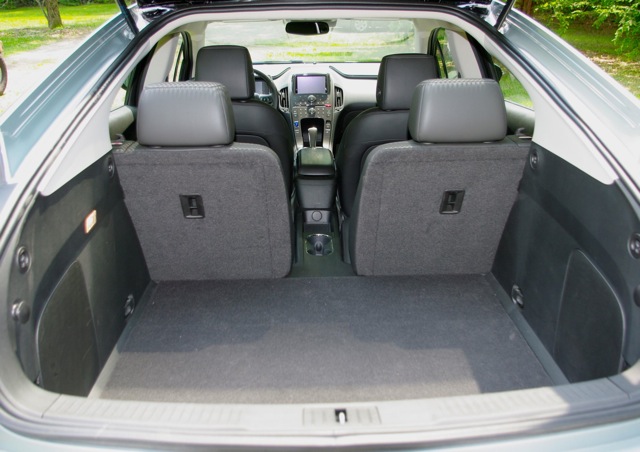
Finally, one of may favorite surprises with the Volt was usable space in terms of cargo. The charging unit and its associated cord are stored in a nice bin under the floor, and there was no spare tire on our unit but instead some flat fixing goo and a small air compressor. With the seats occupied you have 10 cubic feet of cargo space under the hatch; fold down the seatbacks and that swells to. . . something larger. I can’t find the spec, but it’s pretty dang roomy. All in all space utilization is quite good, making this car satisfyingly versatile even though the battery tunnel means you have two buckets in the back seat. 
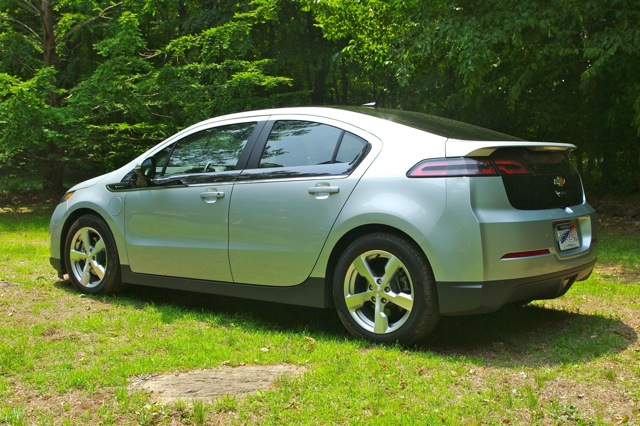
Now we come to the Big Question: is the Volt a good fit you the likes of you? This really does depend more on your driving habits and where you live. I’m not sure how the Volt would do in the dead of winter when you really need a lot of heat in the cabin, for without the engine generating heat all the time like with a conventional car it would become a battery-stressing business to keep you toasty. On one cool morning the front seat heaters actually came on by themselves to try and warm things up (this is tweakable in the climate settings) which for some reason didn’t really work for me. I also don’t know what really cold temperatures might do to charging and battery life, either. Another concern is charging in a big city situations, such as when you have to leave the car on the street with the complications that running the power cord between the garbage cans and over the sidewalk would entail. 

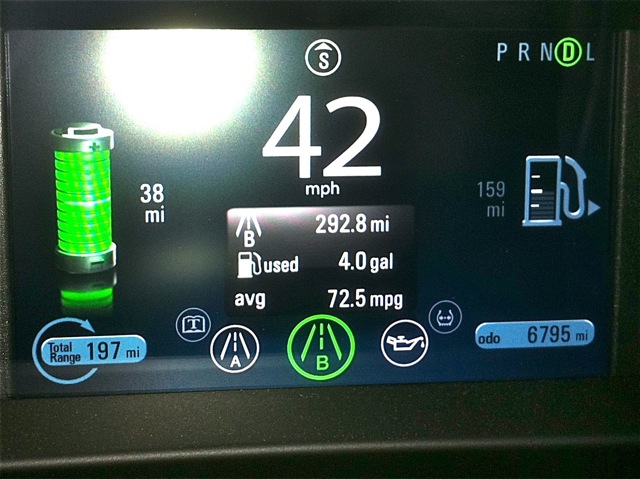
But none of this really detracts from how well the Volt does its thing of delivering low fuel consumption and low emissions, and how good the overall package really is. During a week of driving about 50 miles a day and charging the car fully overnight, I got about 72 MPG. I’ve been skeptical of using lithium ion batteries in cars as opposed to the nickel-metal hydrides (which have proved to be near bulletproof) that have been the staple of hybrids until now. Maybe my prejudice revolves around early experiences with laptop batteries losing their juice after a year or so, but shoot, the MacBook Pro I’m writing this on is a year and a half old and still gives me about 5 hours every night so obviously there has been considerable improvement. The Volt has an 8 year, 100,000 mile warranty on the hybrid battery and who knows? It might prove bulletproof as well. If the hard parts on this car live up to the overall build quality on the one I tested, Chevy has a real special car for sale. The (very well equipped) $43K asking price is made more palatable by a $7,500 tax credit, so it’s not exactly excessively priced either. We’ll see how Toyota ultimately prices the plug-in Prius next year, and the Hybrid Cord Wars will truly be On. Oh, and Chevy, please put a wiper on the rear hatch window. I really missed having one in the rain. 

Volt_r34

I Find Your Lack of Torque Disturbing

“Don’t try to frighten usssss with your Sorcerer’ssss waysss, Lord Vader.”

-Imperial Dude w/ Snake-Like Imperial Lisp

In times of great personal challenge and uncertainty, we often find ourselves asking ourselves, “What would Vader Do?” Yes, the Dark Lord of the Sith does seem to have a handle on things during times of crisis (in his universe, anyway). And today (while I wasn’t even in crisis mode) the question was answered before I had the chance to ask it, which is a special bit of kismet when it happens.

The answer was this here Caddy CTS-V Sport Wagon, and the (slightly altered) question was, “What Would Vader Drive?” Naturally, he’d go for this fine, insanely powerful Millennium Caddy, with its 6.2-liter Supercharged V8 that puts out 556 rebel-chasing horses and 551 lb.-ft. of planet-crushing torque. It’s much like the CTS-V sedan I mumbled about in an earlier post, and has all kinds of wicked goodness such as Brembo brakes, Caddy’s Magnetic Ride Control and a Bose sound system that is a fine medium for John Williams’ soundtracks. Oh, and best of all it’s black. Very black. They call the premium finish Black Diamond, which almost puts Mr. V’s lovely obsidian raiment to shame. Almost.

But while I’m on the subject, can you actually shame a Dark Lord, anyway? Nah. But you can say, “Kudos, Sith Master,” for this crate puts the hyper in hyperdrive. It’s every bit as fun as the sedan, yet you can haul far more light sabers, nuclear nunchuks and even an extra helmet or two. It’s almost enough to go over to the Side that is Dark. Almost.

Vader_aVader_bVader_c

Air Pressure. It Amuses Me

Rpg_a

I often get way too delighted by what some folks would consider mundane things, but hey, mundane is in the eye of the beholder. Regard the Roadgear Programmable Digital Tire Gauge, which is especially designed for motorcycle use (I will allow you to use it on other things, though. If you must). Behold its cool backlit screen, that makes a pressure reading easy to see even if you require +2 diopter reading glasses at close range (not me, of course. I have the near vision of an Aussie Cattle Dog. Oh, crap).

Where was I? I can’t see what I wrote. Oh yes: The greatest. Tire gauge. Evah.

Feel its solid construction. Marvel at its “Double Bridge” processor, that helps the gauge adjust for changes in humidity, temperature and altitude to maintain a claimed accuracy of plus or minus 1%. The programmable part is simple: you put in the desired pressure for each tire separately, and you can recall these values when you check the air and they will be displayed below the measured value to tell you where you are, pneumatically speaking. The head swivels and is mounted at a 90-degree angle so you can access hard-to-find valves, and, coolest of all, an LED flashlight is incorporated into the body to help locate said valve in the dark (and/or the whole motorcycle if you’ve tossed it into the shrubbery).

Now, I’m not saying you have to buy a motorcycle if you don’t have one in order to use this gauge, although you probably should. But it works well with any tire (or tyre) you might come across, and measures up to 99.5 PSI. The battery is replaceable, and the ergonomics of this handsome device are exceptional. Roadgear.com will sell you one for $32.90, and they sell a boatload of other great stuff too, especially catered to the touring motorcyclist. Check ‘em out, bro.